Bettis: Second island chain strategy reflects changing military reality
A proposal to shift more of America's military posture toward Guam, the Northern Mariana Islands, and the rest of the second island chain may be provocative, but Pacific Center for Island Security co-founder Leland Bettis says some of the strategic changes behind it are already happening.
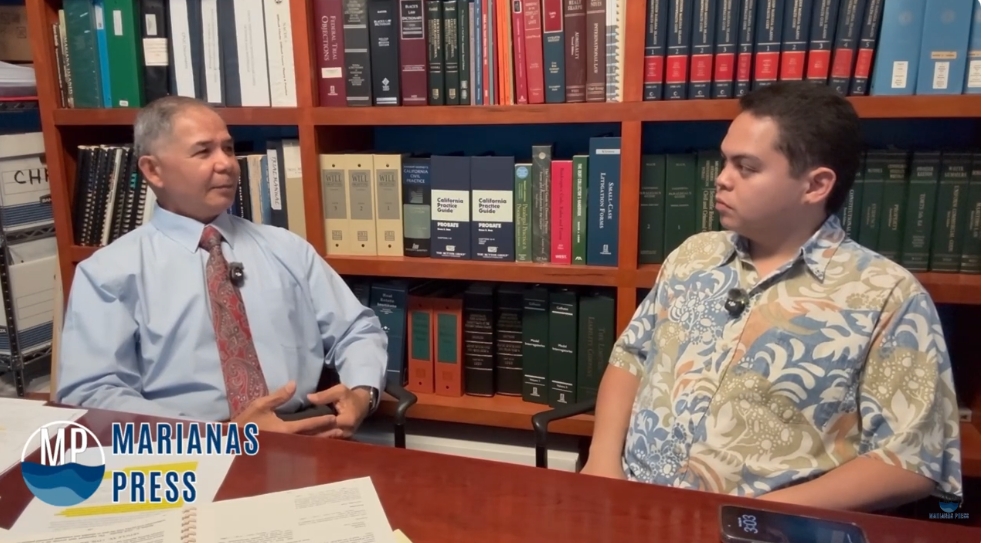
In a Zoom interview with Marianas Press, Bettis said the analysis by Defense Priorities senior fellow Jennifer Kavanagh challenges decades of U.S. security thinking built around containing China from the so-called first island chain.
“She's done something very provocative. It's creating a lot of responses amongst the traditional national security set,” Bettis said. “But I would suggest to you that some of the things she's talking about are things that time is already beginning to make happen.”
Defense Priorities, a Washington, D.C.-based think tank, is proposing that the United States reduce its military presence along the first island chain—including Japan, South Korea, Taiwan, and the Philippines—and concentrate a smaller force farther from China's coast.
That second island chain posture would put places such as Guam, the Northern Marianas, Palau, the Federated States of Micronesia, and the Marshall Islands at the heart of the proposed strategy.
The paper also calls for dramatically narrowing U.S. defense commitments in Asia, including adopting a non-intervention position on Taiwan and eventually ending mutual defense alliances with Japan, South Korea, Australia, and the Philippines.
For the Marianas, however, Bettis said the concept of dispersing military assets is hardly new.
He pointed to the U.S. military's distributed and dispersed operating concept, under which forces and equipment would be spread over a wider geographic area rather than concentrated at large installations such as Andersen Air Force Base in Guam.
“What you do is you spread your resources and your equipment across a broader area from Saipan down to Palau. And we can see those developments in place that are taking place,” Bettis said.
Bettis said advances in precision missile technology have changed the strategic equation for large forward bases.
“If you're asking, does it make the second island chain more important? I think for U.S. military strategists, this is sort of the fallback position,” he said.
That potentially puts Tinian—and even Saipan—in a more prominent role.
Bettis said he reads Kavanagh's proposal as envisioning locations such as Tinian not necessarily as permanent, full-scale operating bases, but as what he described as “recoverable assets” that could be activated when needed.
“All of the developments that are occurring [on] Tinian, and that are proposed in Yap, you know, the runway reinforcements that are ongoing in Saipan that are being proposed are all anticipating recoverable types of operations and not, you know, regular ongoing basing operations,” he said.
Bettis also pointed to proposals to strengthen Saipan's runway to accommodate heavy U.S. refueling aircraft, describing such facilities as alternatives if Guam's primary military infrastructure becomes unavailable during a contingency.
“The alternative, yes. And that's the word that they use consistently in most of their documents is an alternative location in the event of a natural disaster or contingency,” he said.
Defense Priorities likewise notes that the United States already has military locations in the Northern Marianas and the Freely Associated States and is investing in their capacity to accommodate larger deployments and increased military operations.
But Bettis said the growing strategic importance of the islands raises another question: How much say should island communities have in decisions that could also make them targets?
Bettis said the Pacific Center for Island Security strongly supports greater involvement by island governments and residents in security debates.
Using Guam as an example, he said decisions are often made as part of a broader strategy in which the island itself is not at the center.
“Guam is just a piece of a strategy,” Bettis said.
He pointed to the potential consequences for civilians in a conflict and what he described as inadequate preparations for civilian resilience.
“Pacific Island peoples need to have more of a say in what's going on,” he said.
Bettis said technological changes also mean Guam can no longer be viewed simply as a relatively safe platform from which U.S. forces project power westward.
“Twenty years ago, we were not really considered a target. But now, you know, precision missiles, you know, we are a target,” he said.
As for Kavanagh's broader argument that moving away from flashpoints such as Taiwan and the South China Sea could reduce the chances of a U.S.-China war, Bettis said that appears to be the logic behind her proposal.
“What she's trying to say is let's reduce our exposure to risk or reduce the U.S. national exposure to risk of a conflict,” he said.
But he acknowledged that such a shift would carry major consequences for longstanding U.S. allies.
Bettis ultimately described Kavanagh's proposal as an unsettling challenge to traditional thinking rather than a prediction of what Washington will do.
“This is a very provocative piece, which really, I think, really unsettles people who have thought about national security in Asia traditionally,” he said. “But it also is raising some very serious points that are based in the reality of our changing times.”
The Defense Priorities recommendations are a policy proposal and do not represent an announced change in U.S. government or Pentagon policy.
Share this article: