Community voices deep fears, demands answers on deep-sea mining RFI
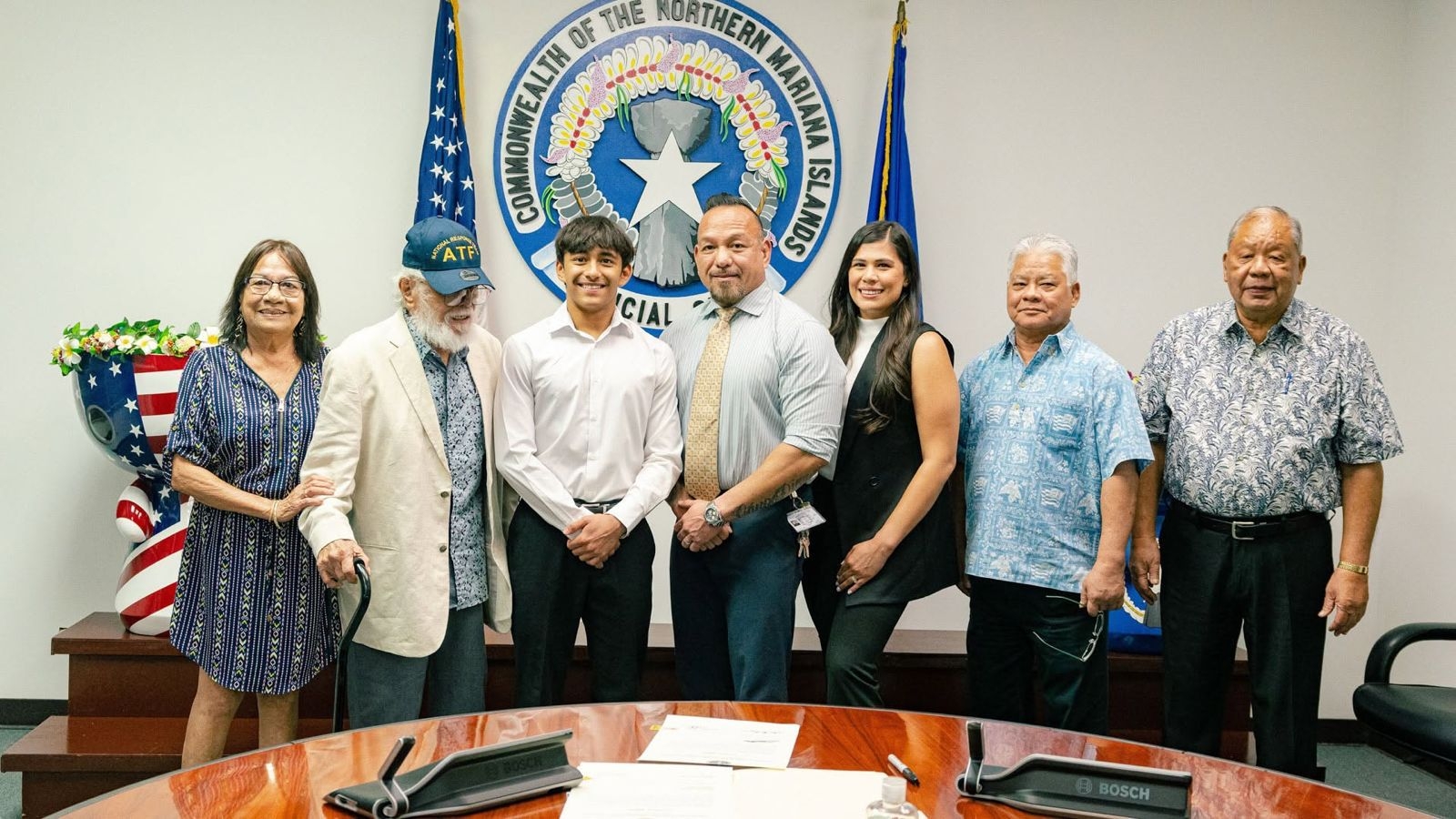
Scientists, traditional navigators, teachers, lawmakers, and ocean advocates packed the American Memorial Park indoor auditorium last Dec. 3 for the Northern Marianas College-Cooperative Research, Extension, and Education Services and the CNMI Green Growth Initiative’s “Community Conversations: Deep Sea Mining in the CNMI” forum.
For three hours, panelists and residents dissected what is at stake as the Bureau of Ocean Energy Management weighs potential leasing blocks inside the U.S. Exclusive Economic Zone—an area roughly 128 miles off Saipan where federal jurisdiction overrides local control.
And if there was one theme throughout the night, it was uncertainty—scientific, economic, cultural, and political.
NMC Natural Resource Management Program coordinator and instructor Kelsey McLennan delivered the clearest warning—almost nothing is known about the ecosystems the U.S. is proposing to open for exploration.
“Not only are we looking at this from an intrinsic value of knowing that these ecosystems are here, but also from the ecological perspective of this very complicated food web. We don't know a lot. And one of the things that I've been speaking to scientists about—they cannot reiterate enough how very little data is collected in the area under potential release. We don't have a ton of data. We need more information. And we also need to understand more about how deep-sea mining could potentially impact not only these ecosystems but also our fisheries,” she said.
McLennan stressed that polymetallic nodules and ferromanganese crusts—the metallic targets of deep-sea mining—take millions of years to form and serve as the only hard substrate on the deep abyssal plain.
“These are not habitats that are easily replicable. The other component that I would like to point out is that when prototypes of mining and experiments have actually occurred, we've gone back 47 years later—and their tracks are still in the sediment. There’s not a ton of movement down on the benthos, so these areas are hard to recover,” she said.
One mining operation could release a dewatering plume equal to “20 Olympic-sized pools,” McLennan warned, with heavy trace metals capable of moving through the midwater column and entering the food chain.
Master navigator Cecilio Raiukiulipiy, originally of Satawal, Yap in the Federated States of Micronesia, underscored the potential cultural fallout.
“In her (McLennan’s) presentation, she said 200 miles. We navigators—across the whole Pacific—we don't have any boundary. Somebody came and said, ‘This is your boundary’—No. We're Indigenous. We claim our Indigenous rights and freedom. That’s our water,” he said.
Raiukiulipiy added that the area east of the Marianas is critical for traditional voyaging, where currents, swells, and water temperature form an oceanic roadmap for wayfinding between islands.
“The scary thing that she pointed out, where the mining stops close to the east side—that area, for navigators, has a special way of determining where you're from. Coming east side of the Marianas, going to colder water—and that water is colder than closer in.”
Coral Reef Initiative coordinator Kalani Reyes noted that deep-sea mining by other countries is already happening just outside the U.S. EEZ, where China, Russia, and Japan hold exploration leases issued by the International Seabed Authority.
“The U.S. is not a participant in the ISA, the International Seabed Authority’s discussions, due to not being a ratifying party or member of the United Nations Convention on the Law of the Sea.”
UNCLOS is the international treaty that establishes a comprehensive legal framework for all activities in the world’s oceans and seas.
If BOEM proceeds through the leasing process, blocks could be issued for up to 30 years. But recovery times for disturbed deep-sea habitats can stretch into the millions of years.
Economist Clement “CJ” Bermudez Jr., a special advisor to the Department of Commerce, said the CNMI has no guaranteed economic stake in any mining that occurs in federal waters.
“All licensing, royalties, monitoring, and enforcement are federal functions. There's no automatic revenue sharing between the federal government and the CNMI when it comes to the U.S. model for deep-sea mining and sales,” he said.
The executive director of the Governor's Council of Economic Advisers added that any economic benefit would require congressional action—something unlikely to materialize quickly.
Friends of the Mariana Trench chair Sheila Jack Babauta said her organization strongly supports the CNMI and Guam’s joint request for a 120-day extension on the comment period. As of this week, no extension has been granted.
She pointed to American Samoa’s experience, “They were able to gather over 76,000 public comments. They gathered full opposition from their political leadership—their governor, lieutenant governor, their delegate, their House, and their Senate. They had a petition with over 3,000 signatures, and still, the U.S. government proceeded to Step 2.”
Rep. Vincent S. Aldan offered a sobering reminder about the CNMI’s political leverage—or lack of it.
“The way the United States Congress has been exercising the Territorial Clause is blanket. They can do whatever they want. They can say whatever they want without listening to any of us. We could shout and scream, and all of that,” Aldan said.
But he argued that collective action among all U.S. territories could force Washington, D.C. to reconsider its century-old approach.
“If we can work together with our territorial brothers and sisters—not just here in the Pacific but also in the Caribbean—and by numbers sign a petition, get a resolution going, and send it up to the U.S. Congress, then they'll listen,” he said.
Aldan then gave the crowd a thought-provoking challenge.
“We didn't land on Plymouth Rock. Plymouth Rock landed on us. So why are you making decisions for me that affect my life, my children's lives, and my great-grandchildren's lives? So please, read and understand the Territorial Clause. Can you beat it? Yes, we can!” he said.
John Gurley, owner of Micronesian Environmental Services, reminded the audience that the area covered by the RFI stems from a 2009 agreement between the CNMI and the federal government when the Marianas Trench Marine National Monument was created. As part of those negotiations, Gurley said the CNMI sought to protect its fishing rights and preserve the possibility of future subsea mining, and the federal government designated the current RFI zone as the area the CNMI could explore.
Sixteen years later, he said, the RFI is merely an information-gathering step—not a mining permit—and rejecting it outright is premature. He argued that no one can assess impacts without first knowing what mining methods would even be used, including how turbidity plumes behave or whether they would rise to the surface.
He urged the CNMI to stay engaged so the federal government doesn’t “take the ball and run,” adding that while revenue-sharing may be difficult, the CNMI could push any future mining company to establish a home port in Saipan and invest in coastal infrastructure rather than rely solely on federal royalties.
NMC-CREES acting dean Patricia Coleman ended the forum by urging everyone in the audience and beyond not to take BOEM’s RFI for granted.
“Let's pretend we’re not going to get that extension. And we only have until December 12th. You brought up so many great points—the panel, the audience. If we don't want it, we need to say it now. If we want it and we want to make sure that we are part of the profit sharing, we need to say it now.”
While American Samoa’s RFI for deep-sea mining garnered a staggering 76,000 comments, Coleman said the people of the CNMI should make sure to exceed that.
“Let's beat that number. Let's show the federal government and all the prospective businesses that want to mine in our waters—the waters that we are going to pass on to our children and grandchildren—that we care about this issue deeply. Because if we don't have the comments, if we don't put forward our substantive views on this issue, which directly impacts our culture, our food system, and our economy, we may lose that opportunity.”
Share this article: