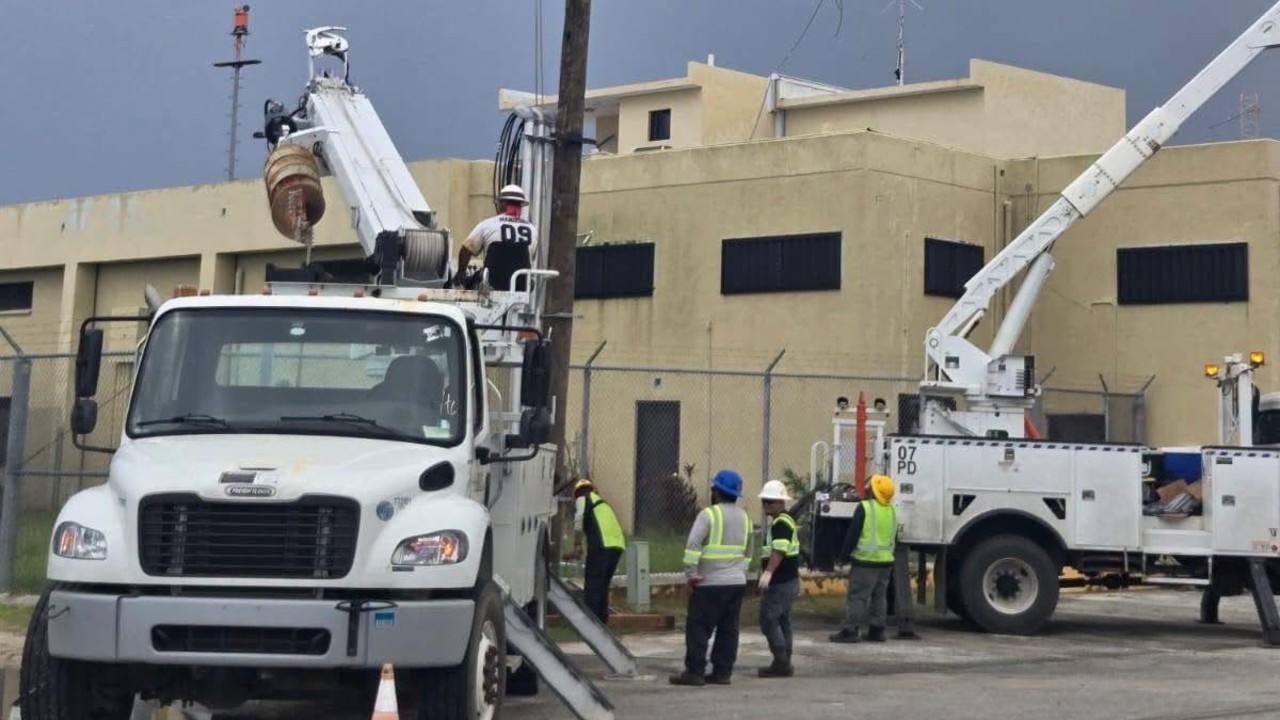
The Commonwealth Public Utilities Commission pressed the Commonwealth Utilities Corp. on its continued reliance on Aggreko temporary power as well as asked for updates on the utility agency’s plans to replace aging diesel engines, the role of solar energy, and long-delayed net metering reconciliations during the CPUC board meeting last Jan. 15 at the Marianas Business Plaza.
In an interview after the meeting, CUC chief financial officer Betty Terlaje said the utility’s power plant engines are old and require regular overhauls to avoid major failures. Aggreko’s temporary diesel generators are currently essential in filling capacity gaps whenever CUC engines go offline for maintenance.
“When one goes back up, another one will go back down for an overhaul. And so we are still dependent on this temporary power that Aggreko is providing us right now,” she told Marianas Press.
Terlaje said CPUC raised the possibility of purchasing new engines sooner to reduce dependence on Aggreko, whose contract is costly.
A previous attempt to procure new engines stalled after a bid protest. She confirmed that CUC is pursuing other procurement options, including an independent power producer request for proposals that is now under review by the Office of the Attorney General.
“Is there a plan to replace the engines? Absolutely! We just need, you know, we're working on other procurements to make something happen. In the meantime, CUC must continue overhauling existing engines, meaning reliance on Aggreko will continue as units cycle in and out of service,” the utility’s CFO said.
Terlaje emphasized that CUC needs to acquire permanent, reliable engines from some source to eventually phase out temporary power. She noted that a new engine for Rota was secured through grant funding.
On renewable energy, Terlaje explained that diesel-powered generators will remain necessary even with the planned solar farms.
Solar power, she said, is only available during daylight hours and drops significantly during cloudy or rainy conditions. As long as CUC must meet roughly 40 megawatts of demand, diesel engines will be required to backstop solar generation when it cannot meet load requirements.
“We will absolutely still need diesel-powered gensets. Even with solar, it's not going to go away because solar power is only reliable for a certain period of the day.”
Terlaje also addressed net metering reconciliation, calling it long overdue. She said the unpaid credits represent an unfunded liability not built into rates. With board approval, CUC has allocated $25,000 per month to accumulate funds for customer payouts, which she said could begin within three months, if not sooner.
“It's due to them. It's a law, and they are entitled to their credit payouts. And so these customers have waited long and have been very patient about it. I'm glad that they will see their payouts soon,” said Terlaje.
During the actual board meeting, CPUC chair James Sirok asked CUC management for clearer cost estimates and a concrete timeline to reduce its long-running reliance on rented Aggreko diesel generators.
Sirok questioned whether CUC has determined the purchase cost of individual generators similar to those leased from Aggreko, suggesting that funds set aside in the genset reserve could allow the utility to begin replacing rented units one by one and lower monthly rental payments. He noted estimates of about $1.2 million per megawatt and asked management to confirm pricing for the smaller one-megawatt generators currently being leased.
CUC executive director Kevin Watson said Aggreko is supplying about 12 megawatts through multiple one-megawatt units, but acknowledged that updated cost estimates are needed.
Sirok directed CUC to present a detailed cost breakdown at the next commission meeting so commissioners can better assess the feasibility of purchasing permanent generators.
The CPUC chair also underscored the importance of bringing repaired engines back online to offset Aggreko capacity ahead of the contract’s June renewal.
CUC Power Generation manager Richard Cano reported that one engine producing about 5.5 megawatts has already returned to service, while another unit, rated at about nine megawatts, is expected to come back online by late February or March once foundation repairs are completed.
However, Cano and other CUC officials cautioned that progress will be partially offset by the need to take other engines offline for major overhauls. One upcoming overhaul is expected to take about two months and cost roughly $3 million, a figure Sirok said would require commission approval.
Sirok also raised broader concerns about the financial impact of Aggreko rentals on ratepayers, noting reports that CUC is considering rolling millions of dollars in past and future Aggreko lease costs into the fuel adjustment charge. He said reducing the rental as quickly and efficiently as possible is critical, given widespread public concern over rising power costs.
The chair asked CUC to provide a forward-looking maintenance and replacement calendar at the February meeting, showing when engines will return to service, when others will be taken offline, and how each step could reduce Aggreko capacity and costs.
“This is a big issue,” Sirok said, stressing that Aggreko generators have been leased for many years and that the commission expects steady, measurable progress toward permanent generation and lower reliance on temporary power.
Share this article: