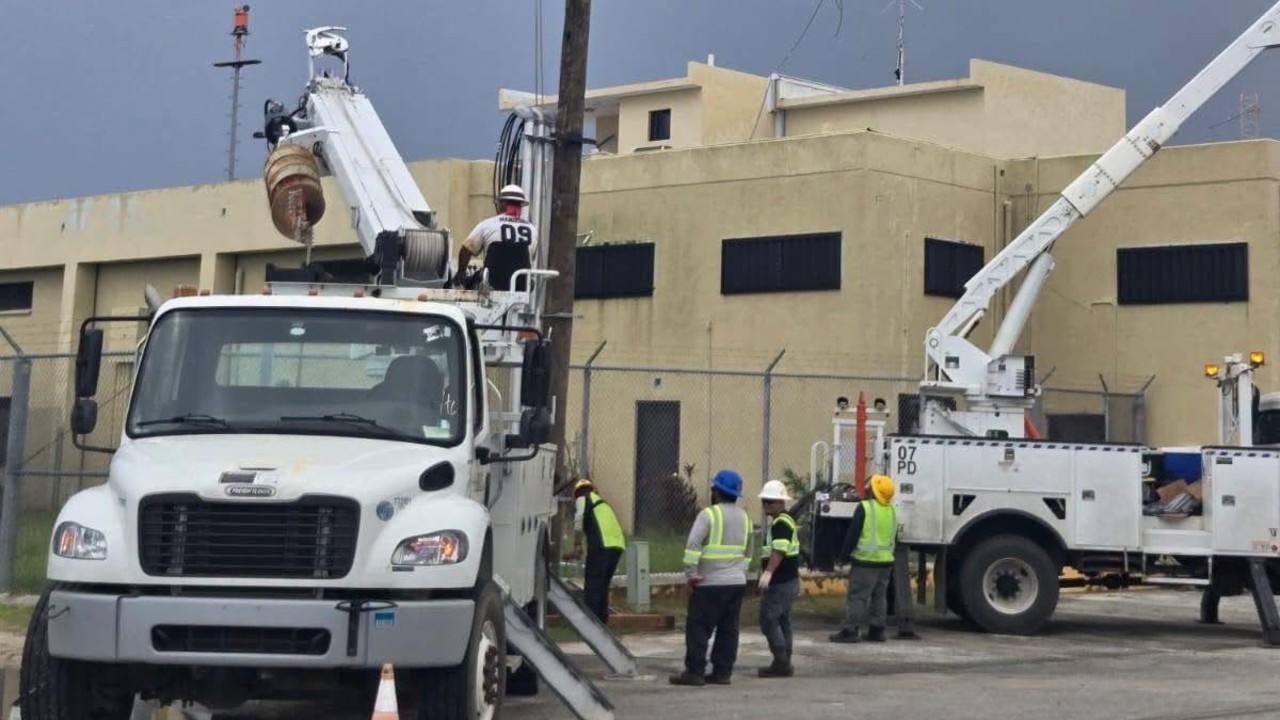
The Commonwealth Utilities Corp. is preparing to seek as much as $700 million in federal grant funding to replace aging diesel generators and upgrade critical power infrastructure across the CNMI, as federal agencies signal heightened support tied to the islands’ growing strategic military importance.
The updates were presented during a special board meeting last Jan. 30 at CUC’s Dandan office, where executive director Kevin Watson briefed directors on recent discussions in Washington, D.C., involving the Department of the Interior, Federal Emergency Management Agency, and other federal partners.
“Our ask right now is up to $700 million,” Watson said, explaining that the funding would be used to replace failing diesel engines across CUC’s power plants, fund underground transmission from Power Plant 1 to the Commonwealth Health Center, and advance other priority projects. “Everybody is very excited about this opportunity and thinks it’s real. That this will really help our citizens of CNMI.”
Watson said the administration of President Donald J. Trump is emphasizing affordability, reliability, resilience, and security in its territorial energy strategy, particularly in light of the U.S. military buildup in the region. He said CUC has already secured about $7 million in energy-related grants, including funding for a 2.5-megawatt generator on Rota, battery storage, and automatic meter reading, with additional requests now being assembled.
“If we can get 100% grant funding to replace our engines that are down, that’s what we’re asking for,” Watson said, noting that Guam Power Authority last year sought more than $2 billion in similar federal assistance.
CUC board chair Allen Perez said replacing generators through grants is the corporation’s top priority, as CUC lacks the cash flow to fund major generation upgrades on its own.
“We know internally we cannot fund that,” Perez said. “If there’s an opportunity… for us to be able to state our case to Interior to prioritize us to get generators from grants, I think that we have to put that as the highest priority.”
The grant discussion came during the same meeting in which the CUC board upheld management’s decision to disqualify AP Energy’s bid in Phase 1 of a major power procurement, denying the company’s appeal and barring it from advancing to Phase 2.
Following the decision, AP Energy managing member Perry Inos said the company respects the board’s ruling but signaled that further legal action remains on the table.
“We respect the CUC board’s decision, even though we disagree with the outcome,” Inos said in a statement to Marianas Press. “Our appeal was based on the plain language of the RFP and the procurement regulations, and we continue to believe our proposal met the Phase One requirements as written.”
“Given the significance of this project to the Commonwealth, we are not going to walk away from the process,” he added. “We intend to proceed to the next level of appeal to ensure the procurement is applied fairly, consistently, and in a manner that protects competition and ratepayers.”
Inos had earlier told the board that AP Energy was not seeking special treatment or an award, but only the opportunity to advance to Phase 2, arguing that the request for proposals expressly allowed audited financial statements or annual reports from affiliates and that no addendum was issued removing that language.
“This appeal is not a request for award,” Inos said during his presentation. “It is simply a request that AP Energy be allowed to proceed to Phase 2, consistent with the RFP, so our proposal can be evaluated alongside others on its merits.”
The board also gave final approval to a new procurement regulation requiring a protest bond equal to 15% of the procurement amount at the time a protest or appeal is filed.
CUC legal counsel Michael Ernest said the amendment mirrors existing Department of Finance regulations and is intended to discourage frivolous protests at no cost to the corporation.
“I think it’s incumbent upon us and almost mandatory on us to promulgate it too,” Ernest said. “I think it will be a net benefit to CUC. It cuts down on frivolous protests.”
Ernest said the regulation received no public comments during the notice period and will be published in the Commonwealth Register on Feb. 15, becoming effective Feb. 24, assuming adoption without changes.
Perez summarized the action by noting that the regulation had already cleared public comment and was now before the board for final approval “as currently written.”
The new bond requirement will apply to future protests and appeals, adding a financial threshold to procurement challenges as CUC advances large, grant-funded energy projects.
Share this article: