Don’t Let Reservations Stop You: Saipan-Raised Justin Ocampo on Finding His Way
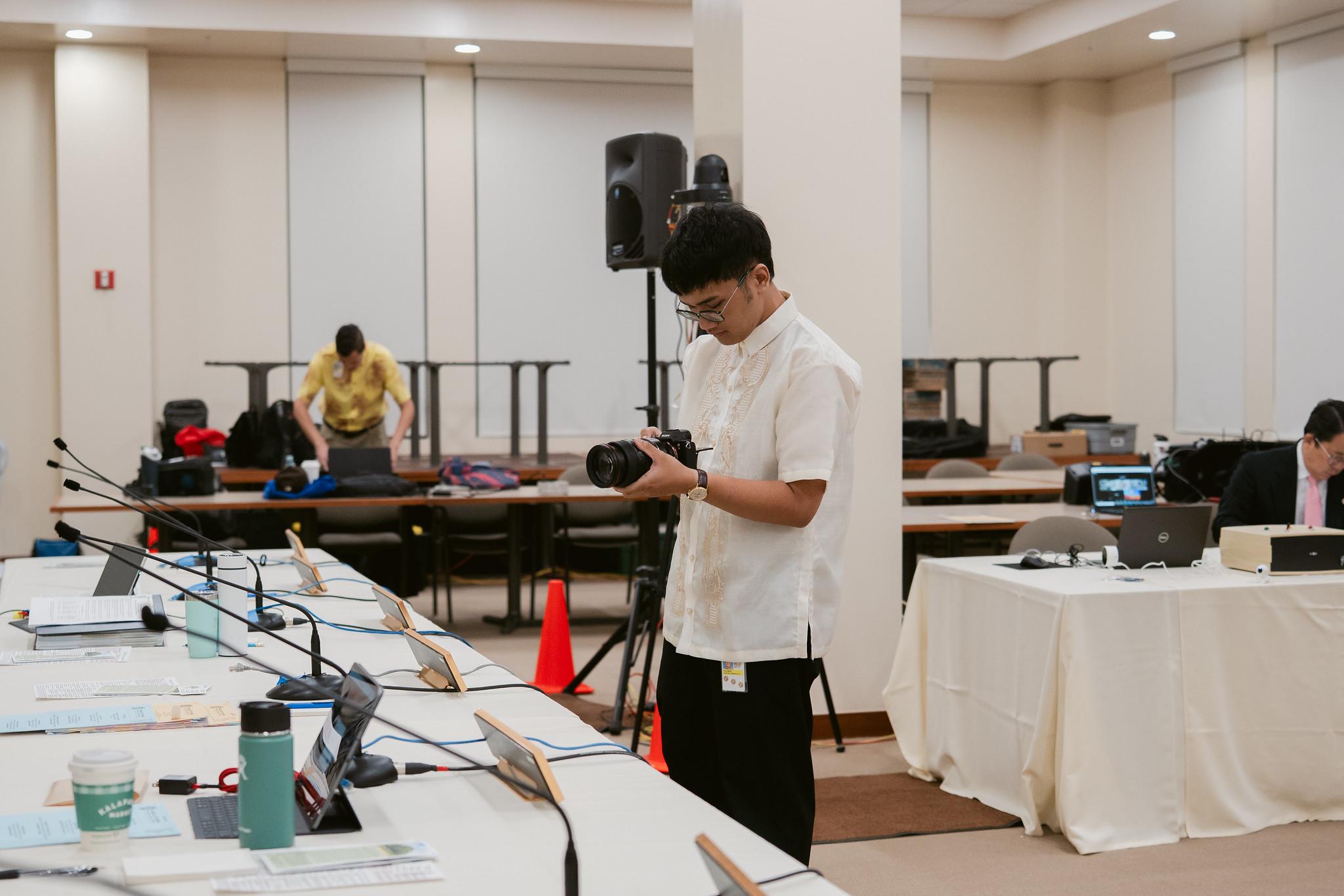
Justin Gerald Pensader Ocampo is a second generation Filipino American filmmaker and documentary photographer born and raised on Saipan but now based on O‘ahu, Hawai‘i. His award-winning filmography has earned him top honors at regional and international film festivals, including Best of Festival at the 2018 Guam International Film Festival and the Driven Student Filmmaker Award at the 43rd Hawaiʻi International Film Festival. Justin currently serves as a Digital Communications Specialist for the Honolulu City Council where he “leverages media production skills to highlight the work being done, at the County level, to make Honolulu a more resilient and inclusive place to live.” Justin is passionate about supporting youth in navigating higher-education and career pathways in creative industries.
Having seen him grow from high school to where he is now, Marianas Press contributor Marquina Hofschneider reached out to Justin to share some words about his educational and career journey.
Q. Tell us about yourself.
My name is Justin Gerald Pensader Ocampo. I’m a second generation Filipino American that was born and raised on Saipan. My family traces its roots to Lucena City, Quezon Province and Pampanga. I attended Sister Remedios for Kindergarten (back when it still had its own separate campus on Chalan Kanoa Drive!) followed by Mt. Carmel School for 1st-12th grade. I then received my Bachelor’s Degree from the University of Hawaiʻi at Mānoa, double majoring in American Studies and Digital Cinema. I am now based out of Mililani, Oʻahu and work as a Communications Specialist for the Honolulu City Council. In my free time, I enjoy watching K-Dramas as well as unscripted reality TV from Japan & Korea. Additionally, as a first time home-owner, my hobbies have grown to include interior decorating and taking care of indoor house plants.
Q. What is your most-played song, and what grounds you at the end of your day?
My top artist in 2025 was the K-Pop girl group TWICE. Their songs, together with other catchy, high BPM K-Pop music, were what I was listening to on repeat when I did my daily walk uphill from my rental in Makiki, where I lived at the time, into the nearby neighborhood of Mānoa. TWICEʻs music helped me lose weight and overall cultivate healthier habits.
I am grounded by prayer, simple self care habits like doing both a morning and night shower, and slow hobbies like taking care of the plants that sit on my nightstands. I am also grounded by driving. My commute to and from work is quite long (between 30 minutes to sometimes upwards of an hour, depending on traffic) but I find that getting up early to drive into work followed by the slow crawl back home later in the afternoon/evening time gives my day a regular rhythm it wouldn't have otherwise if I still lived in town, closer to work. I get to slowly build forward momentum, pray, and listen to music in the mornings and then decompress later in the evening on my drive home. By the time I get into Mililani, it truly feels like the work-day has ended since its distance to downtown, where I work, gives it that sense of separation.
Q. Can you tell us a little bit about your upbringing in the Mariana Islands — which experiences or values shaped you the most?
Growing up in the Marianas, what shaped me most profoundly was my experience of “found family.” To briefly expand on that concept, there’s family you are related to by blood and then there’s “found family” — the people you associate with so closely that you basically become of the same tribe. I’m the proud son of a first generation immigrant mother who raised me as a single parent. The rest of our family still resides in the Philippines, which meant that growing up, my small direct family unit consisted of just three people: me, her, and my older brother. Later, it became two of us for a time when my older brother moved away from college. So because my direct family was small, I found solace and comfort in my mother’s “found family”, namely her coworkers from her over-twenty years at DFS. Some of them became my godparents, my ninongs and ninangs, who were always present and available for me, helping me feel more supported and less alone. We moved around a lot on Saipan. When we moved to an apartment right across from DFS for a time, my ninong Ben Babauta, upon learning that my favorite color was blue, told my landlord to ensure my room was painted accordingly. My experience of found family in the Marianas helped me prioritize cultivating similar relationships now that I live here in the diaspora and am a working adult myself.
Apart from that, I also credit my time at Mt. Carmel School for equipping me with the critical thinking, leadership, relational, and analytical skills necessary to thrive in a variety of settings both in college and later in my career after graduation. I had the pleasure of being a part of so many extra curricular activities at Mt. Carmel, from six years of Mock Trial to four years of Theatre Club to being the Attorney General Cup Speaker my senior year of high school. It's this diversity of experiences at Mt. Carmel that I believe shaped me into an adaptable team player that adds value wherever I can.
Q. What has your journey through higher education been like? How did you find yourself on your career path?
One piece of college prep advice I remember receiving as a high school senior from my mentor, Dr. Galvin Deleon Guerrero, was that choosing a college is akin to entering into a long term, committed relationship. You need to look at the school in its totality and ask yourself if this is a place you can spend the next four years of your life in. In hindsight, the University of Hawaiʻi at Mānoa was the right place for me, for three reasons.
First, UH Mānoa’s School of Cinematic Arts (SCA) places a strong emphasis on telling personal stories and gave me a platform to contribute to the ever growing catalogue of media created by and for AANHPI people. I was proud to have written & directed three of my own short films: “Tala” (2021), “Parental Consent” (2022), and “Kunyari” (2023), all available on YouTube. Each one was personal enough that watching them offers real vulnerable insight into my life and how I persevered with the help of my loved ones. “Tala” was made for my brother, “Parental Consent” was made for my mom, and “Kunyari” was made for me.
Second, UH Mānoa’s identity as a research institution and Native Hawaiian place of learning suited my introspective, humanities minded side. That’s a fancy way of saying I’m a nerd who likes to ask deep questions — “why” and “how” being my favorite. The American Studies program at UH Mānoa enabled me to take a critical look at the different cultures, societies, and institutions that make up America, and my experiences growing up in an incorporated American territory like the Marianas gave me a perspective informed by lived experience to bring into those discussions.
Third, UH Mānoa helped me embrace my identity as a Filipino American. I took four semesters of Tagalog and served a variety of roles in UH’s Filipino student organization, Katipunan, including a term as the organization’s president my senior year. Learning my mother’s maiden tongue gave me more than just bilingual competency. It improved both my self confidence and relational skills with both fellow Filipinos and people of other backgrounds. I now approach interactions guided by a deeper understanding of the good-natured values of my people, who have raised the bar globally for kindness and hospitality.
Overall, the guiding philosophy of my career path has been one of organic self discovery — listening to what opportunities truly resonate deep within me as a person. In my seven years here, I’ve come to learn that to the Indigenous Hawaiians, the Kānaka Māoli, that’s called listening to your naʻau. At UH, I started out as just a Digital Cinema major because I enjoyed the experience I had directing my first short film with Mt. Carmel Schoolʻs Theatre Club (We Drank Our Tears: Rafael Mafnasʻ Story) before eventually adding on American Studies as my primary major because of my longtime love for the humanities and wrestling with the deeper, subtextual meaning behind things. That’s how I found myself on this career path. Every move Iʻve made since then has followed a similar pattern of listening and responding to those deeper movements of the heart. From my first job out of college as an Education & Outreach Specialist with the Hawaiʻi International Film Festival, where I got the opportunity to help a newer generation of creatives, to my career in government, which began at the State Senate and has since moved over to the Honolulu City Council.
Q. You now work for the Honolulu City Council. What does working in public service mean to you, and where do you see yourself next?
Simply put, I see my work at the Council as documenting how people gather, work, and belong. In one of my college classes, I read Susan Sontag’s essay titled On Photography, in which Sontag argued that the camera functions almost like a weapon, giving the person behind it the power to include or exclude people from the frame. Sontag was writing about wartime photography specifically, but their argument stuck with me, informing my personal belief that all creative work is, at its core, an act of empathy. Because the camera has such power, it's necessary to ensure that I empathize with my subject and to translate that empathy into something tangible for my audience.
Case in point, I really look up to Pete Souza, the official White House Photographer first under President Ronald Reagan, then under President Barack Obama. His book with select photos he took during his time with the Obama administration sits at my desk at city hall for days where I need to feel inspired. There is a powerful photo he took of Juan Blanco, also from Saipan, who was just one year below me at Mt Carmel, meeting President Obama. I remember how I felt when I first saw that photo as a young kid. Suddenly, the White House and the Oval Office was brought down to my level and was no longer a distant reality from across the ocean. It was my first taste of witnessing responsive governance. That’s the power of an image and I attempt to evoke the same emotions with my work.
As far as where I see myself next, I hope it's in a place that enables me to continue creating with purpose while also grounding me with stability. Where that is, only time will tell.
Q. What gives you a sense of purpose in the work you do, and how do you hope your work makes a difference in the community?
There’s a line from Mr. Miyagi in Karate Kid III that I hold onto, “Daniel-San, never put passion before principle. Even if win, you lose!” My principles form the core of my purpose, not just in work but in life. The biggest one for me is reciprocity. How are you giving back to the communities that sheltered you and gave you the space to settle and find yourself? That’s a humbling question I always try to ground myself with every once in a while, especially as a settler or an out-of-state “transplant” here in Hawaiʻi.
Q. What would you say to young people from the Mariana Islands, particularly those who may face obstacles or be unsure of what their future holds?
The most immediate advice I would give is don’t be so eager to re-invent yourself so quickly after graduating high school, especially if you plan to leave the CNMI for a time. The right people, whether that be a college professor or a future employer, will see just how much value your unique background, experiences and worldview add to any room you walk into. Instead, let change happen organically. Rather than trend-hopping or chasing “clout”, listen and respond to opportunities that truly move you and resonate with your values.
Remember that there are more people praying for you then there are those wishing for your downfall. Work hard and be for them an answered prayer. One of the last things my late grandmother, my beloved Lola, said to me was that she was my “prayer warrior.” Knowing this saved me from cynicism and selfishness.
Lastly, uncertainty is a reality of life but I truly believe that us sons and daughters of the Marianas are the most resilient and adaptable people in the world. You’ve survived supertyphoons. Don’t let your reservations about life stop you from experiencing it. There’s always time for second thoughts but you won’t always get a second chance.
Share this article: