Dr. Riya Nathrani Publishes Practical Guides to AI and Cybersecurity in Education
From Island Classrooms to a Global Audience: Dr. Riya Nathrani Publishes Practical Guides to AI and Cybersecurity in Education
CNMI educator transforms more than a decade of field experience into practical, human-centered approaches that schools and districts can adapt in their own communities
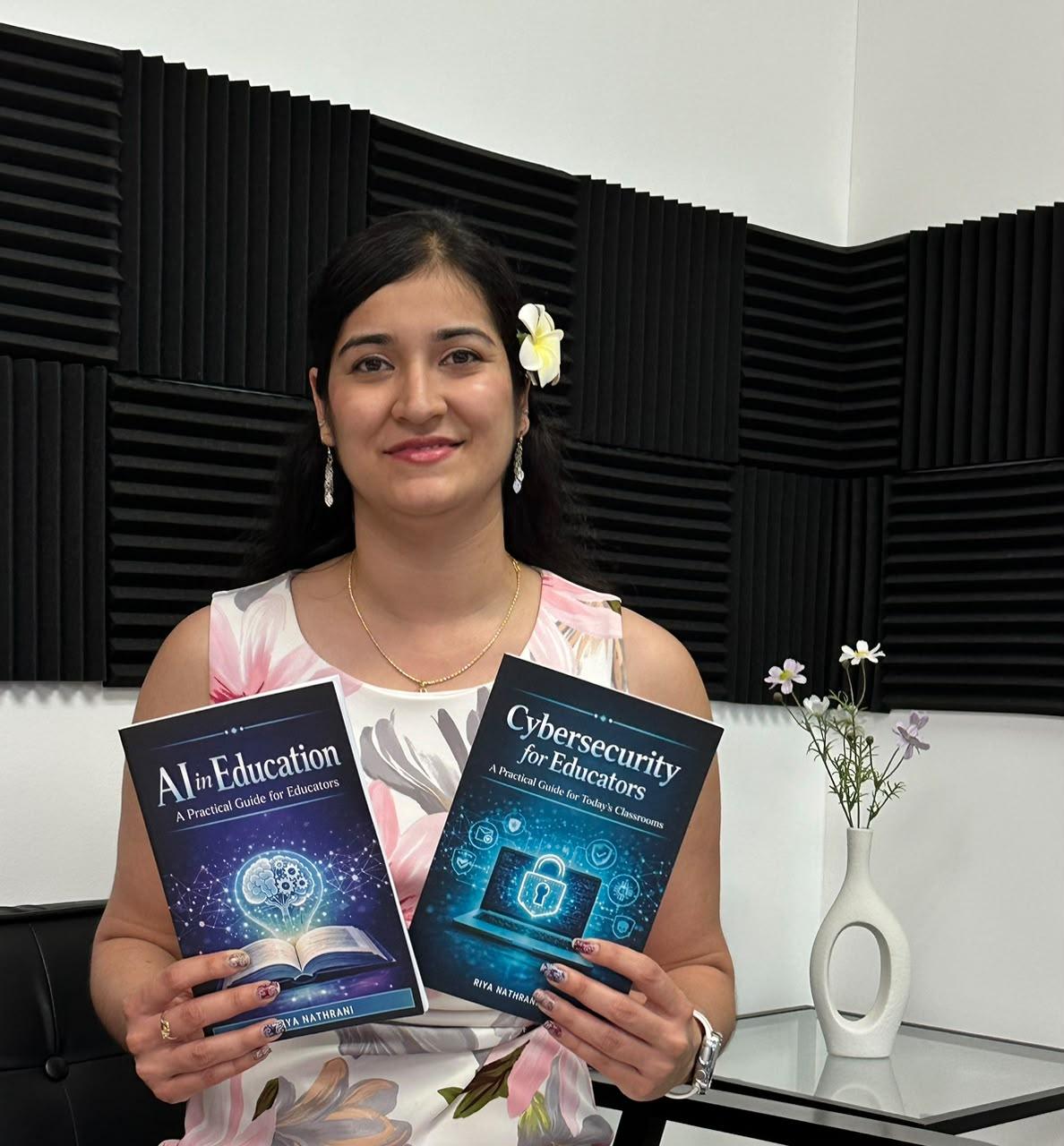
Lessons developed while supporting students, families, educators, and school leaders across the Northern Mariana Islands are now reaching a broader audience through Nathrani’s two new books: AI in Education: A Practical Guide for Educators and Cybersecurity for Educators: A Practical Guide for Today’s Classrooms.
The books address two of the most urgent and often intimidating challenges facing schools today. Written for readers without technical backgrounds, they translate complex concepts into practical strategies that teachers, instructional coaches, administrators, and school systems can adapt to their students, policies, cultures, and local needs.
Nathrani developed the books from more than a decade of work in classroom teaching, instructional coaching, professional learning, educational technology, and program leadership. As an instructional technology coach for the CNMI Public School System, she supports students, staff, and families across 20 schools and departments on Saipan, Tinian, and Rota.
AI in Education: A Practical Guide for Educators responds to a rapidly growing challenge: schools are being asked to make decisions about artificial intelligence while the technology and the guidance surrounding it continues to change. Nathrani introduces an original, educator-centered approach to responsible implementation. Her work places professional judgment, student needs, cultural context, and human relationships at the center of every AI-related decision.
The book helps educators understand what AI is and how to evaluate its use in relation to instruction, student privacy, academic integrity, bias, accessibility, equity, and human connection. It also provides practical questions, scenarios, and strategies that educators can use when deciding how AI belongs in a particular learning experience. Nathrani’s approach recognizes that educators possess knowledge no algorithm can replace: an understanding of their students, content, cultures, and communities.
Excerpt from AI in Education: A Practical Guide for Educators:
“In classrooms, AI works best as a flexible assistant that helps teachers adapt learning to students’ needs. It can translate languages, adjust reading levels, explain a concept in multiple ways, and provide alternative formats for learning. These are more than conveniences. For many students, they can mean the difference between access and exclusion.”
“Dr. Nathrani writes from the perspective of someone who understands what educators are actually facing,” one CNMI PSS educator said. “The scenarios, questions, and practical strategies make complex issues feel manageable. After using the guidance, I developed a classroom AI agreement that clearly explains when students may use AI, how they should verify and cite AI-generated information, and why they must protect personal data. My students became more thoughtful and transparent about their use of AI.”
“Our students should not only learn how to use AI,” Nathrani said. “They should understand how it works, question the information it produces, recognize whose voices may be missing, and make choices grounded in accurate information, ethical judgment, and respect for the diverse cultures represented in their communities. The educator’s role is more important than ever because students need people who can help them ask better questions, examine evidence, and use these tools without losing their own voices.”
Nathrani’s second book, Cybersecurity for Educators: A Practical Guide for Today’s Classrooms, addresses another urgent need. Schools are frequent targets of phishing, social engineering, data breaches, and other cyberthreats, yet many cybersecurity resources are written primarily for information technology professionals. Nathrani’s book begins from a different premise: educators do not need to become cybersecurity engineers, but they do need to understand how their everyday choices can protect, or unintentionally expose, students and school communities.
One of the book’s central original contributions is its human-centered treatment of cybersecurity. It offers guidance for protecting student data, recognizing phishing and social engineering, strengthening passwords and account security, responding appropriately to potential threats, and teaching cybersecurity concepts across grade levels. It also helps school leaders consider how policies, professional learning, and shared expectations can create a culture in which cybersecurity belongs to everyone, not only the IT department.
The book is grounded in Nathrani’s experience developing and delivering cybersecurity, digital citizenship, student data privacy, and online safety education throughout the CNMI. These initiatives reach approximately 700 staff members, 2,000 students, and 200 parents annually. Her work extends digital safety beyond school walls by helping families understand how online decisions can affect children, employees, and the wider community. The guidance also draws upon nationally recognized cybersecurity frameworks and K-12 learning standards, translating them into language and practices educators can use in classrooms, professional learning programs, and schoolwide initiatives.
“The CNMI has taught me that meaningful innovation begins with understanding the people you serve,” Nathrani said. “The questions educators are asking about artificial intelligence, student privacy, and digital safety are shared by communities everywhere. I wrote these books to help educators move from feeling overwhelmed by technology to making informed, confident, and responsible decisions.”
The two books bring a Pacific Island perspective to broader conversations about artificial intelligence and cybersecurity in education. Through this work, Nathrani advances her mission of helping educators approach technology with curiosity rather than fear, confidence rather than uncertainty, and an understanding that the most important decisions in education must remain grounded in human judgment.
Share this article: