A Federal Emergency Management Agency official pushed back on criticism that only about 21% of Super Typhoon Sinlaku housing assistance applicants in the CNMI have been approved, saying the eligibility figure remains fluid as FEMA continues processing survivors' claims.
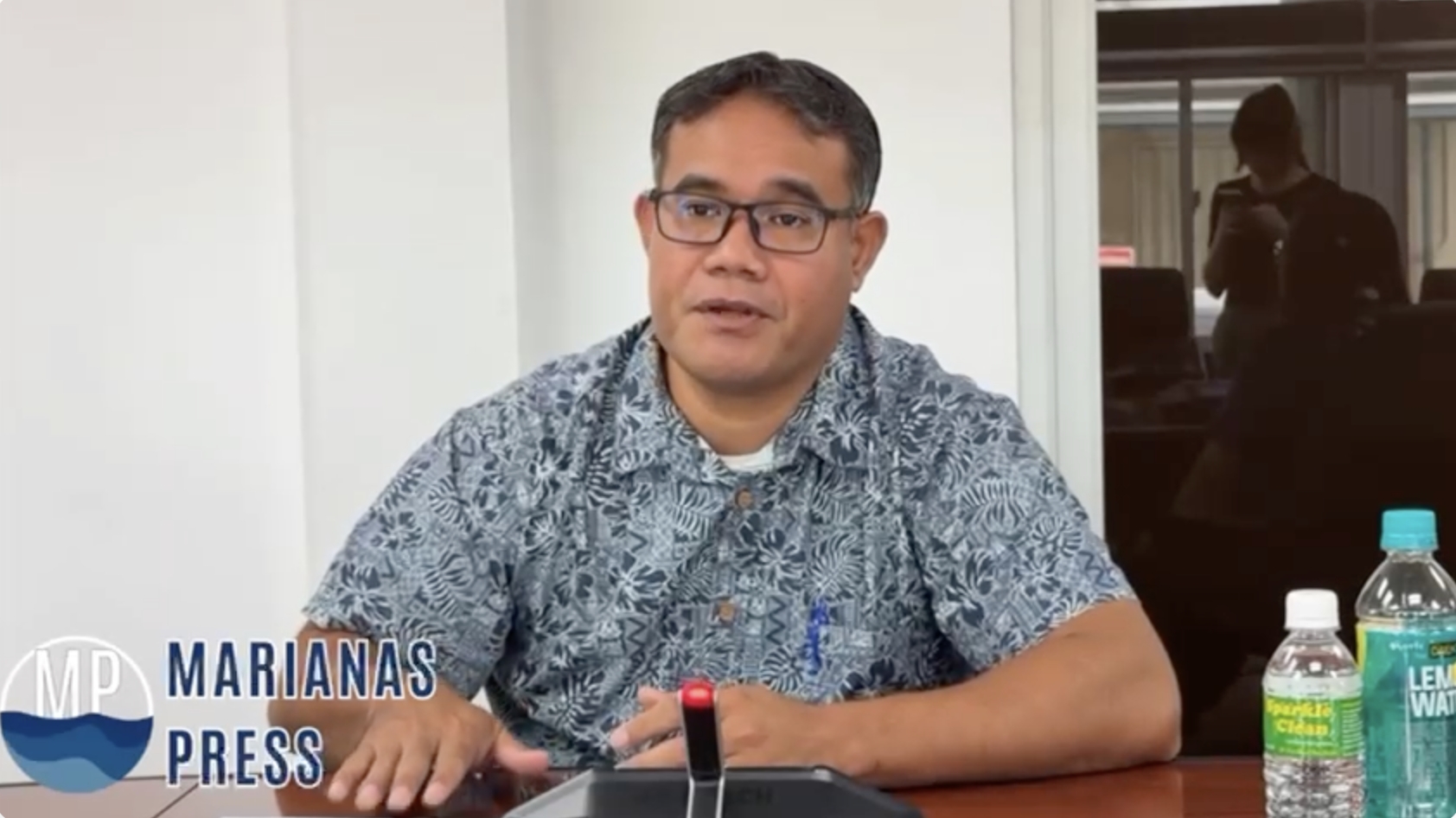
Victor Inge, a FEMA external affairs officer with the Regional Incident Management Assistance Team, made the comments during a sit-down interview with Marianas Press last Aug. 20 at Crowne Plaza Resort Saipan.
His comments came in response to a recent Right to Democracy article that questioned why only about 21% of applicants for housing assistance had been approved following Sinlaku.
“First of all, that eligibility rate is constantly in flux because we're always, and we're still, processing survivors' claims,” Inge said.
Inge said one significant factor affecting eligibility in the CNMI is the federal requirement that applicants meet citizenship or qualified noncitizen requirements under the Stafford Act.
“But here in the CNMI, it's been a little challenging because a large percent of the population could not prove residency. Either they couldn't prove residency or they were not U.S. citizens because the Stafford Act's explicit in explaining who's eligible for federal disaster assistance,” he said.
Inge said a significant number of people in the CNMI have work-only Social Security numbers but do not have a status that qualifies them for federal disaster assistance.
Other applications may encounter issues unrelated to immigration status, he said. FEMA generally recognizes only one registration per household, while some applicants may have difficulty establishing that they occupied the damaged residence when the typhoon struck. Others may still be eligible but need to submit additional documentation before FEMA can make a final determination.
Inge stressed that an initial determination of ineligibility does not necessarily end an applicant's case.
“So, if you've been determined ineligible, and you don't understand why, we will gladly discuss that with you. And if you feel that we made a mistake, then you certainly have a right to appeal that,” he said.
He also cautioned against attributing the overall approval rate to any single reason because each application is evaluated according to the circumstances of the household and its losses.
“We can't sit here and point our finger to one indicator that tells us why a number of people were ineligible for assistance,” Inge said.
He said FEMA has received more than 12,000 registrations and approved more than $51 million in disaster grants for eligible people living and working in the CNMI.
FEMA assistance, Inge said, is intended primarily to make a disaster-damaged home safe and livable rather than necessarily restore it completely to its pre-disaster condition. Depending on eligibility, assistance can also cover certain essential personal property through FEMA's Other Needs Assistance Program.
“Again, federal disaster assistance is concerned with making the home safe and livable, so that if you can live in your home, that's our preference,” he said.
Applicants who lack traditional proof of occupancy may also be able to use a self-declaration under certain circumstances, Inge said. Such declarations must contain specific information, including that the applicant lived at the property when the storm occurred and suffered impacts from the disaster.
For applicants who believe FEMA reached the wrong determination, Inge urged them to carefully read FEMA correspondence, ask for clarification when necessary, and pursue the formal appeals process with supporting documentation.
Inge also rejected the perception that an applicant's chances depend on which FEMA representative happens to handle the case. He said households can receive different outcomes because their circumstances and losses differ, not because FEMA uses different standards.
“That's why every case is adjudicated on a case-by-case basis, and there's no cookie-cutter approach to just handing out checks,” he said.
Asked directly for his thoughts on the Right to Democracy article, Inge said he did not have an opinion on it but characterized it as an opinion piece.
“People are entitled to their opinions. To me, it was more of an opinion piece, where you can take statistics and formulate facts or alternative facts and display those in a way that you're trying to create or support a narrative,” he said.
“This isn't the first time people have taken FEMA statistics and tried to tell a story, and in a lot of ways, in a lot of times, that story's inaccurate.”
Inge encouraged Sinlaku survivors to rely on credible information and continue working through FEMA's process when they have questions about their applications.
“My recommendation is to stay encouraged. Be encouraged and get your information from credible sources,” he said.
Share this article: