Forum highlights sports tourism, healthcare, CEDA effort in diversification push
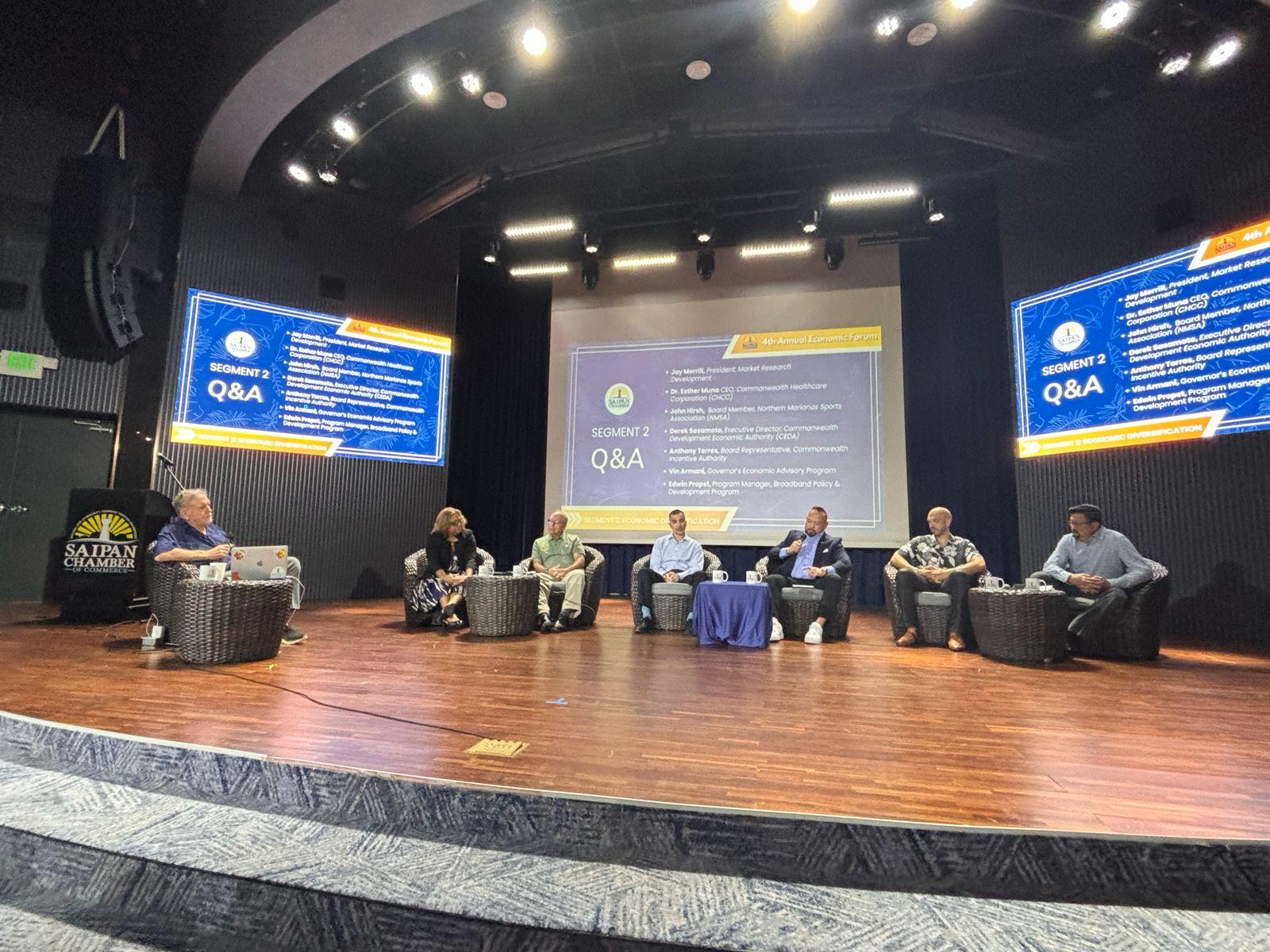
Economic diversification in the Northern Mariana Islands will require coordinated development across sectors such as sports tourism, healthcare, and new industries, speakers said during the Saipan Chamber of Commerce Economic Forum 2026 held last Feb. 11 at the Kensington Hotel Saipan.
The forum’s second segment focused on economic diversification and was moderated by Jay Merrill, president and CEO of Market Research Development, with presentations from John Hirsh of the Northern Marianas Sports Association and Esther L. Muna, chief executive officer of the Commonwealth Healthcare Corp..
Hirsh said sports tourism has become an important contributor to the CNMI economy, particularly through regional and international competitions.
“Sports and competition are nothing new here,” Hirsh said. “Not only did we host the Micronesian Games in 2006, but we also were the host for the Pacific Mini Games in 2022, which had 14 different countries from around the Pacific.”
He said sporting events bring direct economic activity as visiting athletes and supporters stay in hotels and spend money locally.
“These are folks that are not only participating in sports, being excited, having fun, but they're spending money, they're staying in the hotels, they're eating in the restaurants,” Hirsh said.
Recent improvements to sports infrastructure have also helped position the CNMI to host more events and training camps, he added.
“When the [Gilbert C. Ada Gymnasium] looked like it did two years ago, there was no way to host any of these events,” Hirsh said. “When we didn't have those soccer pitches, we couldn't do it.”
Hirsh also pointed to a major federal investment in the Oleai Sports Complex that could significantly expand the CNMI’s capacity to host aquatic sports.
“One of the super exciting things… is that [the Economic Development Authority] has, I think it's about $21.3-million investment in the Oleai Sports Complex and the Cultural Center across the street,” he said. “This is going to allow us to basically be a game changer in terms of aquatics. We'll have a 50-meter swimming pool.”
Meanwhile, Muna said healthcare is itself a major economic driver in the CNMI.
“Of the 47,000 residents of the CNMI, we have 1,000 employees that are spread throughout Saipan, Tinian, and Rota,” Muna said of CHCC. “It is basically one of the largest single employers in the CNMI.”
She said expanding healthcare services also creates jobs beyond the medical field.
“Whenever we expand services, we don't just think of the building, we don't think of the equipment,” Muna said. “We also think about what the support services are going to comprise of.”
Economic conditions in the community also affect healthcare demand and outcomes, she added.
“When individuals are suffering or do not have the quality of life, you would see less access to health care,” Muna said. “You will be seeing them with more severe illnesses coming to the hospital.”
CHCC is also working to reduce the cost of off-island medical referrals by expanding services locally.
“We were spending $18 million. It went down to $9 million,” Muna said. “We want to provide the services locally. People want to be here… culturally, we want to be able to recover quickly, and it requires family close by.”
Merrill said the CNMI’s economic challenges underscore the urgency of diversifying beyond tourism.
“The economy as a whole is at one of the lowest points it's been in well over 20 years,” Merrill said. “Tourism is down by 66%.”
He said the CNMI’s heavy dependence on a single industry creates vulnerabilities during downturns.
“There's an over-reliance on a single industry, which is tourism,” Merrill said. “When it does have ups and downs, which it always will, it creates tremendous issues for businesses.”
Diversification, he said, requires cooperation across government, businesses, and the community.
“Economic recovery represents a community-wide effort,” Merrill said. “It is not something that either a single department or even the public sector on its own can do.”
He added that emerging sectors such as green technology, manufacturing and data infrastructure could become part of the CNMI’s economic future.
“This process of diversification will either happen to you… or it could be shaped by you and for you,” Merrill said.
During the panel discussion, Commonwealth Economic Development Authority executive director Derek T. Sasamoto said the government is working to attract new investment sectors that can complement tourism and create higher-paying jobs.
He said diversification efforts focus on industries that can expand exports and provide long-term employment opportunities for residents while strengthening workforce development programs so local workers can transition into new industries.
Sasamoto emphasized that any new industry brought to the CNMI must be paired with workforce training and coordination with schools and workforce programs to ensure residents are prepared to fill those jobs.
Anthony C. Torres, chair of the Commonwealth Economic Incentive Authority, said the CNMI’s economic incentives and regulatory environment can play a major role in attracting outside investment.
Torres said the CNMI has unique advantages compared to other jurisdictions and should leverage those incentives to encourage investors and businesses to establish operations in the islands.
He noted that clear policies and consistent support for business development are important to ensure companies see the CNMI as a viable place to invest.
Vin Armani, chair of the Economic Diversification Committee of the Governor’s Council of Economic Advisors, said economic diversification will require both government and private-sector participation.
Armani said part of the effort must involve encouraging members of the CNMI diaspora to return after gaining education or professional experience abroad so they can help build new industries in the Commonwealth.
He also emphasized the need for a long-term vision that aligns economic development, workforce training, and investment strategies.
Edwin K. Propst, program manager for the CNMI Broadband Policy & Development Program, said broadband expansion and emerging industries could play a major role in the Commonwealth’s diversification efforts.
He noted that some companies are interested in building data centers in the region, but emphasized that reliable and sufficient power would be necessary to operate those facilities.
Propst also said that the arrival of new industries could open the door for local entrepreneurs and help strengthen existing businesses. According to him, these developments could provide significant opportunities for small local companies to become involved and benefit.
At the same time, Propst emphasized that economic diversification should follow a clear and coordinated vision. Without proper planning, diversification efforts could end up happening in isolated sectors without connection to a broader strategy.
Share this article: