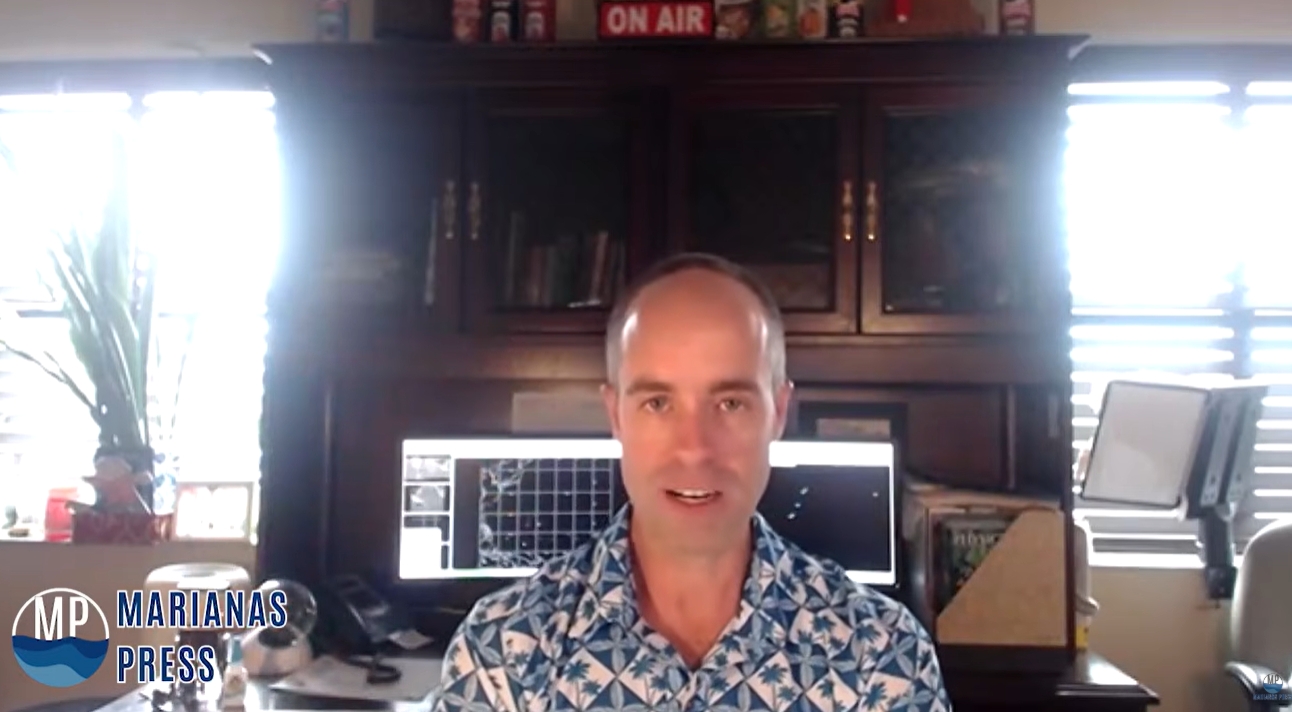
As more Commonwealth residents look for ways to escape soaring electricity bills and the uncertainty brought by recent typhoons, Stacey Wang of Saipan Green Energy and Construction and Jeannifer Cubangbang of SweetGlamIslandChic’s Green Energy Solutions say interest in going fully off-grid has surged in the aftermath of Super Typhoon Sinlaku and the latest fuel-adjustment charge hikes by the Commonwealth Utilities Corp.
Wang said solar technology has become more affordable and practical for homeowners seeking to reduce or even eliminate monthly power bills.
“I think it’s a good time to invest,” Wang said. “The price is really pretty low. And then the investment is not really high.”
Sales representative Mark Lood said homeowners can now realistically disconnect almost entirely from the power grid depending on household size, appliance use, and battery storage needs.
Lood said a typical two-bedroom home can usually get by with an 8- to 10-kilowatt system.
“So the price is going to be around from $10,000 with a regular battery in the night,” Wang said. “If they want to increase the whole night cover with battery… maybe another additional $2,000 for the more bigger batteries.”
She said a 10-kilowatt system can typically power two air-conditioners, refrigeration, lighting, and other household appliances for up to 12 hours overnight through battery storage.
For smaller households consuming around $150 monthly in power before the latest FAC hikes, Wang said a 5-kilowatt setup costing about $6,000 could already significantly reduce dependence on the grid.
“Maybe we can offer right now with the installation, maybe $6,000 something,” she said.
For larger homes with three to four bedrooms and multiple air-conditioners, Wang said the cost typically ranges between $12,000 and $15,000.
“And then the next one is, let’s say the big room, like five- to six-bedroom like that, it’s going to be getting 20 or 25 kilowatts,” she said. “So that price is going to be like $20,000.”
Wang said installations can usually be completed within one to two weeks if the systems are already in stock and fully paid upfront.
She added that demand for solar-powered products exploded after Sinlaku devastated the CNMI power infrastructure.
“After the typhoon, we have a lot of inquiries coming into the office,” Wang said. “People would say… instead of paying apparently in the future 60 cents per kilowatt, they would say, ‘Okay, I’d rather use free sunlight.’”
The company said solar fans, solar generators, and solar lighting systems have become some of their top-selling products since the storm.
Wang said he has personally relied on solar energy for years through his business operations.
“I think I’m the first one to use solar in Saipan, like since 2012,” Wang said. “That time is really big investment. But now this solar, the price is really pretty low.”
Wang later clarified that Saipan Green Energy and Construction has since placed greater emphasis on storm durability and long-term system reliability following the typhoon.
“After the typhoon, we believe structural design is just as important as the equipment itself,” Wang said in a follow-up message. He added that the company now uses mounting structures specifically designed for typhoon and strong wind conditions while taking local environmental factors into consideration to improve overall system stability and durability.
Wang also highlighted the importance of having local after-sales support.
“We are a local company with a physical showroom and service team, so customers can always reach us if they need support,” he said. “We believe this makes a big difference compared to products without local service.”
Cubangbang likewise said residents are increasingly interested in completely disconnecting from CUC service.
“So like my home, which is like about a four-bedroom, seven ACs, you know, a bunch of lights, you can get off the grid at $18,000 with my setup,” Cubangbang said. “That’s using 30kW solar system setup.”
She said smaller homes can fully go off-grid for less.
“You can get totally off the grid with a 10kW system, and it’s only going to be $13,800 with my company,” she said.
Cubangbang said her systems use higher-capacity 700-watt solar panels, allowing customers to use fewer panels while generating the same output.
“With a 30kW system, you only need 20 panels,” she said. “But you’ll see people here who have 30kW and they have 48 solar panels.”
She also said her own solar system survived Sinlaku without damage.
“They’re actually still attached,” Cubangbang said when asked if her solar panels had been removed ahead of the storm. “None of them blew off.”
Cubangbang said her previous monthly power bill once reached as high as $750, but that her hybrid solar setup has already reduced it dramatically.
“But with going off the grid, I’ll just pay the $7 charge and my power is going to be zero,” she said.
She urged residents not to delay switching to renewable energy.
“Don’t wait ‘till later. Do it now,” Cubangbang said. “Maybe start with a solar fan. Start with solar lights. And then upgrade to solar AC or a complete PV system.”
And CNMI residents hopping into the solar energy bandwagon isn’t expected to end soon, with CUC proposing another increase in the Fuel Adjustment Charge to over 60 cents per kWh.
Saipan Green Energy and Construction can be reached at (670) 234-2122 or through its Facebook page. SweetGlamIslandChic’s Green Energy Solutions can be contacted through Facebook Marketplace and WhatsApp.
Share this article: