Guam heads to polls in high-stakes governor’s race

Guam voters will choose between Democratic Sen. Therese Terlaje and Republican Sen. Tony Ada for governor on Nov. 3, in an election with high stakes: The U.S. military is building what it calls a 360-degree missile defense across the island, tourism has been slow to recover and concerns about corruption, the rising cost of living and deep-sea mining in nearby waters.
The current Guam governor, Democratic Lou Leon Guerrero, is term-limited.
The election will also reshape the 15-member Guam Legislature after Terlaje, Ada and four other senators gave up their seats to run for higher office.
Voters will also elect Guam’s nonvoting delegate to Congress, its attorney general and members of the Guam Education Board and the Consolidated Commission on Utilities.
"We are at a point where we need to ensure that we keep our relationship with both the federal government and the military intact,” Ada, 59, told the Marianas Press. “Guam is where America’s day begins but also Guam is the tip of the spear for the defense of America and we need to make sure our homefront is secure in order to keep America secure.”
The integrated air and missile defense system, estimated to cost $8 billion, is meant to protect Guam from increasingly advanced threats from China and North Korea. Construction of other military facilities continues, in support of the relocation of Marines from Okinawa to Guam.
Terlaje, 62, an attorney, said Guam “needs an equal seat at those tables, equal voice” to advocate for its residents on the military buildup and deep-sea mining off Guam and the Commonwealth of the Northern Mariana Islands.
The Trump administration plans to auction leases for about 69 million acres of ocean floor off the CNMI and Guam to secure a domestic supply of minerals used in electronics and defense technology. Conservation groups have sued the Trump administration to stop the deep-sea mining, which they say would harm threatened and endangered species.
“We’ve been very concerned about deep-sea mining and how it can impact, long-term impacts for livelihoods here and we need to have a stronger voice to work with federal partners to ensure that our voices are being heard and engaged in a very meaningful way,” said Sen. Sabina Perez, Terlaje’s running mate. “We want to have access to those decision-makers who are there to make meaningful responses to our concerns.”
Cost of living
“What’s at stake in this election is a really pivotal moment for Guam to change, to become more competitive, more fair, more equal in the way we do business so that we could grow our opportunities for our people, for higher-paying jobs, for being able to afford the cost of living here on Guam,” Terlaje said.
Mer Oasay, 68, a taxi business owner, said he hopes the winning candidates will prioritize tourism recovery. Visitor arrivals are still at 42% of pre-pandemic levels.
Oasay said the next governor should help lower the cost of living on Guam, where diesel costs $7.249 a gallon after hitting a record $9.749 amid the war in Iran. Regular gasoline is at a record $6.529 a gallon.
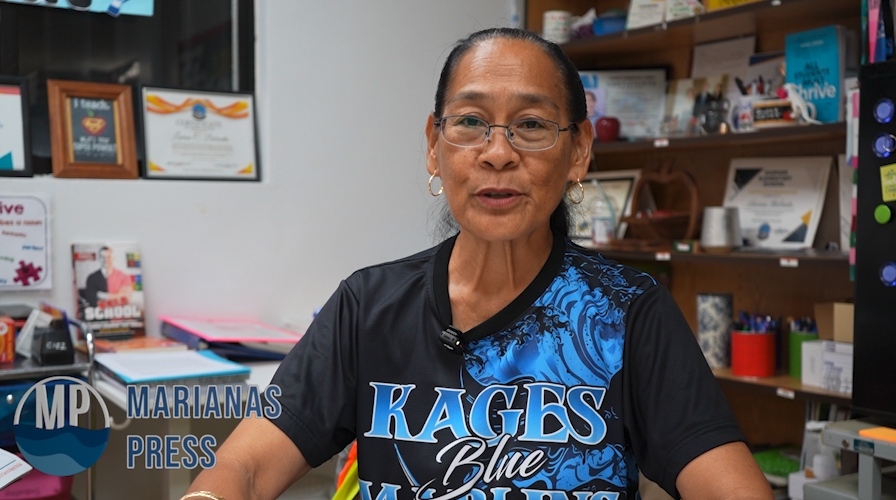
Ailah Maglaque, 27, a biologist, said she hopes elected officials will help make Guam neighborhoods safe from drugs and “focus on ordinary people, the middle class and below that.”
“Looking at the job market, it’s pushing me to go find opportunities outside of Guam,” Maglaque told the Marianas Press.
Guam has more than 58,000 registered voters and about 154,000 residents.
Arun Swamy, Ph.D., professor of political science at the University of Guam, said that unlike much of the U.S., “Guam has the luxury of holding a relatively normal election.”
“What is at stake in this election is many long-deferred items of public investment, most notably a new hospital and building Simon Sanchez High School, as well as issues of affordability and especially housing. These are important public policy debates, but not existential ones. We are not fighting over our election process and rule of law. We should be grateful,” Swamy told the Marianas Press.
Lacking leadership, anti-military?
Both candidates face criticism. Critics question Ada’s leadership while Terlaje’s critics paint her as anti-military.
Terlaje called the anti-military label inaccurate.
“I think that’s kind of negative campaigning being done unfortunately because it really is not accurate at all. It’s not the truth,” she said.
Terlaje said she and Perez support the military, which they called a “huge pillar” of Guam’s economy and a major partner after natural disasters.
“We only ask that while we support this development and we support all kinds of businesses on Guam, that all businesses equally comply with protecting our aquifer,” Terlaje said. “We’ve had some contamination issues already on Guam and we want to make sure that we do not have any more and that’s really the bottomline.”
Ada cited his leadership experience, both as a lawmaker, as special assistant to the governor for legislative affairs and as a businessman. His running mate, E.J. Calvo, is also a businessman.
"You have to have that balance between the government and the private sector because GovGuam does not print money. The economy runs because of the private sector,” Ada said. “I’m not a person who knows everything but I'm the person who brings everyone together.”
Addressing corruption
Terlaje said her administration would fight corruption in the government of Guam by making transparency and accountability a priority, including carrying out best practices identified by the public auditor.
That means standardizing procurement, hiring, licensing and permitting, and even the way the government issues notice of violation, “so that everybody is treated the same despite which agency you’re at and that everything is trackable,” Terlaje said. “We can see whether really the taxpayers are getting value for their dollar.”
Perez said “nobody is tracking the expiration of federal funds and so this is why we are returning federal funds.” She said she would make this tracking a priority.
Kenneth Morales, 44, said that while voters have many concerns, fixing traffic lights, potholes and road signs would save lives.
“It’s not complicated to fix traffic lights for the safety of everyone,” he said. ###
Share this article: