Chief Prosecutor Chester Hinds argued that Delvin Joe Elieisar Rios had the opportunity to stop or steer away after Baybie Dolores San Nicolas Hocog fell from the hood of his pickup truck but instead accelerated again, telling the court, “He chose to run her over.”
Hinds made the argument during Rios’ preliminary hearing and arraignment last Aug. 31 in Superior Court, where Associate Judge Teresa Kim-Tenorio found probable cause to hold Rios to answer to all six charges filed by the Office of the Attorney General.
Rios subsequently pleaded not guilty to the charges. Kim-Tenorio set the next hearing, a status conference, for Sept. 22 at 9am.
“He didn't just drive slowly. He sped again, going right over her. He chose to run her over,” Hinds said during closing arguments at the preliminary hearing.
Hinds said the key to the Commonwealth’s second-degree murder theory was what allegedly happened after Rios accelerated with Hocog on the hood of his white Toyota Tacoma. According to testimony presented at the hearing, the truck then slowed or stopped, causing Hocog to fall onto the roadway.
“The victim was off the truck. He could have gone any other direction. But he sped again,” Hinds said.
Hinds argued that Rios knew Hocog was on the roadway in front of the Tacoma when he allegedly accelerated again. He told the court that the alleged conduct supported probable cause for second-degree murder because Rios killed Hocog “either deliberately, intentionally or recklessly.”
The prosecution’s theory was based largely on testimony from Department of Public Safety Highway Patrol Traffic Investigations supervisor and traffic commander Sgt. Adrian Mendiola and DPS Criminal Investigation Bureau’s Lt. Catherine B. Pangelinan, the case agent.
Mendiola testified about surveillance footage, eyewitness accounts, tire marks, and other physical evidence investigators used to reconstruct the early morning Aug. 22 incident near the Commonwealth Healthcare Corp.
According to Mendiola, surveillance footage showed Rios and Hocog involved in a confrontation near their vehicles. He testified that Rios was seen dragging Hocog away from the Tacoma before returning to the truck, while Hocog subsequently got up and moved toward the front of the vehicle.
Mendiola said an eyewitness told investigators that after the video recording stopped, the Tacoma accelerated west, slowed or came to a stop and then appeared to go over a bump before making a 360-degree movement.
Mendiola testified that, based on the physical evidence and witness accounts, investigators concluded Hocog fell in front of the Tacoma when the truck slowed and that the vehicle then accelerated again.
He said investigators also found hand marks on the hood streaking toward the front bumper, which supported their conclusion that Hocog had been on the hood during the Tacoma’s initial acceleration.
Mendiola also testified that there was room on the roadway for Rios to stop or maneuver the Tacoma rather than continue forward. That testimony became a central part of Hinds’ argument that the alleged second acceleration supported probable cause for the murder charge.
Physical evidence collected from the Tacoma included blood and tissue from underneath the vehicle, Mendiola testified. Investigators also recovered slippers, ripped jeans, and vehicle debris from the scene.
Pangelinan, meanwhile, testified about her review of surveillance footage, interviews with witnesses and her interview with Rios. She said the investigation determined that Rios and Hocog were boyfriend and girlfriend and that the confrontation preceding Hocog’s death was a domestic dispute.
Pangelinan said one witness who was at CHCC heard the sound of an engine and tires and looked outside, where she saw the white Tacoma and a sedan positioned in front of it. According to Pangelinan, the witness saw Rios and Hocog arguing and saw Rios pushing Hocog.
Pangelinan testified that her own review of surveillance footage showed Rios putting his arm around Hocog’s neck and pulling her. She said the video later showed Rios pushing Hocog hard enough that she stepped backward.
She also testified that after Rios returned to the Tacoma, Hocog moved toward the truck before the witness stopped recording. Another witness interviewed by investigators later described seeing the truck appear to run over something or hit a bump.
Pangelinan also testified about what witnesses said happened immediately afterward. She said Rios got out of the Tacoma and went to Hocog as she lay on the ground.
According to Pangelinan, a witness saw Rios holding onto Hocog and heard him pleading, “Please don't die,” and saying, “I'm sorry” and “don't leave.”
Hinds maintained that for purposes of the second-degree murder charge, the critical point came moments earlier, when prosecutors allege Hocog had fallen from the hood and was on the roadway in front of Rios’ Tacoma.
“The victim was off the truck. He could have gone any other direction. But he sped again,” Hinds said.
Hinds also argued that the evidence supported the remaining charges. He said testimony that Rios allegedly pushed and dragged Hocog established probable cause for assault and battery, while the alleged use of the Tacoma to run over her supported assault with a dangerous weapon.
“The defendant used his vehicle to kill the victim,” Hinds argued, saying a vehicle can constitute a dangerous weapon depending on the circumstances and manner in which it is used.
Hinds also argued there was probable cause for voluntary manslaughter based on evidence that Rios and Hocog had been involved in a domestic dispute before her death.
“The defendant was pushing and dragging the victim, and then he eventually runs her over,” Hinds said, arguing that the evidence could support probable cause for voluntary manslaughter based on sudden quarrel or heat of passion.
For aggravated assault and battery, Hinds argued that the alleged purposeful or reckless act resulted in Hocog’s death and therefore constituted serious bodily injury.
The Commonwealth also presented evidence supporting the DUI charge. Mendiola testified that Rios smelled strongly of alcohol and had red, watery eyes, while Hinds told the court that Rios’ blood-alcohol level was more than twice the legal limit.
The defense, however, elicited several points during cross-examination that provided additional context to the Commonwealth’s reconstruction.
Mendiola acknowledged that Hocog’s sedan appeared to have been positioned in a way that blocked the Tacoma. He also testified that investigators had not calculated the Tacoma’s speed, although they identified acceleration marks and reconstructed its direction of travel.
The defense also questioned the circumstances leading up to the incident and whether Hocog had been following Rios. Pangelinan acknowledged on cross-examination that the two had been fighting, although the transcript of the exchange is unclear on the precise characterization of who was pursuing whom.
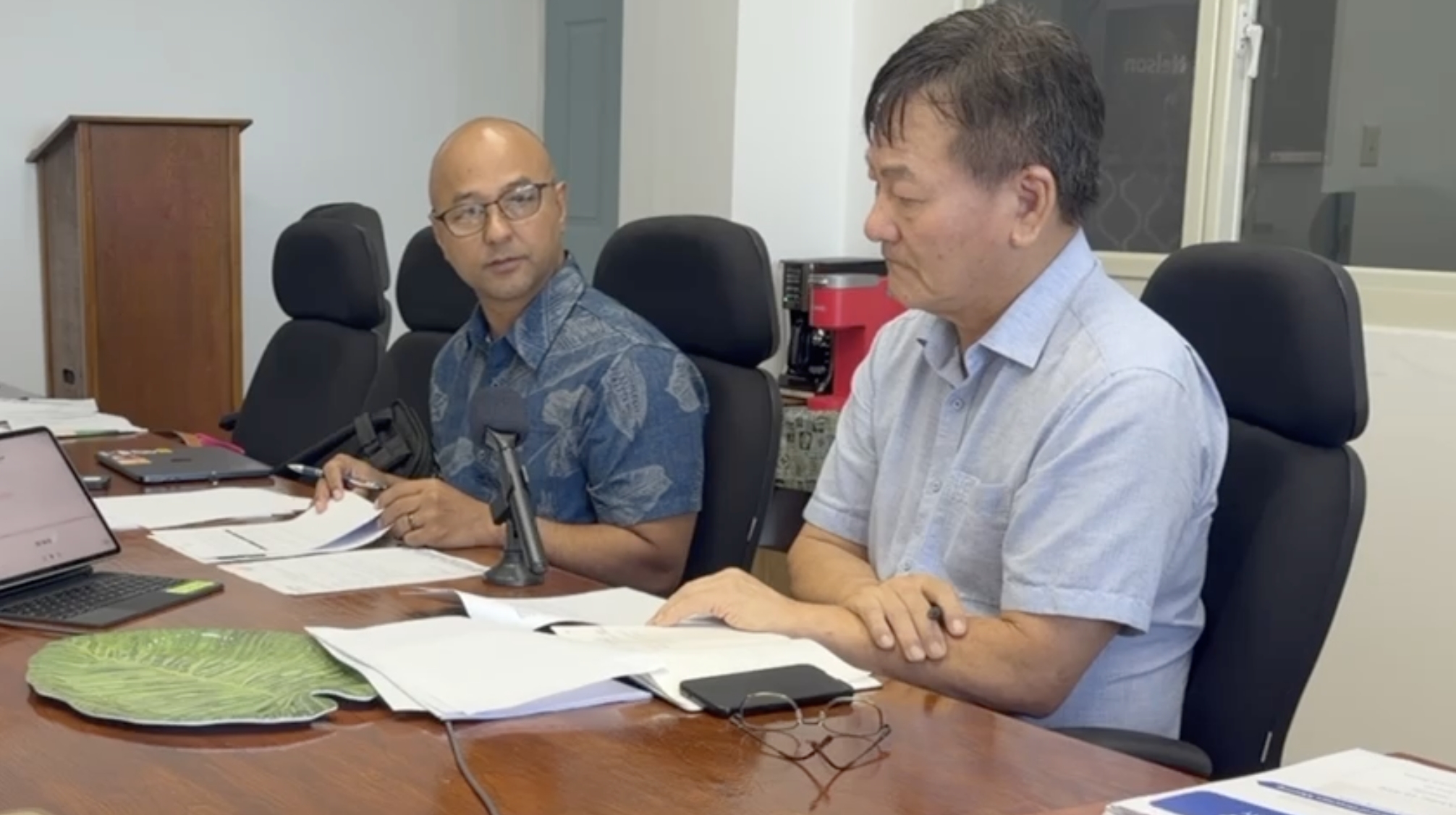
After Hinds completed his closing argument and asked the court to find probable cause on all six charges, public defender Robert McNeil submitted the matter to the court.
Rios is charged with DUI, assault and battery, second-degree murder, voluntary manslaughter, assault with a dangerous weapon, and aggravated assault and battery.
Editor’s note: If you or someone you know has experienced domestic or sexual violence, you are not alone. Support is available through the 24/7 Karidat Victim Hotline at (670) 234-5100 or the 24/7 Karidat Sexual Assault Helpline at (670) 838-7233.
Share this article: