PCIS Forum Balances U.S. - China Geopolitics with Micronesian Human Security
As the United States and China intensify their strategic competition across the Western Pacific, Micronesia has increasingly become the focal point of military war-gaming and defense buildup—a reality that regional scholars, diplomats, and defense analysts say demands a new approach to island security that prioritizes local consent, environmental protection, and indigenous sovereignty alongside traditional defense.
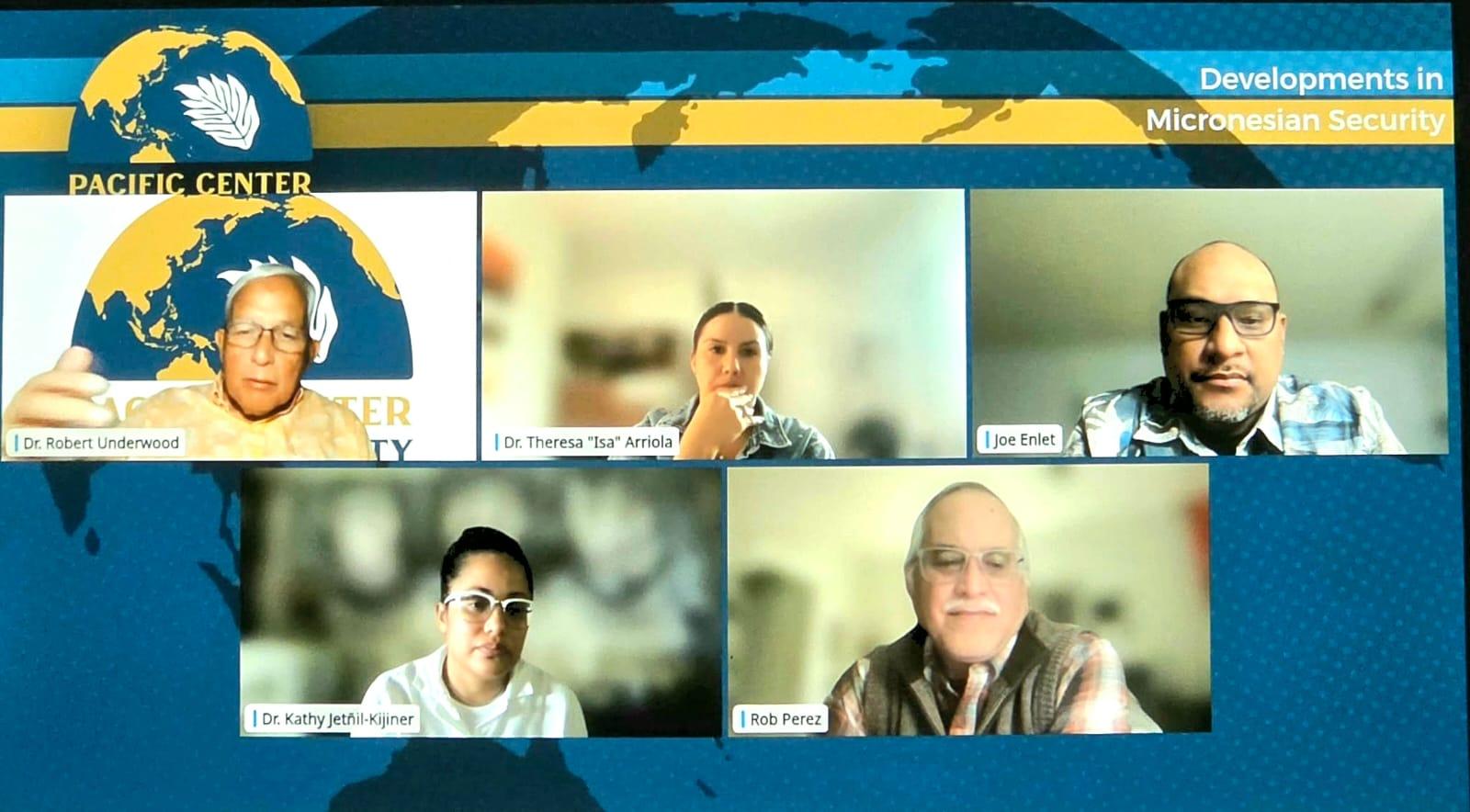
During a virtual forum hosted by the Guam-based Pacific Center for Island Security (PCIS) on October 23, international strategists and Micronesian voices gathered to examine both sides of this geopolitical equation: what drives superpower military posturing across the First and Second Island Chains, and how island communities are navigating a rapid wave of federal initiatives ranging from deep-sea mining and mobile nuclear reactors to multi-billion-dollar base expansions.
Moderated by PCIS’s Dr. Kenneth Kuper and opened by Chairman Dr. Robert Underwood, a former Guam congressional delegate, the webinar sought to anchor an islander perspective at the center of policy debates that are too often held in Washington or Beijing without local participation.
In his opening remarks, Dr. Underwood challenged regional policymakers to abandon what he described as a "nostalgic" 20th-century view of American power. He noted that elected officials in U.S. territories like Guam and the CNMI, as well as in the Compact of Free Association (COFA) states, frequently shy away from foreign policy in electoral politics, defaulting to a pro-status-quo stance even as global dynamics shift toward a multipolar reality.
"We are living in a multipolar world in which military strength or military spending cannot affect everything—they cannot be the solution for everything," Underwood said. True regional stability, he argued, requires a coherent diplomatic and economic strategy rather than military flexing alone, particularly at a time when long-standing alliances and international norms are being re-evaluated by both Beijing and Washington.
To set the regional stage, the forum paired two contrasting international strategic analyses: the expansion of Chinese asymmetric operations and the potential for long-term U.S. military retrenchment.
Dr. Benjamin Blandin, a visiting research fellow at the Institute for National Defense and Security Research in Taiwan, presented a comprehensive mapping of China’s asymmetric and "gray-zone" activities over the past decade. Blandin detailed how Beijing has reinforced its stretched high-seas naval fleet by militarizing the China Coast Guard and deploying thousands of maritime militia and civilian auxiliary vessels—including research ships, long-haul fishing fleets, decommissioned oil rigs, and dual-use ocean buoys equipped with underwater sensors.
These assets are increasingly operating along the First Island Chain and moving into the wider Pacific to conduct hydrographic mapping for submarine warfare, gather intelligence, and monitor subsea telecommunications cables without notifying local island authorities. While Blandin noted that Chinese-funded ports and airstrips in the South Pacific are too small to pose a direct military basing threat, he warned that Beijing systematically uses hospital ships, policing agreements, and infrastructure aid to shift diplomatic allegiances and United Nations voting patterns.
Offering a different view on Washington’s trajectory, Dr. Jennifer Kavanagh, a defense scholar whose recent paper for Defense Priorities has sparked widespread debate in foreign policy circles, argued that the United States is heading toward an inevitable military pullback. Pointing to the ongoing conflict with Iran, Kavanagh said the past eight months have exposed serious U.S. military vulnerabilities, including shallow munition stockpiles and the fragility of fixed overseas bases against modern missile and drone barrages.
Combined with a $40 trillion U.S. national debt and a generational shift among American voters weary of foreign entanglements, Kavanagh predicted that Washington will gradually retrench from the First Island Chain and consolidate its defense perimeter along the Second Island Chain—which runs directly through the Marianas, Yap, and Palau.
"Pulling back to the Second Island Chain would create physical space between the United States and China, radically reducing the risk of war," Kavanagh said. However, she cautioned that this shift carries mixed consequences for Micronesia: in the near term, it will bring heightened military construction, economic spending, and environmental strain to the islands; in the longer term, U.S. fiscal pressures could lead to cuts in social services, non-military infrastructure, and climate adaptation funding across the region.
At the heart of the forum were four presentations by Micronesian researchers and practitioners who examined how these macro-level defense strategies directly impact island governance, resources, and community health.
Deep-Sea Mining in the Marianas: Dr. Theresa "Isa" Arriola, a Saipan-born sociocultural anthropologist, Director of Operations at Blue Ocean Law, and chair of the community advocacy group Our Commonwealth 670, examined how deep-sea mining (DSM) has been folded into U.S. national security strategy. Citing 2025 presidential executive orders—including EO 14285, which links offshore critical minerals and "virtual stockpiling" to defense supply chains and competition with China—Arriola traced how the federal Marine Minerals Administration (formerly BOEM) rapidly doubled its proposed lease area around the Mariana Trench from 35.5 million to 69.1 million acres ahead of a scheduled December lease sale.
Arriola highlighted widespread pushback across the Marianas, including demands for comprehensive studies from all four CNMI mayors, Guam’s passage of Public Law 38-129 banning seabed extraction in territorial waters, and a federal lawsuit challenging the adequacy of endangered species reviews. Addressing legislative proposals like CNMI Delegate Kimberlyn King-Hinds’ Pacific Minerals Economic Security Act (PACMESA) to share federal leasing revenues, Arriola stressed that uncertain royalties do not equate to economic sovereignty or local decision-making power. "An archipelago is not a stockpile," she said.
Military Posture and Customary Consent in the FSM: Joe Enlet, a former FSM Consul General and marine affairs researcher from Chuuk, analyzed the legal fine print of the renewed Compact of Free Association and the Military Use and Operating Rights Agreement. Enlet highlighted a key legal tension: while U.S. officials often describe "strategic denial" as covering the FSM’s entire 200-mile Exclusive Economic Zone, the Compact and the UN Convention on the Law of the Sea limit sovereign territorial waters to 12 miles.
Addressing the planned $2 billion U.S. military buildup in Yap and recent friction over the FSM’s request for a $1.3 billion compensation package, Enlet emphasized that government-to-government payments do not replace the free, prior, and informed consent of traditional clan landholders. Grounding his recommendations in the Chuukese concept of tumwun (holistic care and protection of people, land, and sea), Enlet argued that genuine security requires funding judicial independence and anti-corruption mechanisms, establishing digital data sovereignty, and cleaning up leaking World War II shipwrecks in Chuuk Lagoon.
Environmental Degradation on Guam: Veteran investigative journalist Rob Perez detailed the ecological and human health costs of historic and contemporary military operations on Guam. Pointing to the U.S. Supreme Court battle over open-air munitions detonations at Tarague Beach and the contamination of Yigo’s Y-15 drinking water well with the banned carcinogenic pesticide dieldrin—where residents went 17 years without a public emergency advisory despite repeated detections—Perez illustrated a long-standing pattern of toxic exposure.
Nearly three-quarters of the 114 toxic waste sites identified on Guam in a 2007 federal study were linked to military lands, Perez noted, alongside lingering PCB contamination in Malesso, uncompensated radiation fallout, and the clearing of over 2,200 acres of limestone forest for Camp Blaz and the planned 16-site missile defense system. In a statement provided to Perez, Joint Task Force-Micronesia stated that the military works closely with regulatory agencies to meet environmental standards, pointing to a $122 million upgrade to Guam’s Northern District Wastewater Treatment Plant, forest enhancement initiatives, and the relocation of more than 7,200 coral colonies in Apra Harbor.
Small Modular Nuclear Reactors: Dr. Kathy Jetñil-Kijiner, Climate Change Envoy for the Republic of the Marshall Islands (RMI), examined the federal and international campaign to deploy Small Modular Reactors (SMRs) and microreactors in the Pacific. Driven by Executive Order 14299, the U.S. Army’s "Project Janus," and the Pentagon’s "FORTRESS" initiative to decouple military bases from civilian power grids—alongside surging AI energy demands—nuclear energy is increasingly marketed to island nations as a clean power source.
Jetñil-Kijiner pointed out that the push reached the CNMI through Senate Joint Resolution 24-05, which proposed studying advanced nuclear technologies for Saipan, Tinian, and Rota, drawing sharp opposition from CNMI Rep. Vicente Camacho Aldan over the islands' lack of emergency response capacity and typhoon vulnerability. Citing the Marshall Islands' painful legacy of U.S. nuclear testing and the vulnerable Runit Dome nuclear waste site, Jetñil-Kijiner argued that SMRs are too expensive, slow to build, and hazardous for small island grids compared to proven solar and wind renewables.
To help the public monitor these converging developments, PCIS board member Leland Bettis demonstrated the newly launched Micronesia Security Monitor (MSM). Supported by the Carnegie Corporation of New York and the Sasakawa Peace Foundation, the interactive online platform maps regional military exercises, missile ranges, base construction, and vessel tracks—revealing both Chinese research vessels surveying subsea cables near Guam and U.S. autonomous saildrones mapping seabed mineral zones around the Northern Marianas.
During the closing discussion—which included insights from PCIS Advisory Council member and H.E. Anote Tong—speakers reflected on how small island societies can exercise genuine leverage when power dynamics are stacked against them. Rather than falling into a dependency trap or passively accepting war planning as inevitable, the panelists concluded that Micronesia’s strongest defense lies in regional solidarity, investigative transparency, grassroots organizing, and active "peace planning"—asserting an indigenous definition of security that protects both the islands and the people who call them home.
Share this article: