Community advocates and protesters questioned the timing of the U.S. Air Force's public scoping meeting on Saipan last Nov. 18, saying the ongoing gubernatorial runoff campaign and limited public comment period could prevent residents from fully understanding and responding to proposed expanded military training in the CNMI.
Representatives of Right to Democracy, From Luta, For Luta, and Our Common Wealth 670 raised concerns during the meeting at Pacific Islands Club Saipan, just two days before Friday's gubernatorial runoff election.
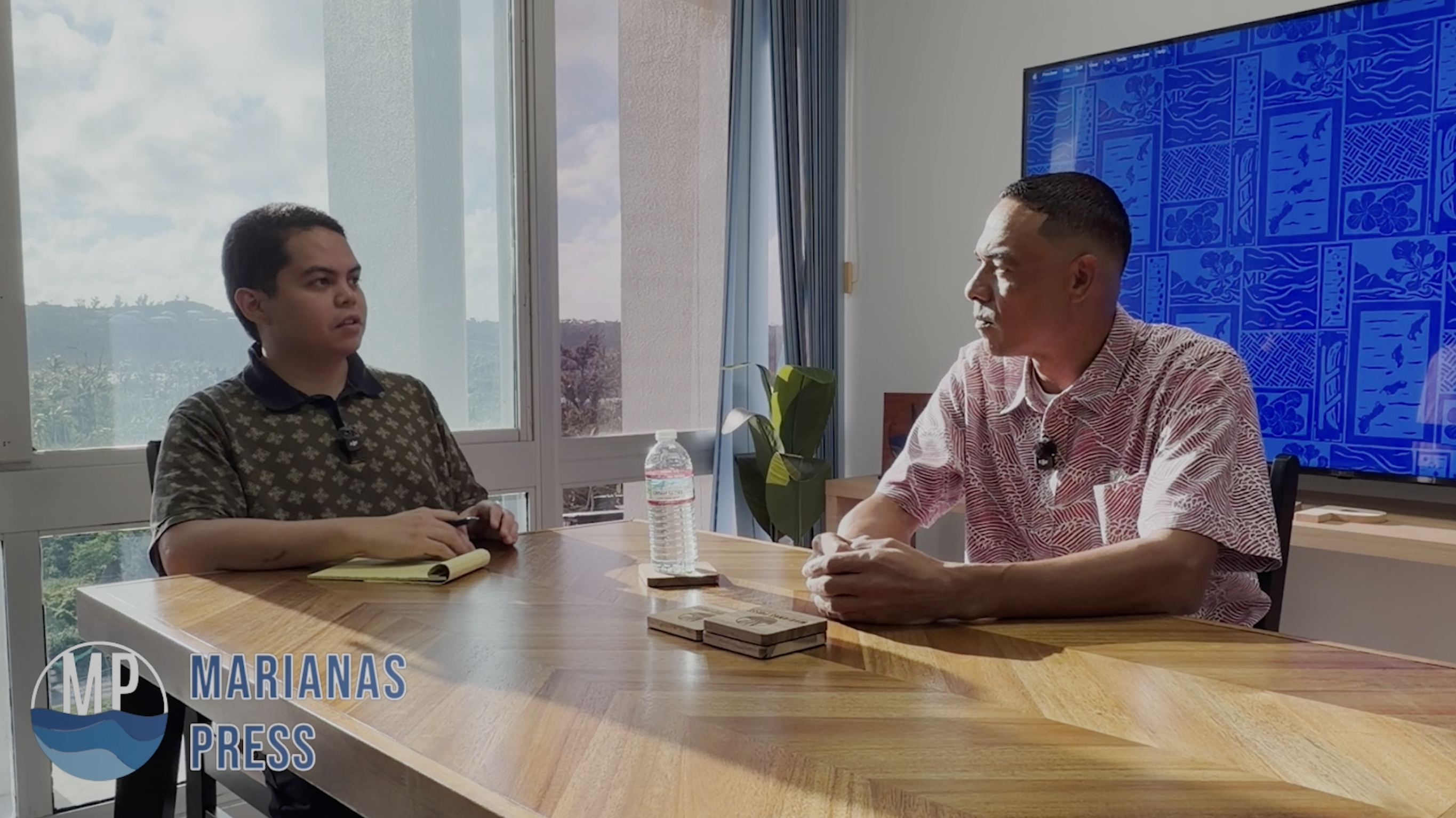
Adi Martinez-Roman, co-founder and co-director of Right to Democracy, said her organization rescheduled a community dialogue to allow more people to attend the Air Force meeting.
She said federal agencies should consider local circumstances when scheduling public consultations, particularly in communities already occupied with elections and other pressing concerns.
"Also, there is an election process that is going on in the community. So, people are distracted, but understandably so," Martinez-Roman told Marianas Press.
She also questioned whether the meeting's format, which required residents to examine information displayed on posters and approach officials individually, was sufficiently accessible.
"So, I just feel like there should be more accessibility and to ensure more participation of the people that are going to be the ones affected by all this," she said.
Zeno Camacho Deleon Guerrero Jr., solidarity director for Right to Democracy, echoed those concerns, saying residents should have a meaningful voice in federal decisions affecting their islands.
"The people of each territory, and in this case, the people of the CNMI, should and should have the opportunity to be meaningfully consulted in the decision-making process," he said.
Deleon Guerrero said the Air Force proposal should also be considered alongside other developments, including deep-sea mining and existing military activities, to better understand their combined effects on the community.
Catherine Atalig, an organizer with From Luta, For Luta who was also representing Our Common Wealth 670, said her group opposed further military expansion because of its potential environmental and social consequences.
"We're here to express our refusal of the hyper-militarization of our islands," Atalig told Marianas Press.
She said increased aircraft activity could affect wildlife, ecosystems, and communities, particularly on Rota, where residents have raised concerns about the island's native species.
Atalig and other advocates also distributed informational materials outside the meeting venue.
Pacific Air Forces public affairs specialist Tech. Sgt. Soo Kim, responding to criticism about scheduling the meeting during the runoff campaign, said he could not speculate on how the dates were selected.
"The intent of the public scoping engagement is to get the public's concerns and comments about the proposed actions," Kim told Marianas Press.
"The election, I cannot speak on that matter."
Kim encouraged residents to submit their concerns through the available channels before the Nov. 29 deadline, including online and by email.
Lt. Col. Onnie Retkofski of Pacific Air Forces, meanwhile, said the proposed activities would support changing Air Force training requirements, particularly its Agile Combat Employment concept, which involves operating from multiple locations.
"Our training needs have changed," Retkofski said.
She explained that the CNMI's four airfields would allow the Air Force to practice distributed operations, including activities involving humanitarian assistance and disaster relief.
Retkofski also addressed concerns about potential disruptions to civilian aviation, saying the Air Force would coordinate with commercial carriers.
"But we would always work with commercial flights and de-conflict from them so we do not disturb their operations," she said.
Asked whether the public scoping period could be extended, Retkofski said the matter was outside her authority.
"That's not something I can speak to. The (National Environmental Policy Act) process covers all that," she said, referring to the National Environmental Policy Act.
During the meeting, Catherine Atalig, Grace Choi, and Liza Atalig also delivered statements opposing further militarization of the Marianas.
Their remarks focused on potential aircraft noise, fuel contamination, threats to native wildlife, and the cumulative effects of military activities on communities still recovering from successive typhoons. All three urged consideration of the no-action alternative.
The protesters spoke during the open-house event, which featured informational displays or storyboards and Air Force representatives answering questions rather than a formal public hearing.
The Air Force is proposing expanded training at Saipan International Airport, Tinian International Airport, Tinian North Field, and Rota International Airport.
Under the proposal, each airfield could accommodate up to 1,200 fixed-wing aircraft operations and 320 helicopter operations annually, with up to 1,000 military personnel supporting the exercises. Aircraft operations refer to takeoffs and landings, not individual aircraft.
Our Common Wealth 670 previously called for extending the initial 30-day public scoping period to at least 60 days to allow residents more time to evaluate the proposal.
Additional public meetings are scheduled for Nov. 19 at Tinian Western Lodge and Nov. 21 at the Rota Mayor's Office.
Residents can submit comments through Nov. 29 at www.CATEEIS.com or PACAF.NEPA.CATEEIS@us.af.mil.
The Air Force expects to release its draft environmental impact statement in fall 2027 and the final version in summer 2028. No final decision has been made on the proposed activities.
Share this article: