With a strategic focus on household waste sorting and recycling to cut landfill volume by 50 percent by 2030, the Municipality of Tinian and Aguiguan, the Office of Planning and Development (OPD), and the Department of Public Works (DPW) are preparing to implement a new solid waste tipping fee schedule slated for early January 2027. During the town hall meeting on October 30, officials outlined the upcoming disposal rates under the CNMI Solid Waste Collection and Disposal Regulations (NMIAC § 155-30.1) and emphasized how residents can significantly lower their trash bills by sorting recyclables at home.
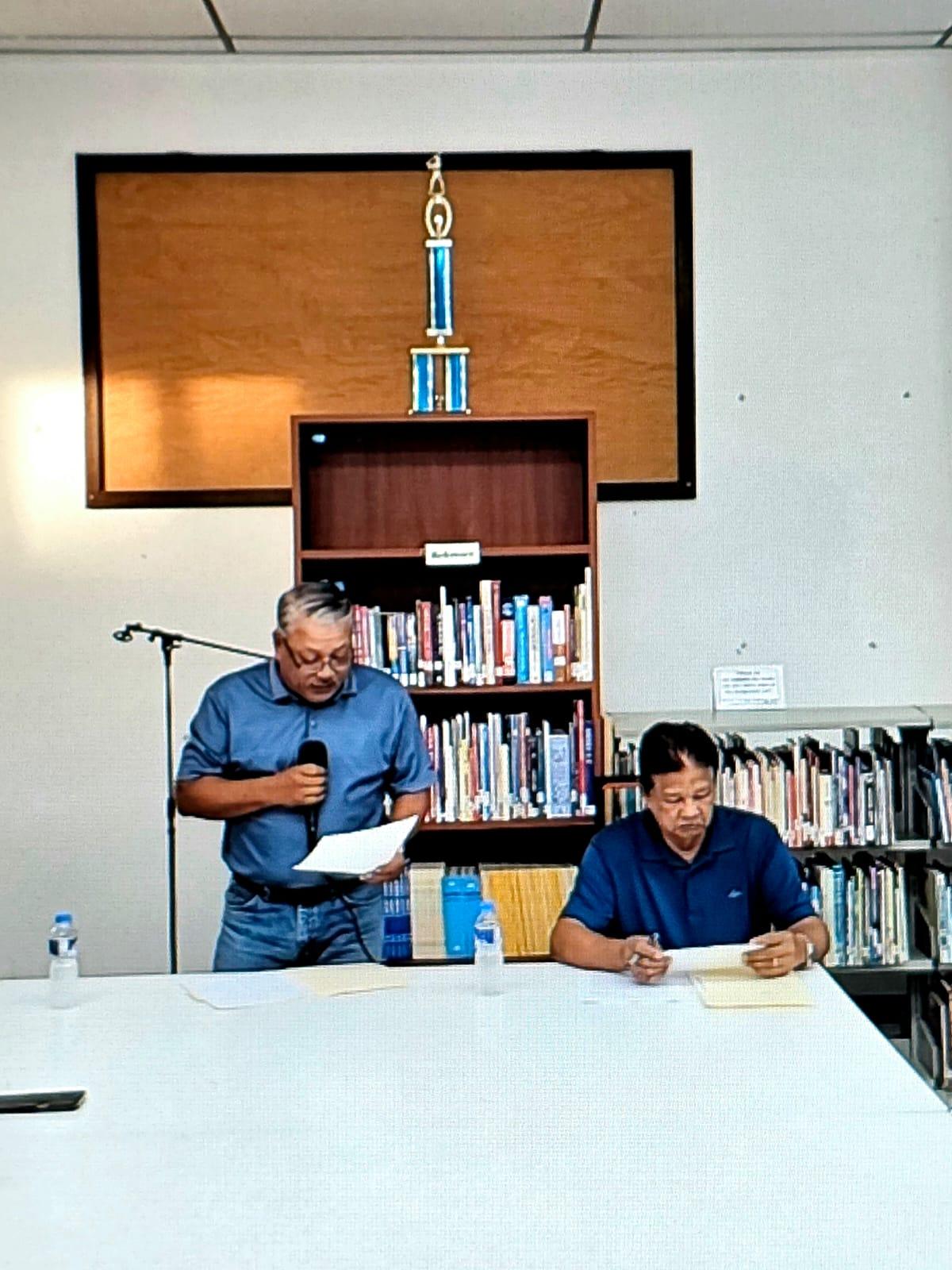
The town hall brought together Tinian Mayor Edwin P. Aldan, Tinian Legislative Delegation Chairman Sen. Jude U. Hofschneider, OPD Solid Waste Project Coordinator William Cing, DPW Resident Director Joal Untalan, Solid Waste Branch Manager Ray Lazaro, and Landfill Supervisor Ray Pangelinan to walk residents, business owners, and government agencies through the new fee structure and the financial realities of operating a compliant waste facility.
“I know that the topic of a tipping fee does not sit well with our community and our residents given all these economic crises that we're facing, a lot of super typhoons, a lot of costs in repairs, and trying to get our lives back," Cing acknowledged. "I know that is not a very popular topic but let me give you some good news."
While Tinian secured crucial federal grants from the U.S. Environmental Protection Agency (EPA) under the Additional Supplemental Appropriations for Disaster Relief Act (ASADRA) and Solid Waste Infrastructure for Recycling (SWIFR) programs to close the unpermitted Puntan Diablo dump, renovate the Transfer Station, and build a small community exempt landfill, the EPA requires the island's waste operations to become financially self-sustaining. Revenue from the tipping fees will remain earmarked for Tinian's solid waste operations to fund ongoing equipment repairs, fuel, maintenance, and staffing.
"I want to stress that the tipping fee is not for Solid Waste to make a profit," Cing emphasized. "It is to stay sustainable for their operation so that they continue serving the public in managing waste on our island."
Opening the discussion, Mayor Aldan noted that maintaining essential sanitation services requires a careful balance between operational funding and community affordability.
"At the same time, we recognize that any proposed changes may affect our residents and businesses differently," Aldan told attendees. "It is important that we take the time to listen and consider the needs of our community. ... Our goal is to maintain a clean, safe, and healthy island while being mindful of the needs and circumstances of all residents and businesses."
Sen. Hofschneider also addressed the crowd, thanking the DPW solid waste crew and federal partners while emphasizing the importance of preparing residents ahead of the fee rollout.
"We're here this evening to hear out the proposal—one of the elements of the solid waste management system that we're going to employ moving forward—and it's important that the community is informed so that they can be better prepared," Hofschneider said.
Under the new operational procedures targeted for early January, the active landfill site will close to private vehicles. All residents, businesses, and government agencies—which will be billed as commercial haulers under the regulation—will bring their loads exclusively to the renovated Transfer Station tipping floor to be assessed and paid for before disposal.
Crucially, officials highlighted a major financial relief measure for households: all sorted recyclables and green waste will be accepted at the Transfer Station completely free of charge. Residents will only pay tipping fees on unsorted municipal solid waste destined for the landfill.
"You're going to be charged $37.50 per ton, [or] if you sort it, your plastic bottles, aluminum cans, and green waste are free," Lazaro told the crowd.
Until the Transfer Station's new commercial truck scale is fully installed—which will set standard weight-based rates at $37.50 per ton for municipal solid waste and $70 per ton for construction and demolition (C&D) debris, special waste, and commercial garments—tipping fees will be calculated by volume.
Walking attendees through the volumetric fee schedule, Lazaro explained that residential trash brought in 55-gallon drums (roughly one-third of a cubic yard each) will cost a flat $3.00 for one to three drums, $7.50 for four to six drums, $15.00 for seven to eight drums, and $7.50 for every two drums thereafter. Pickup trucks and passenger vehicles will be charged $3.00 for loads under one cubic yard, $7.50 for one to two cubic yards, and $15.00 for two to four cubic yards. Drivers can estimate their cubic yardage by multiplying the length, width, and height of their load in feet and dividing by 27 or have station attendants measure the load upon arrival.
For larger residential or commercial loads, flatbed trailers or overloaded pickup trucks will be billed $15.00 for under three cubic yards, $18.50 for three to five cubic yards, and $37.50 for five to eight cubic yards, while larger dumpsters and commercial trucks will scale up based on capacity. Construction and demolition debris brought in 55-gallon drums will start at $8.00 for three drums or fewer, or $8.00 for passenger vehicle loads under one cubic yard, and $28.00 for flatbed trailers under three cubic yards.
Special disposal fees will also apply to hard-to-manage items. Tires off the rim measuring under 22.5 inches will cost $2.50 each ($5.50 on the rim), larger truck tires measuring 22.5 inches or more will cost $8.00 off the rim ($15.00 on the rim), and heavy equipment tires will cost $75.00. Electronic waste such as computer monitors and televisions will carry a $25.00 fee, while fluorescent tube lights will cost $1.00 to $2.00 depending on length. Large household appliances—including air conditioners, refrigerators, washers, dryers, and water heaters—will be charged $25.00 per unit, plus a $10.00 special handling fee and a required certification letter from a licensed technician confirming that all refrigerant has been evacuated. Additionally, residents can avoid disposal fees on usable furniture, building materials, and clothing by donating them to the station's upcoming Community Reuse Center.
According to a Zero Waste study conducted on Tinian, recyclable materials like cardboard, cans, plastics, and yard debris make up a massive share of household trash. By separating those items at home, families can drastically reduce how often they pay to tip.
"Three or four containers at the house—one labeled plastic, one labeled can, one labeled paper—and it will be a lot easier for people to tip at the transfer station if you sort," Cing said. "Right now, one to three drums for $3.00 is not that much, but if you do those three or four times a month, that can add up. If you sort, you'll probably fill one drum, and it'll take you probably a month before you visit the tipping floor. So, the more you sort at the house and recycle things, the less that you're going to have to pay."
Keeping landfill volume down through tipping fee incentives is also essential to preserving Tinian's status as a small community exempt landfill.
"As long as we stay below the 20 tons per day, we will remain a small community exempt landfill, and what that means is it's going to be a lot cheaper than running a full RCRA-compliant landfill," Cing explained, noting that exceeding 20 tons per day would trigger millions of dollars in federal mandates that would ultimately drive costs higher. "Puntan Diablo is a nice area, and when we finally close that, we'd like to keep it—not like the Puerto Rico dump mountain—we want to keep it at least six or seven feet at the highest point from 8th Avenue looking at the ocean. That is why the Sustainable Development Plan that was created at the start of all these projects came out with a challenge for all of us—a goal that by 2030, we should be reducing what goes into Puntan Diablo by 50 percent."
To help families prepare for the fee rollout, Cing and Lazaro are launching an educational campaign across Tinian's elementary, middle, and high schools ahead of a November 12 visit from EPA Region 9 officials and mid-November's CNMI Recycles Week and America Recycles Day. Meanwhile, illegal dumping restrictions will be strictly enforced by the Bureau of Environmental and Coastal Quality (BECQ).
"This is not the time to be asking people to pay for their trash, pay for more electricity, pay for higher costs of food—but it's something that we must do," Cing concluded. "It's our island, it's our Commonwealth. We need to protect our environment, our ocean, our water by managing waste correctly. ... Sooner or later, it's going to be automatic."
Share this article: