Tinian residents warn CNMI risks becoming ‘sacrifice zone’ at seabed mining town hall
Deborah Fleming of the Tinian Women’s Association warned that deep-seabed mining poses irreversible threats to Pacific ecosystems, cultures, and food security, while Richard Farrell cautioned that the CNMI risks once again becoming a federal ‘sacrifice zone,’ during a Bureau of Ocean Energy Management town hall on Tinian last week.
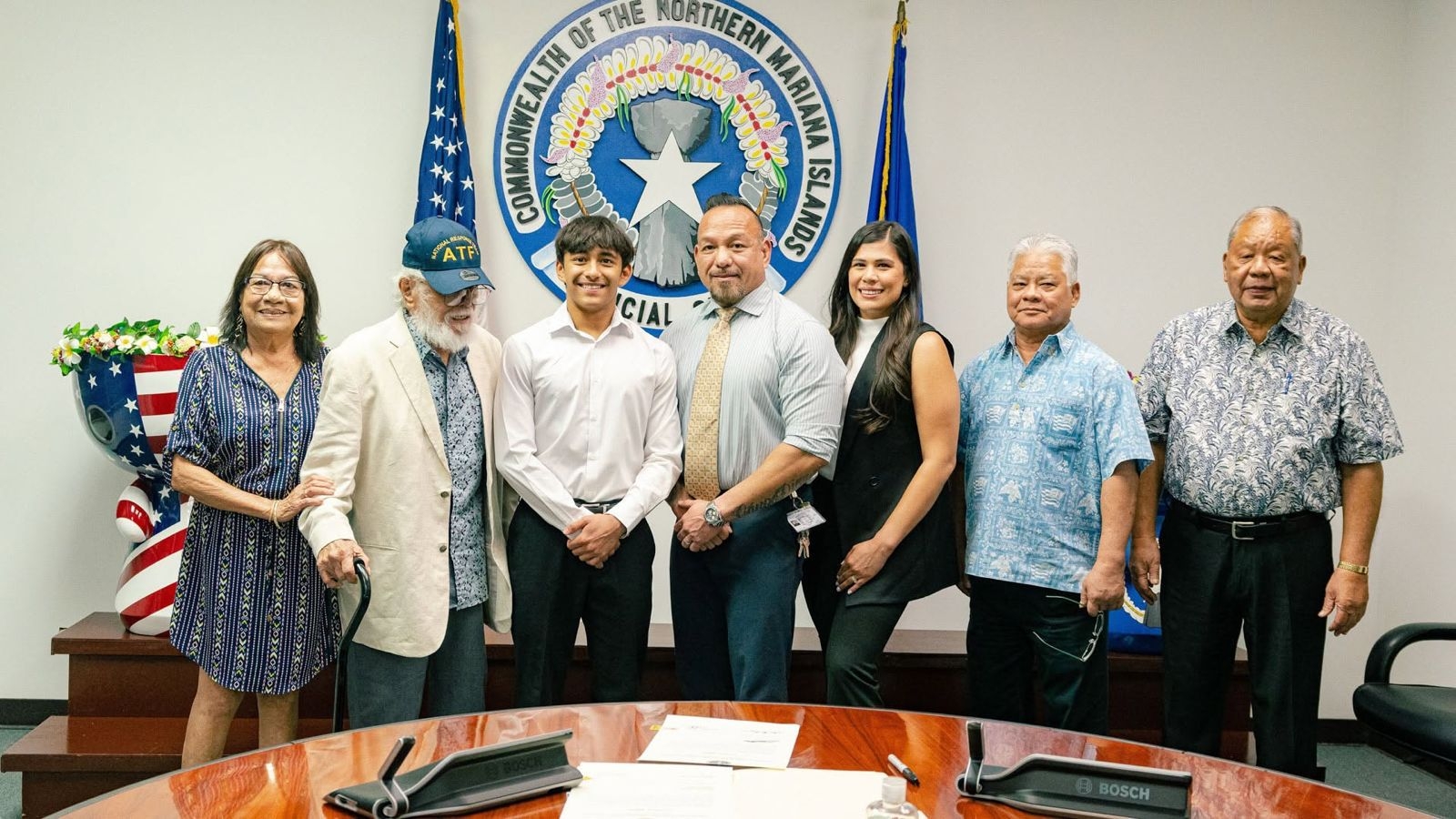
Speaking at BOEM’s public meeting on its request for information on seabed mineral leasing at the Tinian Conference Center–Bar-K Diner on Jan. 9, Fleming delivered a forceful denunciation of deep-sea mining, framing it within the region’s long history of environmental and military harm imposed in the name of U.S. interests.
“Deep-seabed mining presents profound and irreversible risks to fragile marine ecosystems, cultural heritage, regional stability, and long-term health and security of Pacific communities. It is important that these risks shall not be viewed in isolation. The Pacific region has already endured a cumulative burden of environmental and military harms from nuclear fallout in the Marshall Islands to the release of treated nuclear wastewater in the Pacific Ocean, to continued military buildup on and around U.S. territories,” she said.
Fleming said that given the irreversible ecological damage, federal agencies should reject any permanent licenses or authorizations for deep-seabed mining in U.S. territories and associated waters, and establish a moratorium or outright prohibition until comprehensive independent science demonstrates that mining can be conducted without harm.
Farrell said the push for seabed mining followed a familiar federal pattern in which risks are borne locally while benefits flow elsewhere, warning that the CNMI could again be left with lasting damage and little return.
“If BOEM allows an Australian investor to proceed with the seabed mining despite local opposition, then the people of the CNMI must demand nothing less than heaven on earth in return for what history tells us will otherwise be taken without adequate return. The people of the CNMI have seen this story before. We've been told that federal projects will bring opportunities, stability, and progress, only to be left with lost dependency and diminished control over our own future,” he said.
In the end, Farrell said extracted resources will not remain in the CNMI, and the profits will not stay in the Commonwealth.
“The decision-making authority will not rest with the CNMI. What will remain are the risks, damage to marine ecosystems, disruptive fisheries, cultural loss, and permanent uncertainty about the health of our waters. Once again, the CNMI is positioned as a sacrifice zone for national and private interests,” he said.
Jose M. Dela Cruz, chairman of the Soil Water Conservation District and president of the Tinian Cattlemen’s Association, voiced opposition to seabed mineral mining, warning it could cause severe and irreversible harm to marine species and fragile island environments.
“We have sacrificed two-thirds of our island that actually directly impacts our Cattlemen's Association at this point in time. We want to expand to the point where we can develop a better beef industry, but with the limited land area that we have, we are pretty much struggling to get that thing through.”
While acknowledging that the federal government appears determined to move forward as part of its push to secure rare earth minerals, Dela Cruz called for full transparency, meaningful local participation from the outset, and assurances that there is no hidden agenda.
“If something goes wrong, we're going to be left with, possibly, destruction that cannot be resolved in an appropriate manner. I know that the federal government is doing this under this administration because of the war on rare earth minerals. And they're trying their very best to be competitive with, particularly, China, of course.”
Dela Cruz also said he was surprised the Mariana Trench area was being considered at all, noting he had believed it would remain protected, and stressed that island communities must be included in decision-making at every stage of the process.
Tinian Mayor Edwin Aldan criticized what he described as inadequate consultation and said island communities could not afford long-term damage to marine resources that sustain future generations.
“I'm opposed to this venture of the federal agency not really coming to our island and really sitting down with us. They do understand that we're not that gullible, although we are poor at this time, but at least talk to us about some kind of benefits that we can get out of this. This benefit is going to go to the federal government, why not the Commonwealth?” he asked.
Sen. Jude Hofschneider said he could not support the proposal given the limited information and compressed timeline, questioning both the environmental risks and the tangible benefits to the CNMI.
He said that since the 1960s, the people of Tinian have repeatedly been told that projects were necessary “because of the interest of national security,” a justification he said is again being raised in connection with deep-seabed mining.
“Respectfully, in the interest of national security, we gave up two-thirds of Tinian. And again, we're being presented with this proposal by BOEM. I respectfully request that I register my opposition at this juncture because of the lack of information that my people, our people, have. To further understand the validity of this, especially the environmental impact. Because we rely on the ocean a lot,” he said.
Joanne Merrick raised concerns about geological instability, citing the region’s seamounts and its location along the Pacific Ring of Fire.
“It's upsetting to me that man has to go and suck the life out of a beautiful place like the Trench and all the wonderful life that is down there that we're just finding out about, but not destroying it. And this machinery that they take down there, you can't tell me that it's not going to disrupt everything that's there, all the life that's there. And if they're stirring that toxic material, we have enough metals in our fish today without having that kind of thing,” she said.
Drawing on her experience aboard deep-sea research expeditions, including within the Mariana Trench Marine National Monument, Amanda Dedicatoria, a board member of the Micronesia Climate Change Alliance and a Guam-based science communicator, described seamounts and undersea volcanoes as ancient “ocean engineers” that regulate currents, concentrate nutrients, and sustain fish populations relied upon by island communities.
“Those currents go toward the mountain, and all of that water goes around the mountain and over it, and those currents are full of nutrients, of plankton, of detritus, that the fish eat, the very fish. It nourishes the very fish that our communities eat, that sustains us, that makes us able to live the lives that we live. That ferromanganese crust takes millions of years to form, with a growth rate of around a millimeter; a millimeter of growth takes around a million years,” she said.
With roughly 150 seamounts located within BOEM’s request-for-interest area—among the world’s oldest and densest systems—Dedicatoria said seabed mining could destroy coral-rich habitats and generate toxic sediment plumes containing heavy metals that could spread through ocean currents and contaminate fisheries.
In closing remarks, Gov. David M. Apatang’s chief of staff, Henry Hofschneider, said the push for seabed minerals must be viewed through the lens of national security under President Donald Trump.
He cited Trump’s executive order prioritizing domestic supplies of critical minerals and reducing U.S. dependence on foreign sources amid growing global competition. While acknowledging strong local opposition, Hofschneider said the administration believes the process cannot be stopped outright but could be slowed, adding that public comments would inform discussions with BOEM and requests for additional consultations and deadline extensions.
Bureau of Environmental and Coastal Quality Administrator Floyd Masga, who facilitated the event, said comments from the CNMI town halls would be transcribed and submitted before the Jan. 11 deadline, reiterating that the current phase is strictly information-gathering and does not authorize mining.
Share this article: