Up to 400 government workers could face furloughs under one of the administration’s proposed fiscal year 2027 budget scenarios as the CNMI government tries to keep more employees on a 64-hour biweekly work schedule despite sharply lower revenues.
Meanwhile, the administration of Gov. David M. Apatang projects it will need $11.8 million to fund retirees’ additional 25% pension payments in FY 2027, an obligation that is essentially unfunded under the two budget scenarios presented to lawmakers Friday.
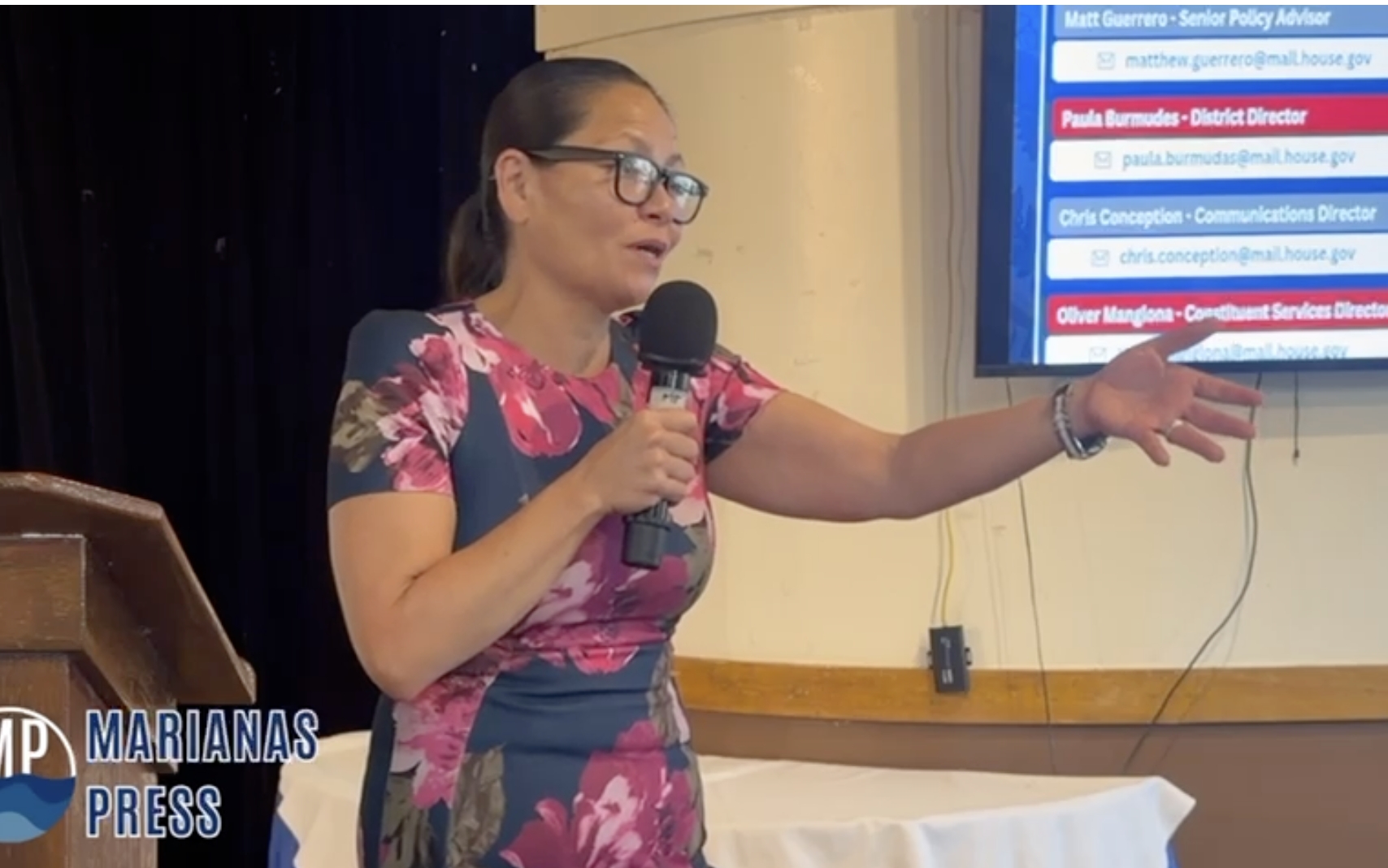
The figures emerged during the House Ways and Means Committee’s FY 2027 budget hearing last Aug. 14 with Finance Secretary Tracy Norita, Office of Management and Budget special assistant Vicky Villagomez, and other administration officials.
The administration presented lawmakers with two options for dealing with the government’s worsening fiscal situation.
Under the first scenario, the government would avoid furloughs but keep employees on a 40-hour biweekly work schedule. The plan would make proportionate reductions to several programs, including the Government Health and Life Insurance for retirees, CNMI Medicaid, CNMI Office of Youth Affairs, and the CNMI Scholarship Office.
The second, priority-based scenario would protect constitutionally mandated and critical programs and maintain a 64-hour biweekly work schedule, but would require hundreds of furloughs.
Asked by Ways and Means Committee chair Rep. J.P. Sablan how many employees could be affected under the second scenario, Jazmin Camacho, senior financial analyst at OMB said, “It would be a range estimated between 200 to 400 to meet the dollar amount that needs to be reduced.”
The estimate is part of a proposed budget scenario and does not represent a final decision to furlough 200 to 400 employees.
Administration officials said they have been working with the Civil Service Commission on how furloughs would be implemented. Two sets of regulations—emergency regulations and permanent amendments—were under review by the Office of the Attorney General at the time of the hearing.
The administration’s revised budget plan is built around significantly lower revenue expectations. Finance said the FY 2027 forecast began with $172 million in actual FY 2025 collections as its baseline, then removed nonrecurring revenues, adjusted for permanent business closures and reduced tourism-related revenues because visitor arrivals and air service remain below historical levels. That process initially resulted in $101.9 million available for appropriation.
The administration later applied an additional reduction to account for economic uncertainty following super typhoons Sinlaku and Bavi.
The choices facing government employees come as retirees also face uncertainty over their additional 25% pension payments next fiscal year.
During the hearing, lawmakers noted that the retirees’ 25% is carried at only a nominal $1 under one scenario and is unfunded under the other.
Asked how much would actually be required to make the 25% payments in FY 2027, Norita said the estimate is based on the current fiscal year.
“Chair, based on FY26 payments, our projected amount that's needed for the 25% is $11.8 million,” Norita said.
The $11.8 million is separate from the government’s remaining shortfall for retirees’ 25% payments in the current fiscal year.
Norita said Apatang recently signed Public Law 24-34 providing additional funding, but only $1.6 million of the $2.1 million appropriation went toward the retirees’ 25%, while the remainder went to the Public School System.
Finance said $2.6 million had been needed for the 25%, leaving the government short by a little less than $1 million.
Asked whether the administration was still looking for money to cover the remainder of the obligation through the end of September, Norita confirmed it was.
The administration and lawmakers must now decide how to close the FY 2027 funding gap while balancing employee work hours, potential furloughs, retirees’ benefits and other government obligations.
No final decision on the proposed furloughs has been made as the House Ways and Means recessed to allow Finance and OMB to gather more information.
Share this article: