When Disaster Aid Is Misspent, the Tax Bill Is Only the Beginning
By Jeremy Taitano, Azarvand Tax Law
The Marianas knows catastrophic storms. It also knows that what follows them is millions in federal disaster aid that can rebuild a community or, without careful oversight, end up lining the wrong pockets.
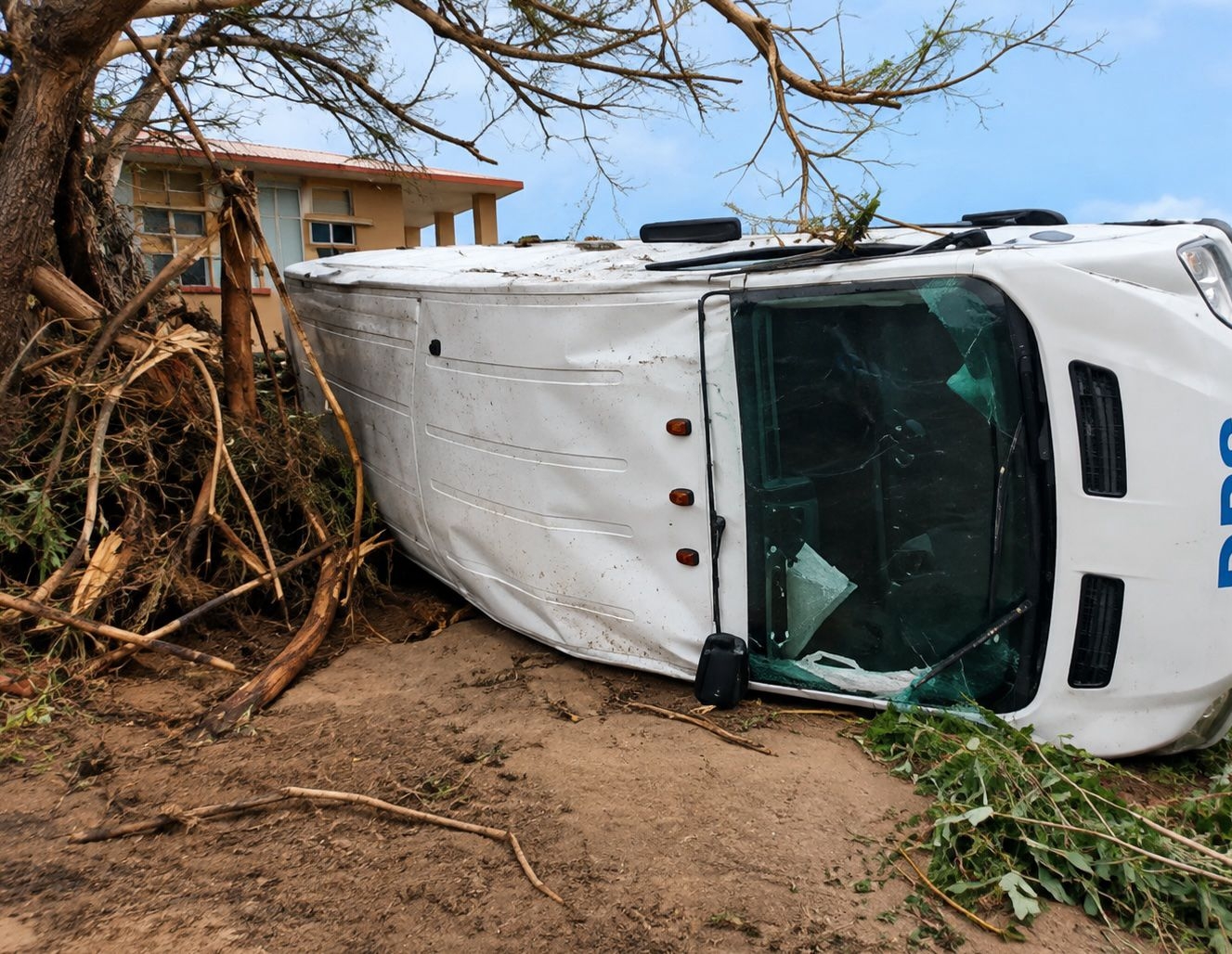
The Marianas survived yet another havoc-wreaking typhoon, just over three months after the last. Super Typhoon Sinlaku struck Saipan and Tinian in April, and Super Typhoon Bavi devastated Rota in July. In October, Super Typhoon Champi blew through the Marianas and struck Guam with force.
However, the Marianas is not out of the woods yet, with forecasts expecting that the strengthening El Niño, which federal forecasters expect to become very strong this fall and winter, will attract more devastating storms throughout the rest of the year and into 2027. More storms mean more repair work. More repair work means more federal recovery dollars moving through local contractors to local crews. The tax and federal claims reporting that comes with those dollars applies to everyone who accepts them in the CNMI, Guam, and anywhere else federal recovery dollars are spent.
In Part I of this series, we followed a hypothetical crew on a FEMA-funded recovery job to show how underpaying workers can create tax, wage, and False Claims Act problems for a contractor.
Part II looks at that same crew from two other angles: what a worker can do after discovering they were shorted, and what a contractor receiving federal grant money can do to fix its practices before anyone files anything.
I. A Short Recap for Contractors
The rules from Part I have not changed. The Fair Labor Standards Act fully applies to FEMA-funded work, including minimum wage and overtime at one and one-half times the regular rate for every hour worked beyond 40 hours. That means workers must be paid time and a half starting with the 41st hour of the week. This pay, plus the tax obligations that accompany wages paid, is obligatory for any contractor receiving federal money. On contracts over $100,000 that use laborers or mechanics, the Contract Work Hours and Safety Standards Act adds its own overtime guarantee. The wage terms written into a FEMA-funded contract are a promise to the federal government, and failing to deliver on that promise has consequences.
A contractor still billing FEMA-funded work should be extremely mindful of how billing works. Most contractors never invoice Washington, D.C. Instead, they bill the local government, which pays the contractor with federal money. Under the False Claims Act, a request for payment to a grantee can still count as a “claim” when the local government uses federal funds to pay contractors. In practice, every invoice for labor on a recovery job may be treated as a claim to the federal government about what services federal dollars paid for.
To stay in compliance, reconcile three records each pay period: hours billed, hours actually worked, and wages actually paid. Keep those records clean, because they are your best protection in an audit. Review the contract's wage terms before the crew starts work.
Treat FEMA money received as taxable business income. If you find a hole where you have underreported wages and taxes, fix it early. Remember that you must pay FICA tax on the wages your crew earns from the recovery dollars, and that amount depends on accurate reporting of the wages paid. Failing to pay the correct amount can put contractors on the hook for back taxes and potentially trust fund recovery penalties as well.
II. The Crew Revisited: A Worker’s Path Under the False Claims Act
To illustrate this, we will revisit our crew from Part I to review proper FEMA reporting. Recall the five-person crew on a recovery job. The contract set the labor rate at $42 an hour; the contractor billed the grantee at that rate and paid the crew $30 an hour, $12 less than required.
Suppose one crew member reviews their pay stubs, compares their pay to the contract language, and realizes that, for the last month, the crew was paid $12 an hour less than the rate the contract promised. Across a month of full-time work, that is about 800 hours for the five-person crew. The contractor billed $33,600 for the labor and paid the crew $24,000, leaving $9,600 of promised wages unpaid. What can they do?
They may be able to file what is called a qui tam action. The phrase comes from a Latin expression meaning roughly “he who brings the action for the king as well as for himself.” Under the False Claims Act, a person can use a qui tam action to sue on the government’s behalf against someone who defrauded it. The Department of Justice has previously reported that False Claims Act recoveries have topped $85 billion since Congress strengthened the law in 1986, and the whistleblower cases produced more than $5.3 billion of the record $6.8 billion recovered in fiscal year 2025.
Here is how a case like our hypothetical crew’s would move forward:
Step one: gather the paper. Our crew members should collect paperwork showing their wages: pay stubs, time records, and the contract's wage terms. Never take documents that you are not authorized to access, and consult with a lawyer to make sure everything you are doing to document is legal.
Step two: find a lawyer to represent you. This is not optional. A person who sues on the government’s behalf must be represented by an attorney. The Ninth Circuit, which includes the CNMI and Guam, has held that a relator cannot bring a False Claims Act case on their own. A lawyer can also help decide whether and how to raise the issue inside the company.
Step three: prepare the complaint and the disclosure. The lawyer drafts the complaint and a written statement of substantially all of the worker's material evidence. The statute requires that both go to the government.
Step four: file under seal. The lawyer files the complaint in federal court. That generally means in the U.S. District Court for the Northern Mariana Islands for CNMI-based work, or the District Court of Guam for work performed on Guam. The complaint is filed confidentially. By statute, it stays under seal for at least 60 days and is not served on the defendant until the court orders such.
Step five: the government investigates. During the seal, government attorneys review the evidence. The government often asks the court for more time. After this review period, the government decides whether to take over the case or decline it.
Step six: the case goes forward. If the government takes the case, it handles the litigation. If it declines, the worker and their lawyer can keep going on their own.
This process matters to a worker who is worried about their job. At the start, the worker can bring the claim without their employer or coworkers' knowledge. However, the seal is temporary. When the case is eventually unsealed, the employer will learn of it, and the complaint names the person who filed it. That is why the False Claims Act also protects whistleblowers from retaliation. A worker who is harassed or fired for bringing or supporting a claim can seek reinstatement, twice the pay lost due to the firing, with interest, and other damages, including legal fees.
A successful whistleblower can also receive a substantial share of the recovery. By statute, if the government takes over the case, the whistleblower receives 15-25 percent of the proceeds. If the government declines and the worker carries the case themself, they receive 25 to 30 percent. For illustration only, suppose a recovery of three times the $9,600 shortfall, or $28,800. That worker’s share would run from $4,320 to $7,200 if the government stepped in, and from $7,200 to $8,640 if it did not. Penalties, settlements, and legal fees would change those numbers. A False Claims Act recovery is also not the same as a wage claim. The money comes from the case's proceeds, and the crew’s unpaid wages are a separate question. If all five crewmembers brought the case together, they would split that one share rather than each receiving a separate award, because while a case is pending, no one other than the government itself can bring a related case on the same facts.
There are limits. The employer must have acted knowingly. Under the statute, a person acts “knowingly” if they have actual knowledge of the information, act in deliberate ignorance of whether it is true, or act in reckless disregard of whether it is true, and the government does not have to prove a specific intent to defraud. The false statement must also be material, meaning it could influence the government’s decision to pay. A claim may be barred if the fraud has already been publicly reported, unless the worker is an original source of the information. Courts require detailed facts in the complaint, and the case must be filed within six years of the violation, or within three years after the government knew or should have known of it if that is later, but never more than ten years after the violation. Not every pay dispute becomes a fraud case, and a lawyer can tell the worker which side of the line their facts fall on.
Employers should read that standard carefully because it works both ways. A genuine mistake, such as misreading a wage rule or a contract, is not the same as fraud. But deliberate ignorance and reckless disregard count, so a contractor who ignores warning signs or never bothers to read the wage terms of the contract it signed is not safe simply because no one admitted intent. Once you learn of a problem, you also cannot claim to be unaware of it. If you keep billing at the contract rate after you discover you are paying less, later invoices become much harder to defend. Do not retaliate against any worker who raises the issue, because the Act protects that worker. The statute also lets a court reduce damages from three times to not less than two times the government’s loss when a person gives investigators all the information it has within 30 days of first learning of the violation, cooperates fully, and does so before any criminal, civil, or administrative action has begun and before it knows of any investigation. That is a strong reason to move quickly.
III. When Wages Go Unpaid, the Tax Bill Follows
Underpaying a crew on a FEMA-funded job is not only a wage and False Claims Act problem. It is also a payroll tax problem. FICA is calculated on wages, so when wages that should have been paid are left off the books, the taxes that go with them are left off as well. In our crew’s case, the $9,600 in promised wages that never reached them is the kind of shortfall that eventually has to be corrected, whether by the employer through a settlement or by a judgment. Once those wages are paid, FICA applies to them for the year(s) they are actually paid, at the combined rate of 15.3 percent, split evenly between the employer and the employee. On $9,600, that comes to $1,468.80, with $734.40 owed by the employer and $734.40 withheld from the workers.
If the employer never reports and pays that FICA tax, it may owe back taxes, interest, and penalties. The IRS can assess the unpaid amount, charge interest from the original due date of the tax, and add penalties for failing to deposit and pay on time. As we discussed in Part I, the IRS generally has three years from the date a return is filed to assess additional tax, and longer in some circumstances. An uncorrected shortfall does not go away, and it gets more expensive the longer it sits.
If the employer cannot cover the bill, the IRS can look past the business to the people who run it. Federal tax law allows the IRS to assess penalties for failing to pay over withheld income tax and the employee side of FICA against any responsible person who willfully fails to collect, account for, or pay those taxes. These penalties are called trust fund recovery penalties. Trust fund recovery penalties equal 100 percent of the unpaid trust fund taxes. A responsible person, who may be personally liable for these penalties, is generally someone with the duty and authority to ensure those taxes are paid, such as an owner, an officer, or any other person who decides which bills to pay. If the IRS finds that such a person knew the taxes were due and paid other creditors instead, they will likely assess a penalty. The IRS can pursue more than one person for the same penalty and collect the debt from responsible persons’ individual assets, not just those of the business. The employer’s share of FICA isn't part of the penalty, but the business still owes it. In our example, once the back pay is issued, the employees’ share of FICA is $734.40, plus any income tax that should have been withheld from the back pay. On Guam and in the CNMI, that income tax withholding is owed to the local taxing agencies rather than to the IRS. On a long job with several crews, the numbers grow quickly.
The practical answer is the same one we gave in Part I: fix the problem early. Compare the wages your payroll records show with the wages the contract required, correct payroll tax returns and deposits for any period where wages were left out, and ask a tax professional how to handle prior periods. Make sure whoever signs the checks understands that withheld employee taxes cannot cover other bills. If you are an employer who has been mistakenly paying below the required rates, you still have time to correct your practices, and doing so before a revenue service or a worker raises the issue will almost always cost less.
Conclusion
If you work for an employer you suspect is paying you below contractually designated wages on a job funded with federal tax dollars, you may have a route to relief without having to pay large sums up front. If you are an employer who has mistakenly paid below the federally funded contract’s required labor rates, you still have time to correct your practices. Make sure you are tracking hours worked and wages paid, and that those hours and wages are following the proper rules under tax law and under the False Claims Act.
Azarvand Tax Law can help you assess your tax exposure and what tax documentation you will need for your situation. Call or text us today at 670-785-4050 or 410-698-4005, or email us at info@azarvandtaxlaw.com for a complimentary 30-minute consultation.
This column is general information, not legal or tax advice. If you have questions about your own facts, whether as a contractor billing a FEMA-funded recovery job or an employer managing a post-storm crew, consult qualified counsel before you rely on anything written here.
Share this article: