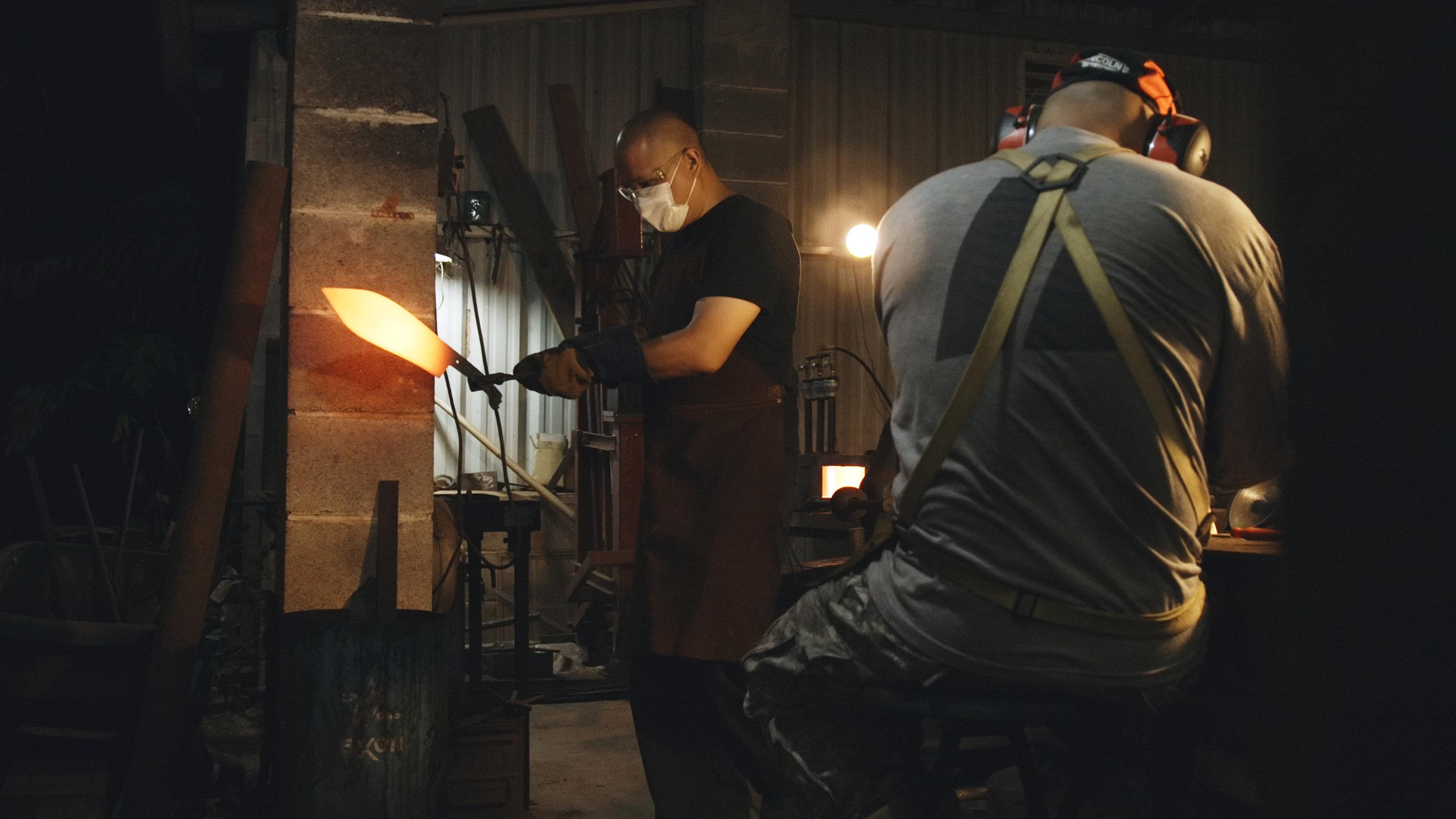
From the island of Guahan, a son of the Lizama family waxes rhapsodic over his familial history with the forge.
Legacies of forging began in the 1600s, when metals were first introduced to communities in the Marianas through the Spanish galleons. Iron nails prised from the floors of the waterborne vessels revealed a material atypical to the pliable red clays in the badlands or the soft fibers sourced from dried strands of pandanus. Where fire glazed pottery to form, the metals were made malleable with it. The ships carried these in abundance -gold and silver were among the first to be scavenged, while iron was preserved from the sands scouted in wrecks off the shores.
It is from here that the Marianas' history with metals began.
To Sean Lizama, 47, that history didn't begin for him until 12 years ago in 2014, when his father, Francisco "Frank" Lizama, began to set up a home-based forge in Yigo on the island of Guahan. Sean happened to be at home with a couple of friends at the time. They decided to approach Frank, who asked if they would like to learn the family trade. The answer was immediate. "From then on, we were hooked," said Sean.
"If he always has to get grants, it would be harder to perpetuate the craft." Sean thought to himself. It had been months after he began his apprenticeship at his family's forge, and Sean recalled a few moments he realized the cost of stoking the flames and purchasing various tools would be higher than money they could collect through selling their creations at the open-air markets.
"I don't rely on the profits for sustenance," Sean explained. "It's a side thing - I just want to keep the culture and the craft alive, really. To honor my father and Tun Jack's memory, and all the blacksmiths who have ever been in the Marianas. Because if people don't continue it, it'll be just another craft to die out."
Joaquin "Tun Jack" Lujan had apprenticed Frank Lizama in the 198os, after he was made Guahan's last master blacksmith after being tutored by Mariano Leon Guerrero Lujan, Tun Jack's father. At the time, Frank had returned to the island of Guahan after a stint in the military and was working at the Guam Fire Department as the island's Fire Chief. In a video documenting his father's legacy (titled "Kantan Hereru" on Youtube, Frank claimed Tun Jack to be a very knowledgeable and no-nonsense man. It was through Tun Jack's tutelage that Frank was able to gain his certification as Guahan's last remaining master blacksmith in 2013, succeeding the place of his mentor.
In 2015, a year after officially beginning his apprenticeship, Sean decided to turn the forge into a family business, offering lessons in smithing over selling products. It made the most sense - rather than firing up the forge to make tools for sale, apprentices were charged a fee in exchange for lessons. This way, the money circulated back into the forge, and Frank would be able to proliferate the craft of Chamorro forging through his pupils.
The business bloomed, and in 2016, apprentices of Lizamas Forge were able to make their mark at the 2016 Festival of Pacific Islands and Culture (FESTPAC), hosted in Guahan.
When asked about his experience at the event, Sean replied, "That was interesting to see. There are connections that we still make for people off-island who practice old arts, like canoe-building. The people who want these tools are the older people - the ones who remember. Sometimes, it's not just for utility. They want them for nostalgia."
He was speaking of tools used in the Pacific. While some customers specifically asked for custom articles, like swords or kitchen knives, Sean's craft delivered him straight to circles of farmers, fishermen, and cultural practitioners. The adze was one such tool that Lizamas Forge continues to supply, but not strictly for profit. The fusinos (garden hoes), kåmyu (coconut grater), and machete all have a place in the Lizamas Forge because they play a distinct role in the lifestyles of those living straight off the land.
The goal of Lizamas Forge is to keep the art of smithing alive in younger people. To Sean, the pandemic highlighted issues of modern convenience - the mad scrambles to the grocery stores, the health problems hidden in modern diets, the loss of widespread agricultural expertise. "To go back and retrieve the ways of living traditionally may offer a solution," said Sean.
When asked if he tried incorporating other methods of forging with what the Lizama family knew, Sean notes that Japan's refined smithing culture tends to recycle their own steel, folding the metals into itself over and over again to remove impurities. This process strengthens the blades, but the technique was borne from necessity - recycling was able to accommodate Japan's inability to supply a rising demand for metals. He goes on to say that in Guahan, attitudes like these are reflected in the smithing community's own processes.
Concerning the materials - it's all reclaimed. When cars were first imported to Guahan, excursions through abandoned autolots produced coils and springs with valuable forging potential. He could always buy fancy steels, Sean mused, but doing things the traditional way - through scavenging and reclamation - was useful in teaching Sean to appreciate various metal properties.
"The tools have their own history and story, and that is closely tied to family and community. That's what I was more interested in, in terms of preserving. I modernized my smithing techniques in order to preserve these tools as a facet of our culture - but the only thing that really changed were the techniques and efficiency. You could maybe find a way to mass-manufacture these tools - but at a cost [of quality]. I would prefer people don't use tools that are poorly-made."
The nature of the craft is time-consuming and labor-intensive. "It's never going to be a mass-produced thing," Sean explains. The business model is simply not scalable - however, the objective of Lizamas Forge is not to sell, but to perpetuate culture and provide for the community. "To me, that's more important than growing as a business. I'd rather have us grow [forging] as a craft. In that sense, I want to see everything grow, rather than just keep it all in [Mes Chamorro]. That's what we're going for. But I know it's a hard thing to balance in modern life." Sean laughs as he explains that he has no tools for himself - although he always has a chance to make them, he often ends up selling the tools or giving them away. His resolution for 2026 is to record what the Forge does in order to spread the craft around, and maybe even grow the business in the process.
These days, the Lizamas Forge offers a $300 basic blacksmithing course, teaching all the basic forging techniques for up to three students at a time, for three Saturdays, from 12pm-8pm. This class offers everything to get started in forging - and from there, a smaller fee can be paid to teach students how to craft Chamorro tools.
"We're all still learning, but it's a life-long endeavor."
Frank Lizama passed away in 2021 at the age of 80, leaving the Lizamas Forge and its legacy to his four sons and grandchildren. Although it was planned for Frank to attend the next FESTPAC in Hawaii, COVID-19 had pushed the event all the way to 2024, and Sean decided that he would go to represent Guahan while honoring the legacy of his father and Tun Jack.
He was inspired by the energy, the unity displayed by other attendants. "The sense of culture was strong," Sean said, speaking slowly as he went through the memories. He noted the interest in his tools during the festival, and the sense of invigoration that being surrounded by other practitioners gave him. "Practicing a traditional craft is hard, but to turn it into a business adds another layer of difficulty on top. As young people, the best we can do is learn from our man'amkos. Not necessarily to turn [our pursuits] into a business, but to turn it into a lifestyle.
Whatever your interests are in the culture, dive deep into that. Language, dance... perpetuate some part of the culture so that it moves into the future. Don't let it die."
"That's my message to young people - if you're interested in a craft, dive into it deeply. And if you can, support local businesses and try to go deeper into what it means. Just being able to afford a piece of culture doesn't mean the meaning behind it is there for you. That's the most important thing - if you're wearing something or utilizing a piece of culture, you're able to explain it to younger people. This is why we sleep on the guafak, or this is why we use a si'i (a traditional weaving tool) to weave, or a machete to cut down our trees... There are reasons behind all of these things. If you're able to latch onto that, you're able to spread it." said Sean.
The Lizamas Forge is reachable through Instagram @lizamasforge.
Share this article: