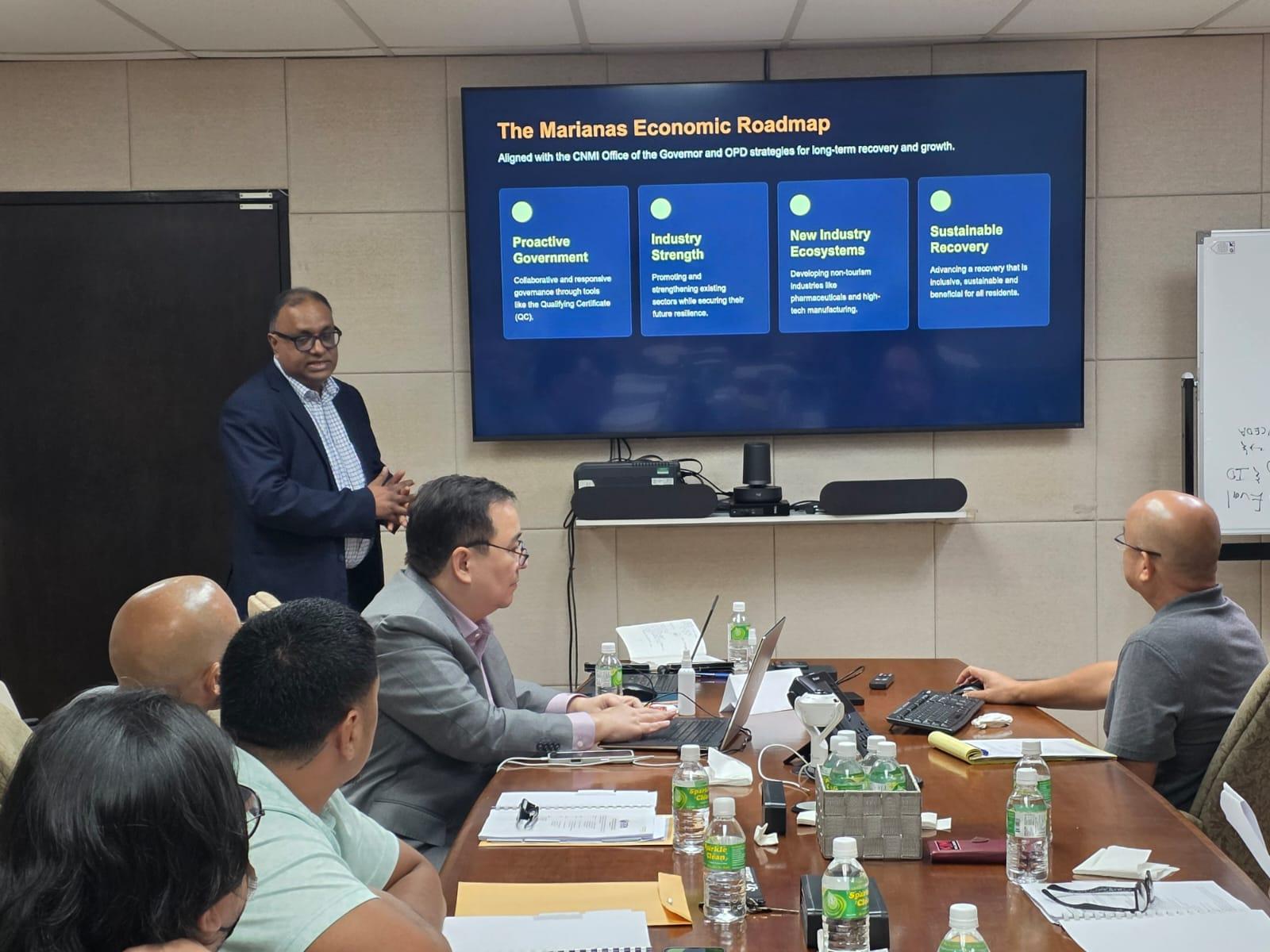
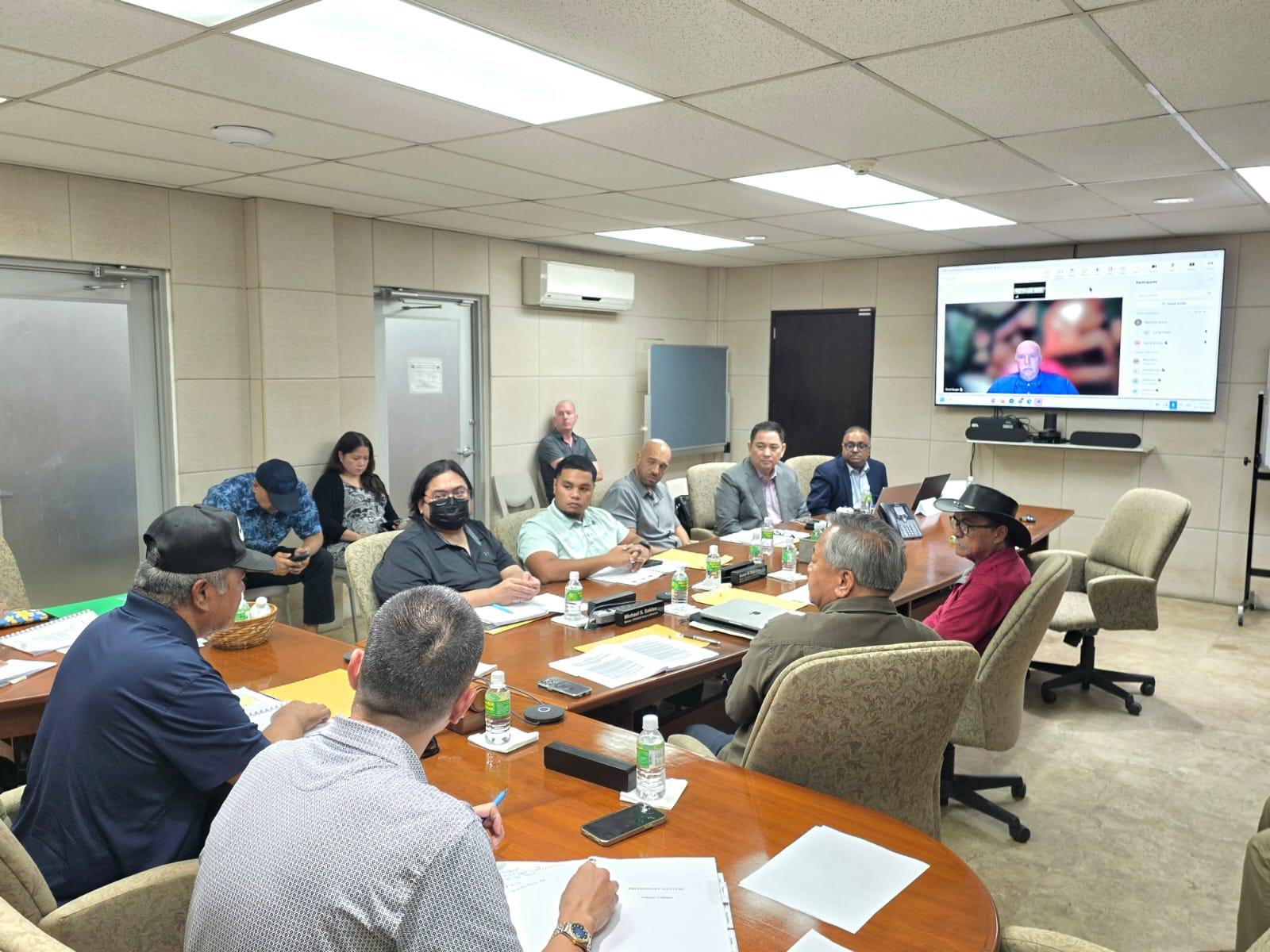
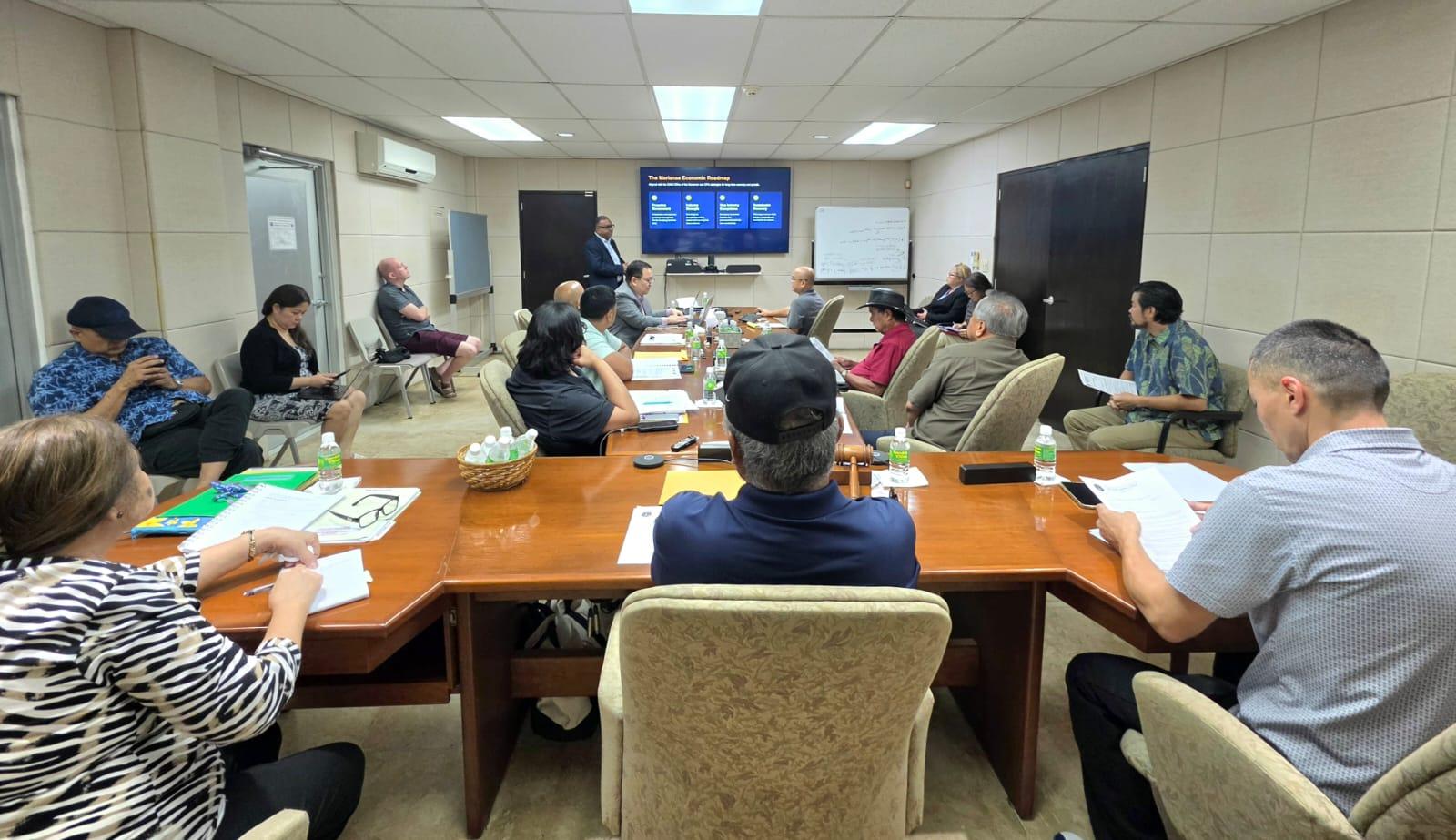
Outlining plans to transform the National Office Supply building on Beach Road into a high-tech supplement and pharmaceutical facility within 18 months, executives of CNMI Investment LLC (CIL) defended their request for a 25-year Qualifying Certificate (QC) before the Commonwealth Economic Development Authority (CEDA) Board of Directors while facing tough questions over a $30 million seed capital fund bundled into the proposal.
During the CEDA board meeting on October 24, CIL principal Matthew Toh, CEO Devan Pillay, and local tax consultant Dave Berger outlined their three-pillar proposal to establish a multi-sector healthcare manufacturing, global trading, and seed equity hub on Saipan. The company is seeking a 25-year QC requesting 100% tax abatements across multiple tax categories, including trading activity, capital gains, and CNMI earnings taxes.
According to Pillay, CIL is in the process of leasing the two-story, 28,000-square-foot former National Office Supply building on Beach Road to launch a phased manufacturing operation. Phase 1 involves producing dietary supplements and vitamins on the first floor, which does not require U.S. Food and Drug Administration (FDA) pre-authorization. Matthew estimated production could begin within 1.5 years after securing local sanitary permits and FDA non-objection clearances. Phase 2 would expand into full pharmaceutical manufacturing on the second floor once cleanrooms are constructed and U.S. FDA pre-authorizations and registrations are obtained, a regulatory process expected to take several years.
CIL noted that its existing factories in Rancho Cucamonga, California, at 45,000 square feet, and Myanmar, at 150,000 square feet, are significantly larger than the Beach Road site. The company projected that it would need to lease land and build a larger facility on Saipan within three to five years if the first phase succeeds. Pillay also informed the board that CIL has already begun interviewing local job candidates, met with a local staffing agency, and consulted with CNMI Customs and zoning officials to prepare for a commercial launch.
The central point of debate during the session centered on CIL’s third pillar, "Global Ventures," a $30 million seed equity allocation intended to finance local entrepreneurs to build supporting industries such as pharmaceutical-grade plastic bottle manufacturing, label printing, and machine calibration services. Pillay argued that importing empty plastic bottles—which he described as "shipping fresh air"—and paper labels across the ocean is cost-prohibitive due to high freight rates to Saipan. Under CIL’s proposed model, the company would invest seed capital for a minority stake, such as 40%, without requiring collateral or interest, allowing a local partner to hold a 60% majority share and buy out CIL’s shares after two to three years.
However, CEDA board members questioned the disproportionality between the $2 million Phase 1 manufacturing investment—consisting of $450,000 for construction and $1.6 million for equipment—and the $30 million seed fund. While CIL searches for local entrepreneurs to partner with, Toh explained the $30 million would be held in U.S. or CNMI bank accounts and invested in U.S. Treasury bonds and stocks to hedge against inflation.
CEDA board Vin Armani challenged the necessity of starting new packaging and printing companies from scratch, noting that established vendors in Saipan and Guam, including Triple J and local industrial printers, already have packaging capabilities and could upgrade their facilities to meet Good Manufacturing Practice (GMP) standards.
"In Phase 1, the majority of the capital that you're going to do is going to be put into this, and I just don't see $30 million—and then we're talking about putting it in Treasury bonds, putting it in stocks, talking about capital gains," Armani said. "If what you guys want to do is have a financial business, have a family office, have a U.S. company that can have U.S. banks, I'm actually a big supporter of that... We just need to talk about those terms and be realistic about what it is that we're talking about."
Armani added that whether the $30 million sits in a Singapore bank or a U.S. mainland bank purchasing Treasury bonds, the CNMI receives zero economic benefit until the capital is actively deployed locally for payroll, rent, and operations.
Toh denied that the proposal is intended to operate as a family office, stating he already maintains substantial private banking accounts in Singapore with Citibank, J.P. Morgan Chase, and DBS, and noted that Singapore is already a tax-friendly jurisdiction for financial investments. He maintained that Global Ventures will not invest in businesses outside the CNMI and will only use U.S. financial instruments temporarily to cover inflation while local manufacturing partnerships are developed.
During the meeting's public comment period, prior to CIL’s presentation, a testifier urged the CEDA board to deny or substantially limit CIL’s application, comparing the financing component to a legislative "rider" attached to a manufacturing project. The testifier argued that financing activities do not produce the same broad public benefits or job creation as manufacturing operations and should not receive the same level of tax concessions without compelling evidence of substantial economic returns to the Commonwealth. Citing past QC beneficiaries such as Bridge Capital, Mariana Resort, and Imperial Pacific, the speaker called on CEDA to pause the program to audit how much tax revenue has been foregone versus actual economic growth returned and requested that CIL be required to submit a separate application for its financial investment activities.
The board and CIL’s advisors also reviewed technical tax details, including CIL’s request for clarification on the CNMI’s 0.42% Beautification Tax on imported raw materials, which is bundled into the 5.42% customs excise rate, as well as a 3.7% export user fee. Berger noted that Revenue and Taxation officials confirmed the 3.7% user fee applies only to the defunct garment industry, while CEDA legal counsel discussed how an excise tax abatement would need to be specifically worded to encompass the beautification tax. Additionally, because CIL’s entities are structured on the advice of PwC Singapore as pass-through partnerships generating K-1 returns—and because Toh intends to become a CNMI resident if the business succeeds—the applicant requested an abatement on individual earnings and capital gains taxes tied to the project, though a board member suggested a C-Corporation tax election might be simpler.
Board members noted that QC tax incentives are time-based and can be structured on a tiered schedule as project milestones are met. Following the public presentation, the board prepared to review management’s recommendations and deliberate on specific QC terms in executive session.
Share this article: