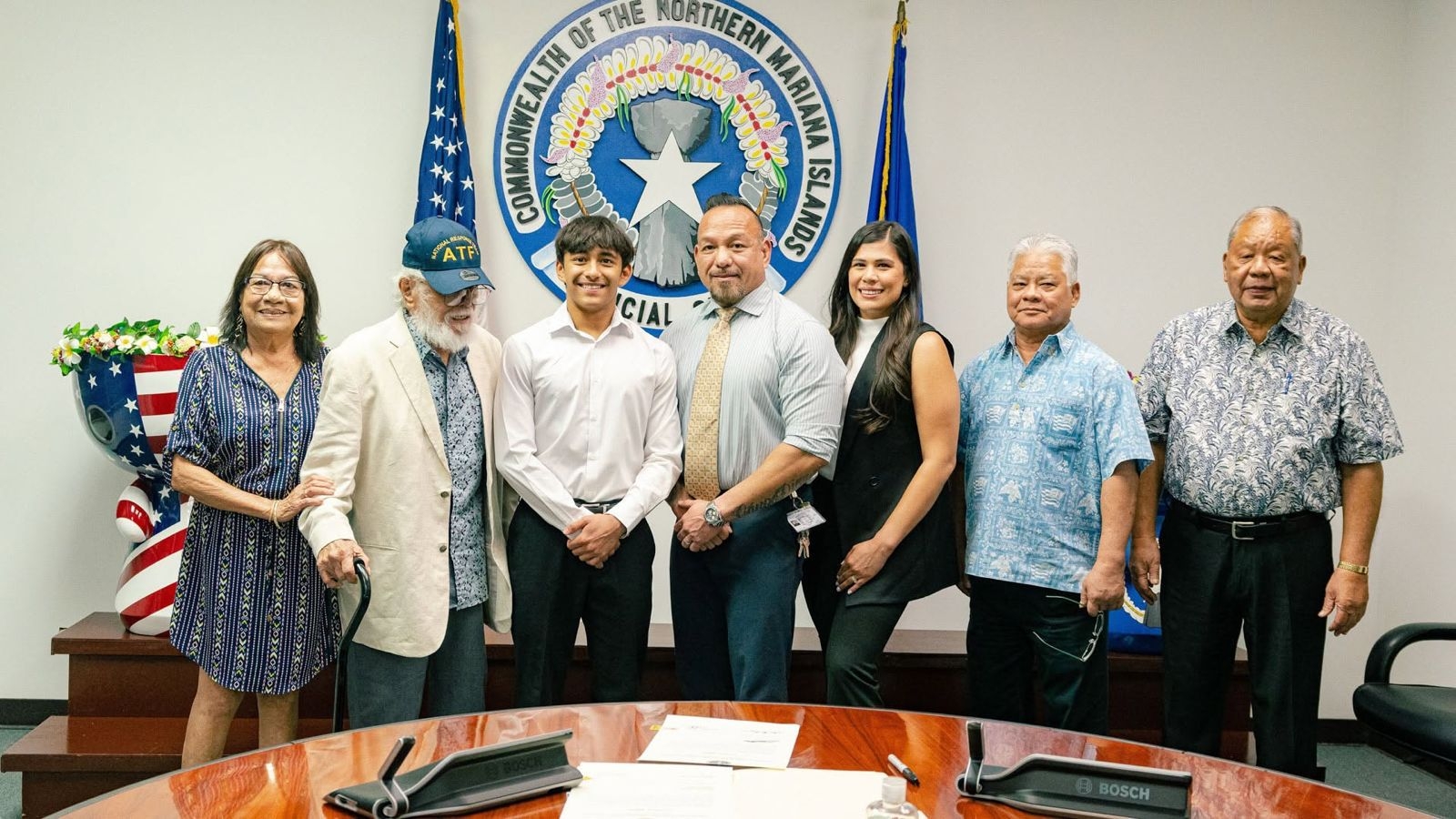
Philippine Airlines’ Northern Marianas roadshow continued at the Commonwealth Healthcare Corp. last Feb. 4, where hospital officials welcomed the return of direct Manila-Saipan flights but openly raised concerns about persistent problems in referring CNMI patients to hospitals in the Philippines, including what CHCC CEO Esther Muña described as a “lack of respect” toward local providers.
Muña said that while the Philippines offers clear advantages for medical referrals—especially with direct flights cutting travel time to about three and a half hours—provider-to-provider communication and professional regard remain key obstacles.
“And knowing the challenges we have here, it’s the lack of respect. There is actually a lack of respect for providers from the Philippines about the providers here,” she told Philippine Airlines regional head for Japan, Korea, and Oceania Bryan Sansolis and PAL marketing specialist Blaine Roxas.
Muña said feedback from Philippine hospitals sometimes comes back through patients, undermining trust between providers and discouraging future referrals.
“The comment that comes out of the Philippines was, ‘Well, it’s like the provider didn’t do this, so, you know, what are they doing on Saipan?’” she said. “The kind of comments that come back, and the patient shares that information, and it basically leaves a bad taste in the [mouth for] providers here to send patients there again.”
She contrasted that experience with referrals to U.S. hospitals, where limitations faced by CHCC are more readily understood.
“Unlike in the States, when we send patients over there, they understand that, well, the reason why it wasn’t done is because you don’t have an MRI,” Muña said. “The reason why this was not done is because you don’t have this specialty.”
Muña said that without improved coordination and respect, CHCC providers are placed in a difficult position.
“I’m going to send a patient there, only to be insulted, right? And that’s not a good conversation that we—I cannot support that also,” she said.
Muña emphasized that CHCC operates within the constraints of being a rural hospital in the U.S. healthcare system, where federal requirements dictate what equipment can be used and significantly increase costs.
“We’re in a rural America, right? It’s basically a lot of things are not available,” she said. “Unfortunately, the equipment also has to be U.S. because [Centers for Medicare & Medicaid Services] provides payment to us.”
She added that even donated equipment from outside the U.S. often cannot be used unless it meets federal standards.
Health Network Program Care Coordination manager Carmen Lizama explained that patients must meet medical necessity, residency, and income criteria before being referred off-island. Most CHCC patients are Medicaid recipients, and Medicaid currently does not cover foreign providers.
Muña said CHCC has been requesting changes for more than two years to allow Medicaid referrals to the Philippines, citing distance, cost, and patient preference—particularly for patients with family support in the Asia-Pacific region.
“When we transfer patients to the Philippines, we actually would pay them,” Muña said. “It’s a humanitarian on our part… even though their insurance doesn’t cover it.”
Sansolis said the visit helped PAL better understand the significance of the medical referral segment in the CNMI.
“At first, when we’re looking at it on a high level, us in head office, we just look at Saipan as the opportunities there because of the lack of connectivity,” he said. “But what we just realized recently during our trip is also the positive impact that this will bring to the community, especially for the medical referral.”
Sansolis said many patients currently face long transit times through Guam, adding cost and stress.
“So there’s a lot of roadblocks or pain points that a patient has to undergo just to have their routine checkups or something like that,” he said.
PAL marketing specialist Blaine Roxas said the airline also views the route as a way to extend what she described as “Philippine care,” particularly in sensitive medical travel situations.
“Filipinos around the world are known for their signature care,” she said.
Sansolis said PAL is willing to elevate CHCC’s concerns to Philippine government agencies, including the Department of Tourism, which has an established medical tourism division.
Muña noted that CHCC employs nearly 300 nurses, the majority of whom have roots in the Philippines, strengthening ties between the CNMI and the Philippine healthcare systems.
“Our staff are ecstatic, actually,” Muña said, with CHCC chief financial officer Perlie Santos volunteering that she already booked her flight for June, then reminded the CHCC CEO of her leave.
Muña said direct flights also benefit contract workers and medical staff who travel frequently in the region.
“For us, we know the advantages of sending patients to the Philippines,” she said. “It’s closer, especially with a direct flight… So we want to make it work.”
Share this article: