CNMI told no more federal funds; Norita pushes for administrative fixes after 902 talks
The CNMI was told point-blank that “no further funding will be made available” from the federal government, Finance Secretary Tracy B. Norita said, as she outlined the outcome of the just concluded Section 902 consultations and Interagency Group on Insular Areas meeting in Washington, D.C.
Speaking at a March 4 press conference at the Governor’s Office on Capitol Hill, Norita said there is currently “no funding vehicle” to provide the additional immediate financial assistance the CNMI had sought.
“There is no funding vehicle to provide us with that initial funding assistance that we requested,” she said.
Norita said the fiscal team’s message during the 902 talks was clear.
“Ultimately, the message in the 902 from the fiscal team is that federal administrative actions that are capable of helping to restore economic activity in the near term are essential, especially since there is no current funding vehicle to help us with our immediate needs,” she said. “And so, again, the continuing conversation will happen in the next 30 days.”
Norita said while a second round of immediate funding is off the table for now, the CNMI and federal officials agreed to form a multi-year funding working group.
That proposed framework envisions roughly $60 million annually in federal support for economic development and government operations, though details are still being worked out.
She also said discussions continue over tax “cover-over” funds, with the CNMI asserting it is entitled to additional corporate income tax revenues derived from activity in the Commonwealth but paid to the U.S. Treasury.
At the February meeting, she said, the IRS indicated disagreement with the CNMI’s interpretation, but the Commonwealth intends to maintain its position.
Gov. David M. Apatang, meanwhile, framed the D.C. trip as a push for federal policy changes rather than direct cash assistance.
“We all went there as a team,” Apatang said, noting participation from the Governor’s Council of Economic Advisers, private sector leaders, and the Marianas Visitors Authority.
He said he met one-on-one with the Department of Homeland Security Secretary Kristi Noem and described the meeting as “very fruitful,” adding that the official was “very receptive about our issues here in the Commonwealth.”
On the issue surrounding the Guam-CNMI China Visa Waiver Program, Apatang said, “We don’t want to cut any Chinese tourists coming to the CNMI.”
He added that he asked Homeland Security to “look into that and see if we can get help getting the Chinese airlines to come into the Commonwealth and do away with some of those restrictions.”
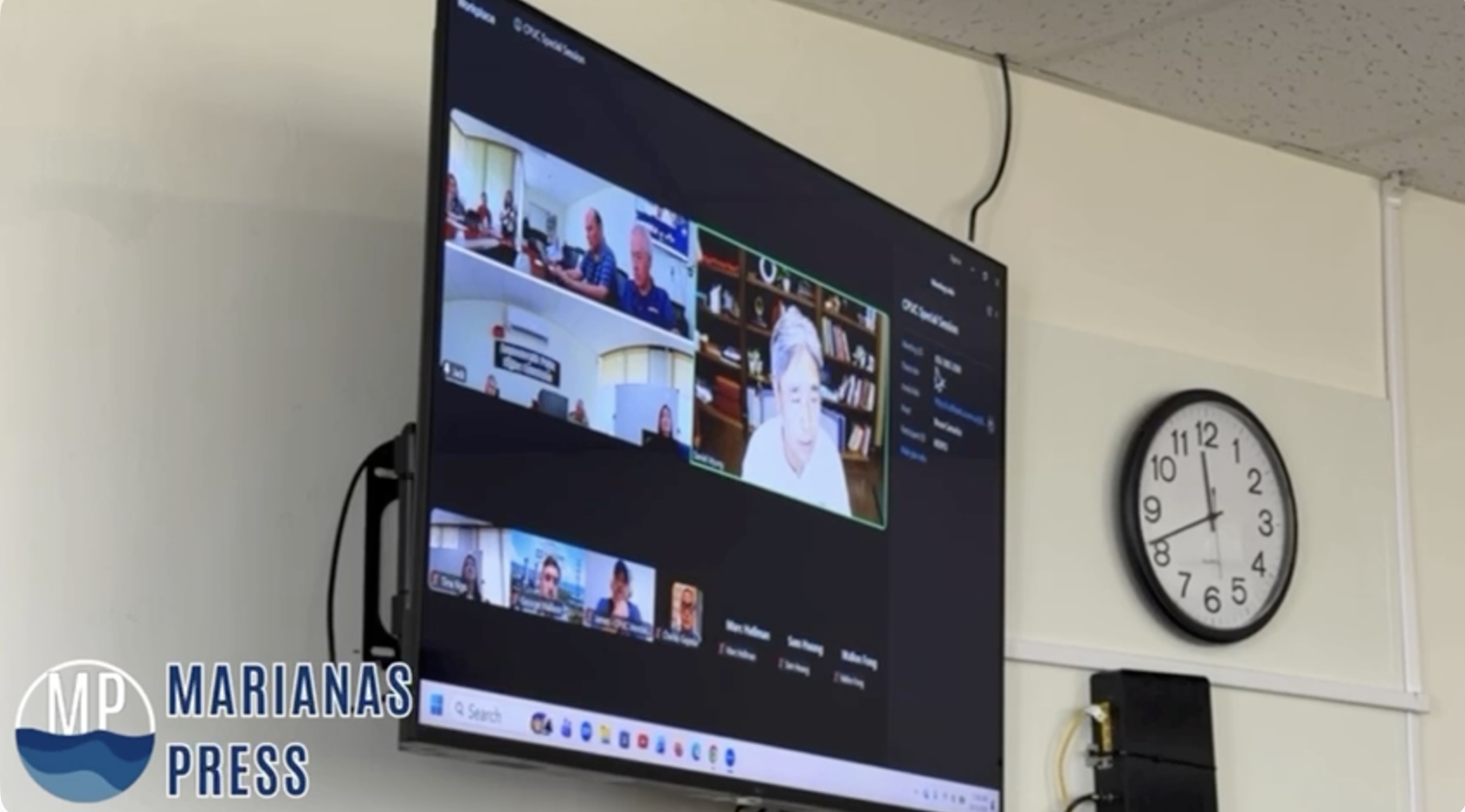
Joining via Zoom, Delegate Kimberlyn King-Hinds said it was helpful to be part of the 902 conversation so she could better push the CNMI’s priorities on the congressional side.
“My job here as the delegate is to be able to take your asks and work on the federal level, on the congressional side, to be able to push for those policy changes,” she said.
She also emphasized unity during the 902 talks.
“That’s why I’ve been always very vocal in pushing for a united voice, a united front—one team, one fight, one Team CNMI approach,” she said.
King-Hinds said she has already been receiving callbacks from federal stakeholders seeking more information about possible administrative fixes.
Michael Sablan, CNMI lead representative in the 902 talks, praised the governor’s presentation and said the mission was not to seek bailouts.
“Our mission in D.C. was not to ask for handouts, but for handouts. As cliché as that might sound, it’s true,” he said, later clarifying that the CNMI is seeking “the tools” and “regulatory changes that are needed to restore those tools.”
Joe C. Guerrero, co-chair of the Governor’s Council of Economic Advisers, said the business community was deeply involved this round.
“We’re all in this together,” he said.
Key priorities in the tourism and transportation working group include air service issues, Annex 6 of the 2007 U.S.-China Air Transport Agreement, inclusion of the Philippines in the Guam-CNMI Visa Waiver Program, and possible relief from cabotage restrictions.
Alex Sablan, chair of GCEA’s Committee on Tourism, Infrastructure, & Sports, said many of the proposals presented to federal officials would cost the U.S. government nothing.
“These are really initiatives that the federal government could provide today at no cost to the federal government, but would be absolutely empowering for the CNMI to get back and to move forward with this economy,” he said.
Retired associate judge Wes Bogdan, a key legal adviser in the 902 process, said the strategy is to work within existing laws.
“What we’ve done is we’ve gone and asked for as much help as we can without requiring any type of additional congressional actions,” he said. “We’re using existing laws, interpretations, policy decisions to try and shape those to fit what’s happening in the CNMI today.”
Volunteer adviser Jason Osborne said the delegation received encouraging responses from federal agencies.
“We have received nothing but positive feedback that at least they are examining everything,” Osborne said. “We also know that the congresswoman (King-Hinds) has been great about this, too, and that we’re not taking no for an answer necessarily. We’re continuing to go back and offering out our other alternatives and other solutions in different ways.”
Apatang’s chief of staff, Henry Hofschneider, said the Section 902 consultation lasted about two and a half hours and marked a more structured process moving forward.
He said working groups were established and that both sides now have a reporting timeline.
“We established working groups,” he said, adding that the CNMI and federal teams have 30 days to submit a report to both sides.
On a separate matter involving the Commonwealth Utilities Corp. request tied to the military buildup, Hofschneider said, “We’re coordinating that with the OLDCC.”
OLDCC stands for Office of Local Defense Community Cooperation, which is a U.S. Department of Defense field activity and provides technical and financial assistance to states, territories, and communities that are invested in the defense mission
“CUC has submitted a list of things they want to improve, and it’s estimated around $800 million,” he said. “They’re not going to get everything. If we’re lucky, we’ll get $100 million for CUC.”
Several speakers stressed that working groups have 30 days to produce reports and recommendations.
Joshua Weiss, president of the Saipan Chamber of Commerce, said he was encouraged that the timeline was firm on the asks for the 902 talks.
“I’m glad that they were insistent on a 30-day timeline and not letting this just dissolve into conversation,” he said.
Share this article: