The Defense of Guam initiative is increasingly being viewed not just as protection for Guam, but as a security umbrella for the entire Marianas—including the Commonwealth of the Northern Mariana Islands.
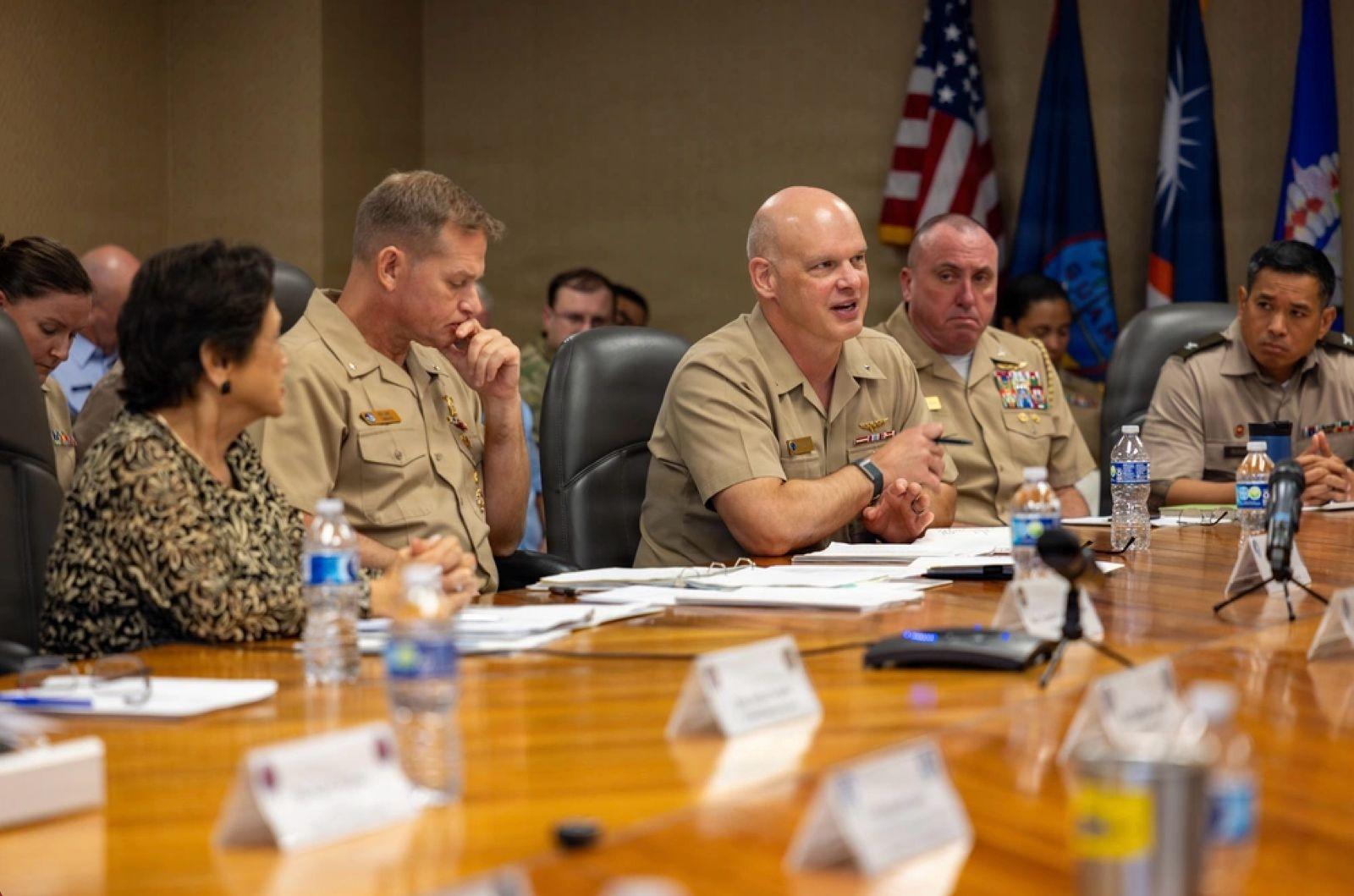
That broader regional lens emerged last Jan. 28 as Guam Gov. Lourdes Leon Guerrero, U.S. military commanders, and CNMI Gov. David M. Apatang convened the Civil-Military Coordination Council at Joint Region Marianas headquarters on Nimitz Hill in Asan-Maina, Guam.
While the missile defense architecture is centered on Guam, officials acknowledged that the strategic assets it protects—and the threats it is designed to counter—have implications for Saipan, Tinian, and Rota as well.
According to analysis published by the Atlas Institute for International Affairs, Guam's geographic position makes it indispensable for rapid U.S. reinforcement across the Indo-Pacific. The island sits within operational reach of key allies in Japan, South Korea, the Philippines, and Australia, enabling it to serve as a forward logistics and strike hub - a role that also makes it a prime target in any major conflict involving China or North Korea.
The Atlas analysis notes that critical facilities such as Andersen Air Force Base—capable of hosting B-1 and B-2 strategic bombers and supporting virtually every aircraft in the U.S. inventory—along with Naval Base Guam and Camp Blaz, anchor U.S. power projection in the region. Guam also serves as a logistics hub supporting Fifth and Seventh Fleet operations.
Currently, about 22,000 military personnel, contractors, and dependents are stationed on Guam, with projections rising to 33,000 by fiscal year 2027.
The same Atlas study points to wargame assessments suggesting that in a potential conflict, China's People's Liberation Army Rocket Force would likely target Guam using long-range Dongfeng ballistic missiles and hypersonic systems, while North Korea's Hwasong-series intercontinental ballistic missiles also place the island within range.
The Enhanced Integrated Air and Missile Defense system—integrating Aegis, THAAD, and Patriot interceptors with advanced radar and command-and-control networks—is intended to counter precisely those threats.
Against that backdrop, officials from the U.S. Department of War representing the Air Force, Navy, Marine Corps, and Coast Guard met with GovGuam agencies, including Guam Homeland Security's Office of Civil Defense and the Guam Department of Labor, to review progress and coordination.
Attendees received updates on the Defense of Guam plan, joint exercises between DoW and Guam Homeland Security, logistics surrounding Permanent Change of Station moves, capacity building at Department of Defense Education Activity schools, and housing initiatives aimed at easing pressure on Guam's real estate market. Participants also discussed pathways for coordination and partnership on priority projects supporting both civilian and military readiness.
Leon Guerrero emphasized collaboration.
"It's a historic moment with CNMI taking part, at least as an observer of the CMCC," she said. "The work that we do here has been substantial for Guam, productive toward our mutual goals, and that's the purpose of this meeting; to come to the table, discuss how to work through issues, how to mitigate impacts, and how else we can further our united front for the defense of our island. Many of the issues that we discuss here also apply to our brothers and sisters in the CNMI, and I hope they can take part in future meetings."
Apatang said the Commonwealth intends to apply lessons from Guam's defense buildup.
"Like brothers and sisters, we want to do as well as our siblings [Guam], and we want to continue the buildup on Saipan, Tinian, and Rota. I know today we're going to be talking about the Defense of Guam; we're prepared to build defense for the Commonwealth."
Rear Adm. Brett Mietus underscored the importance of presenting "a consolidated voice" to Washington, D.C., while Rear Adm. Josh Lasky highlighted the Defense of Guam Working Group's efforts to synchronize Pentagon planning with GovGuam response frameworks.
Established in 2010, the CMCC has evolved into the primary forum for aligning federal defense initiatives with local government priorities. Similar executive-level coordination meetings are held quarterly in the CNMI.
Share this article: