Feds move to protect habitat for CNMI’s endangered species as pressures mount
A year after local officials underscored the growing list of threatened wildlife in the Northern Mariana Islands, federal regulators are now moving to protect nearly 60,000 acres of habitat seen as critical to their survival.
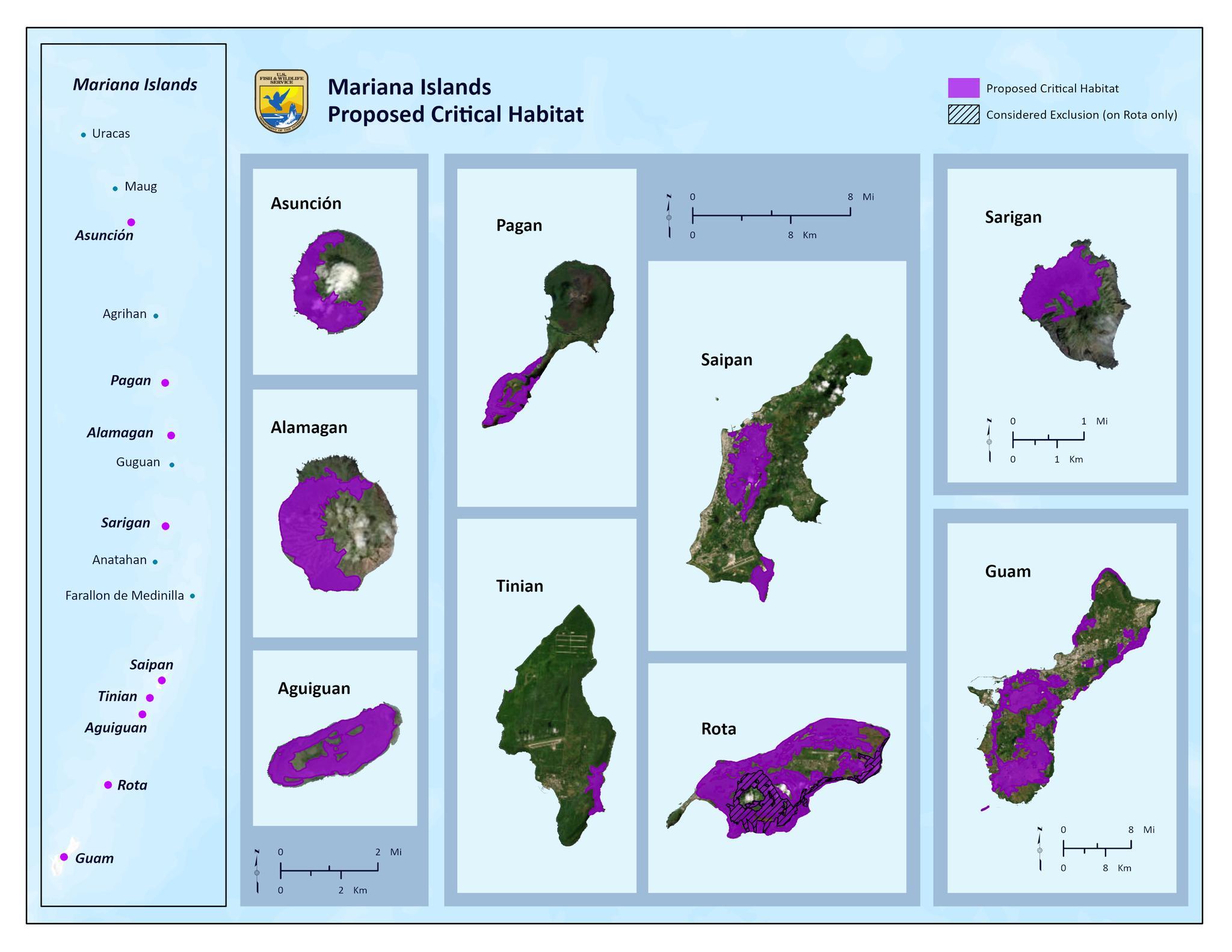
The U.S. Fish and Wildlife Service last March 24 proposed designating about 59,886 acres across the CNMI and Guam as critical habitat for 22 endangered and threatened species—many of them already identified by CNMI officials as at risk.
The proposal covers areas on Rota, Saipan, Tinian, Aguiguan, Pagan, Alamagan, Asuncion, Sarigan, and Guam.
“We are proposing a designation of critical habitat for 22 Mariana Islands species, totaling 59,886 acres,” the agency said.
The move comes after CNMI Division of Fish and Wildlife officials reported in April 2025 that 29 resident species in the Northern Marianas are protected under the Endangered Species Act, including the sheath-tailed bat, nightingale reed-warbler, Mariana swiftlet, Mariana crow, Mariana common moorhen, Micronesian megapode, Rota bridled white-eye, Slevin’s skink, hawksbill turtle, Mariana eight-spot butterfly, Mariana wandering butterfly, Rota blue damselfly, humped tree snail, Langford’s tree snail, fragile tree snail, Serianthes nelsonii, Osmoxylon mariannense, Nesogenes rotensis, Heritiera longipetiolata, Solanum guamense, as well as threatened species such as the Mariana fruit bat, green sea turtle, Bulbophyllum guamense, Cycas micronesica, Dendrobium guamense, Maesa walkeri, Nervilia jacksoniae, Tabernaemontana rotensis, and Tuberolabium guamense.
Several of those species—including the Pacific sheath-tailed bat, Slevin’s skink, Mariana eight-spot butterfly, Mariana wandering butterfly, and multiple tree snails—are among those included in the proposed federal habitat designation.
The bat, for instance, is now largely confined to caves on Aguiguan, while Slevin’s skink has seen a dramatic contraction in range and is now limited to a handful of islands, including Alamagan, Asuncion, and Sarigan. Tree snails and butterflies, meanwhile, remain dependent on intact native forests and specific host plants—habitats that have steadily declined across the region.
Federal officials said the designation targets areas with the “physical or biological features… essential to the conservation of the species,” including limestone caves, contiguous native forests, and vegetation needed for feeding and reproduction.
The action is required under the Endangered Species Act, which mandates that critical habitat be designated “to the maximum extent prudent and determinable” once species are listed.
The proposal also follows a legal settlement with the Center for Biological Diversity, which sued the federal government for missing deadlines tied to species listed in 2015.
While the federal rule addresses 23 species overall, one plant—Solanum guamense—was excluded from the proposed designation because its habitat areas are exempt under federal law.
Local conservation efforts outlined last year by CNMI officials have included bird translocation programs, invasive predator control, long-term monitoring of bats, snails, and sea turtles, and propagation of endangered plants, particularly on Rota. Those initiatives, officials said, are aimed at stabilizing populations and supporting eventual recovery.
Federal officials emphasized that the proposed designation does not change land ownership or automatically restrict private land use.
“The designation of critical habitat does not affect land ownership… [and] does not allow the government or public to access private lands,” the agency said.
However, federal agencies would be required to ensure that any projects they fund, authorize, or carry out do not destroy or adversely modify designated habitat.
An economic analysis has also been released alongside the proposal, and the final designation could change based on public input and additional scientific data.
The public comment period opened with publication of the proposed rule on March 24 and will run through June 22, 2026, under docket number FWS–R1–ES–2024–0194 via Regulations.gov or by mail.
The agency said the final rule may include revisions, additional areas, or exclusions depending on the feedback received.
Share this article: