Framing Pasifika: Jayson Sablan
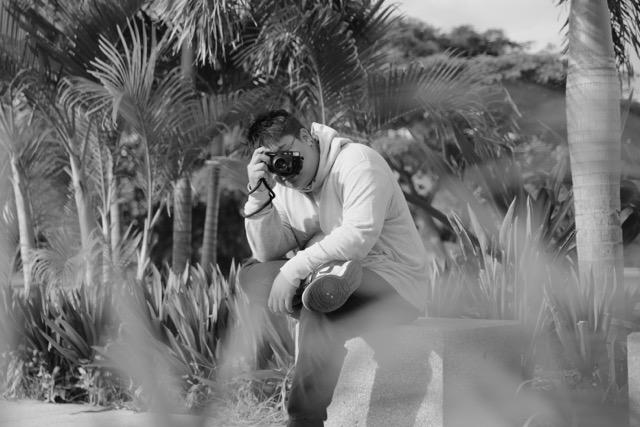
The portfolio of Jayson Sablan, a 28-year-old photographer born and raised on the island of Saipan, is a carefully assembled body of work. Upon closer inspection, it’s easy to spot the minute details the photographer sought to define. A mix of black-and-white photographs dominate his page, each with an eclectic spin on cultural representation. In every captured piece is a flourishing of personality caught within the span of a heartbeat. A homage to the people of the Pacific.
“Pasifika work… for me, it honors the community. You know when you see photos of… Saipan, Tinian, Luta, you see the landscapes and think about the oceans and scenery, I think we should honor the community more. Even just like… the everyday, mundane things. I wanted to honor that. I see it everyday, but it's not being talked about. I wanted to put a little bit of a spotlight on it - this is also what's happening here, it’s not just the ocean and scenery. It's about the community and everything surrounding it.”
After his Pinoy father was adopted by the Sablan family of Saipan, he found himself wrestling with how to reconcile his two cultural worlds. Jayson’s eyes take on a serious, contemplative air as he explains how his history affected the shape of his practice. “I used to be made fun of,” he said. “I’m Sablan, but I’m also full Filipino. Growing up, I realized I had an identity crisis. I kind of tried to figure it out, and I'm still trying to figure it out. I still want to honor my Filipino and Chamorro side.”
Jayson portrays his struggle with his identity through his photography. Pouring his dual cultures into his works felt true to him - a reunification of life and its many clashing facets. Despite keeping photography as a hobby since he was 18, Jayson’s work was soon sought out by family and friends. Each session became a way for him to train his sense of composition to the narrow confines of his viewfinder. “When I first started, I only did practice photos of family and friends. I became that one person who took photos at every event. I probably thought I was a real, legit photographer back then. I edited through a free app on my phone and only shot in JPEG. Four years ago, I started shooting RAW.”
Since solidifying his side gig as a freelancer, Jayson has worked for KSPN 2 as a photojournalist and listed photos with The Pacific Community (New Caledonia), as well as hosting a photo series exhibition on Ta Nå’i Ånimu II: Sacred Waters at the Guam Museum in January. “I practiced this method of street photography where I get a wider lens, and I really get up close. Before, I used to be scared. The more I did it, the more I found out that it was a good starting point to talk to people. Even learn from them.” When asked how his compositions affected the way people reacted to his images, Jayson said, “A majority of my photos are in black and white. Black and white photography is a way for me to force people to focus on more than just one point.”
When asked about his creative goals for the future, Jayson takes a moment to consider his answer. “I’m trying to get to a more filmic look. I’m more drawn to that kind of work, I wanted my photos to be remembered as kind of a memory. You know, [you] see a big gap between what you think people like and what they actually like. Nowadays I kind of just, like… became more accepting of what I like shooting, and how I like to shoot.”
Jayson’s photography plays a part in self-reconciliation. Memory becomes the closest resolution for an identity piece - creating visual narratives that aim to portray the NMI lifestyle exactly as it is, without the frills and conventions of commercialized island aesthetics.
View the work of Jayson on his Instagram page @__jsb1n__.
Share this article: