Greenland debate revives territorial questions
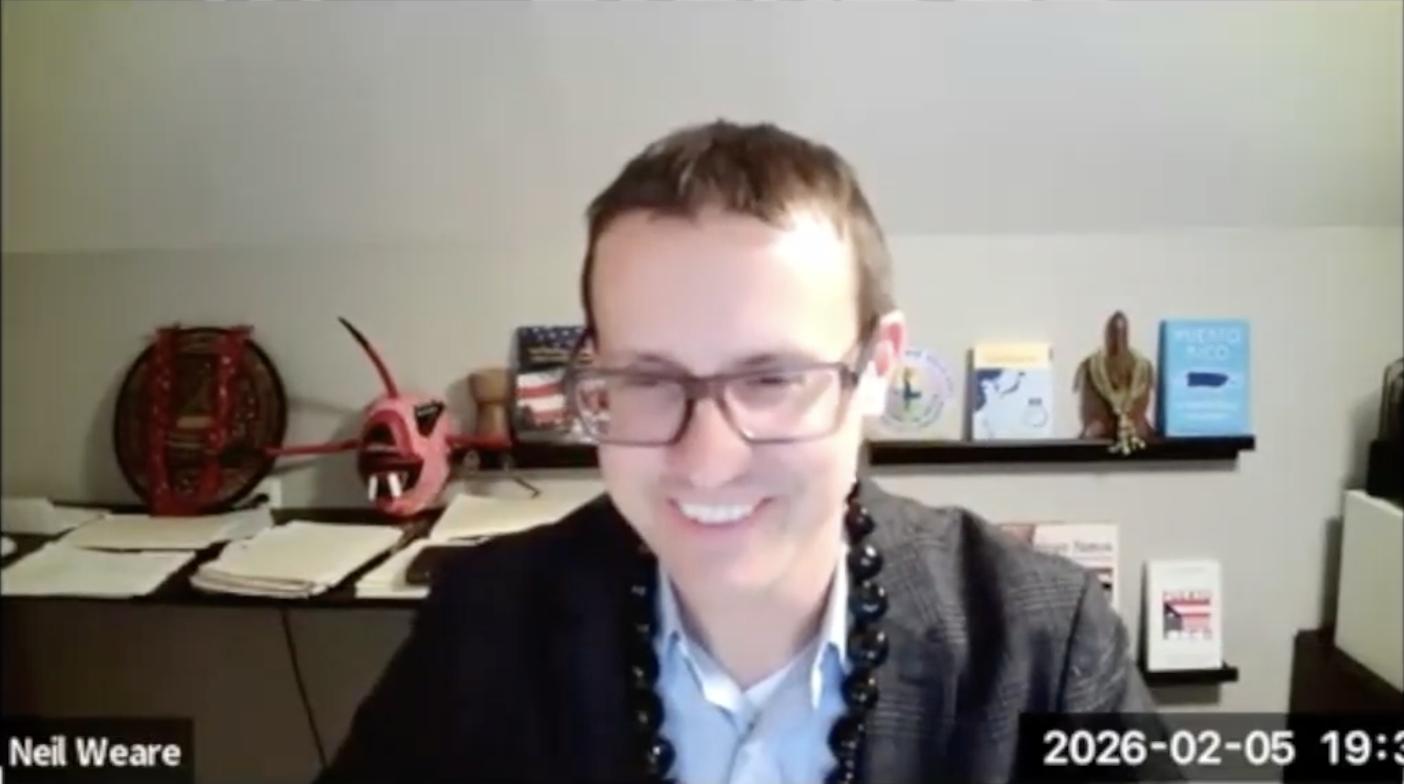
As renewed discussion in Washington, D.C., about potentially acquiring Greenland circulates, socio-civic leaders from several U.S. territories gathered last Feb. 6 (ChST) for an online forum hosted by Right to Democracy to discuss what lessons Greenland might draw from existing U.S. territorial relationships.
For the Northern Mariana Islands—which this year marks 50 years since approval of its Covenant with the United States—the discussion echoed longstanding concerns about autonomy, federal authority, and the durability of negotiated agreements.
Sheila Babauta, Democracy and Environment Fellow and a former lawmaker, said the Covenant remains central to the territory’s political identity.
“This year, we’re actually celebrating or commemorating the 50th year of our covenant,” Babauta said.
She described the document as “beloved” because it was negotiated rather than imposed, calling it an exercise in self-determination that reflected the will of the people at the time.
Babauta noted that the Covenant included provisions unique to the CNMI, including control over immigration and restrictions on land ownership to people of Northern Marianas descent.
For many years, she said, leaders in the territory emphasized that the CNMI’s relationship with Washington, D.C., was distinct because it was based on a negotiated agreement.
“Here in the NMI, we’ve always stated that our relationship is unique with the United States, because we have a negotiated document called the Covenant,” she said.
However, working alongside other territories has broadened that perspective.
“After working with Right to Democracy, many of the other territories also feel that their relationship is unique,” Babauta said. “We’re all constantly trying to clarify this relationship that we have with the United States.”
She pointed to several federal actions that residents viewed as overriding locally negotiated authority, including the federalization of immigration in 2009, the imposition of federal minimum wage increases in 2007, and the ban on cockfighting. She also cited concerns about proposed deep-sea mining activity in waters adjacent to the territory.
Babauta said there had been no meaningful federal support for community engagement or consultation regarding the mining proposal, including what she described as the lack of “free, prior and informed consent.”
While some elected officials argue that waters beyond 3 miles fall outside local jurisdiction, Babauta said many residents reject the idea that the territory has no role in decisions affecting surrounding marine resources.
Dr. Robert A. Underwood, former delegate to the U.S. House of Representatives from Guam and former president of the University of Guam, said territorial policy in Washington, D.C., often develops on parallel tracks.
“Guam and the Virgin Islands are constantly paired,” Underwood said, citing shared legislative developments such as elective governorships, non-voting delegates to Congress, and tax systems.
He said Guam’s push in the late 20th century for a Commonwealth-style arrangement stalled in part because Congress had not resolved Puerto Rico’s political status debate.
“I would say at least 50%, maybe as much as 60 or 70%” of the delay was tied to Puerto Rico’s unresolved status, Underwood said.
Territories, he added, are politically interconnected.
“Territories sort of hang together. And if they don’t hang together … then they’ll continue to be picked apart,” he said.
Comparing the situation to Greenland’s current autonomy within the Kingdom of Denmark, Underwood said he was “very envious” of the degree of self-governance Greenland exercises, including its explicit right to self-determination.
Dr. Hadiya Sewer, assistant professor at the University of the Virgin Islands and a political status advocate from the United States Virgin Islands, noted that her territory was purchased from Denmark in 1917 “for $25 million in gold.”
She said the territory remains under Congress’ plenary authority and does not operate under a locally ratified constitution.
“We do not have a constitution … we exist under the plenary power of Congress,” Sewer said, adding that the Virgin Islands continues to grapple with what it means to be “foreign in a domestic sense”—belonging to, but not fully part of, the United States.
From American Samoa, attorney and political status advocate Charles Ala’ilima said sovereignty was formally ceded to the United States through deeds signed by local chiefs.
“The cessions were absolutely clear; we’re ceding sovereignty. U.S. laws are supreme,” Ala’ilima said, noting that the territory remains under the plenary authority of the Secretary of the Interior.
Eva Prados, civil rights attorney and co-founder of Defend Puerto Rico, spoke from Puerto Rico, where debates over status continue locally and internationally. She referenced the island’s ongoing advocacy for “nuestro derecho a la autodeterminación”—“our right to self-determination.”
Neil Weare, president of Right to Democracy and moderator of the forum, said Greenland’s political arrangement with Denmark includes an express right to self-determination, including the option to hold a referendum on independence.
He noted that Greenland also has representation in Denmark’s parliament—a structure he described as “a very different relationship than the one that the U.S. territories have with the United States.”
For the Northern Mariana Islands, the forum served as both a reflection and a reminder. As the territory commemorates 50 years of its Covenant, Babauta said the underlying question remains unresolved.
“We’re all constantly trying to clarify this relationship that we have with the United States.”
As the virtual forum drew to a close, Weare asked each panelist for a final, quick-fire message to the people of Greenland.
Ala’ilima did not hesitate. “My first question would be, do you really want to be subject to the plenary authority of Congress?”
Prados framed her message around the sense of political powerlessness she said often accompanies federal control.
“Well, I think that most of the time we feel powerless when the federal government imposes all these things, so… it’s terrible. Feel powerless,” she said, adding that “right now, with the military present in Puerto Rico, that get worst.”
Babauta offered a blunt warning rooted in the islands’ own experience. “The experience of imperialism is real for us,” she said. “Get ready to fight, and fight, and fight.”
Sewer urged Greenlanders to keep the focus on self-determination rather than geopolitics.
“Self-determination, I would argue, is always more important than quote-unquote military strategic interests,” she said, noting that much of the debate tends to center on colonial powers. “We should shift that focus back to ourselves.”
Underwood closed with a caution about Congress’ sweeping authority over territories.
“There’s always the theory that plenary power can be used for good,” Underwood said. “But… maximum authority by Congress means that they can avoid the Constitution in the cases of the territories. I’ve yet to see it happen, but… just so that people are aware that that seemingly is out there somewhere.”
Share this article: