Maramba, lawyer to review sealed plea deal in fake green card case
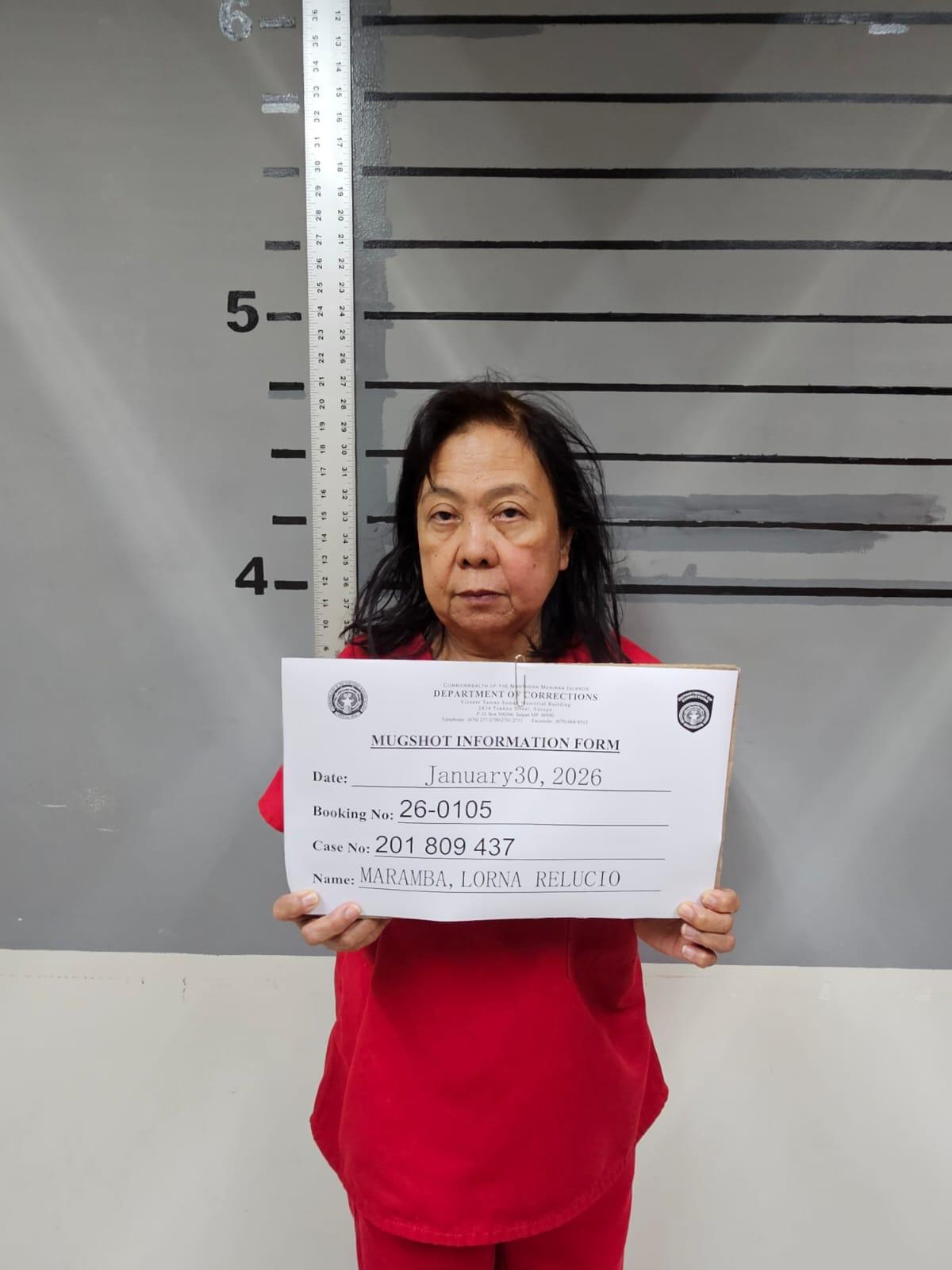
Lorna R. Maramba, a Philippine national accused of possessing fraudulent U.S. permanent resident cards, appeared last Feb. 11 before Chief Judge Ramona V. Manglona in the U.S. District Court for the Northern Mariana Islands, where federal prosecutors confirmed they will proceed on a misdemeanor charge by information instead of seeking a grand jury indictment.
Maramba, wearing red overalls typically issued to federal prisoners, appeared out of federal custody but remained in Department of Homeland Security custody. She was assisted in court by interpreter Crispulo “Chris” Hilario.
Assistant U.S. Attorney Eric S. O’Malley told the court the government had filed the information last Feb. 6 and that it “will govern,” adding that the United States would proceed on the misdemeanor charge and would not seek indictment on a more serious offense.
The U.S. Attorney’s Office charged Maramba with possession of fraudulent identification documents with intent to defraud the United States, in violation of Title 18 U.S.C. Section 1028(a)(4). The offense is punishable by up to one year imprisonment and a fine of up to $100,000.
The court noted that as a Class A misdemeanor, the charge carries a maximum penalty of one year and that Maramba retains the right to a jury trial if she maintains a plea of not guilty. The court also said the penalty could include “zero jail time and zero fine.”
Defense counsel Richard Miller confirmed he had reviewed the information with Maramba. Counsel waived formal reading of the charge and further advisement of rights. Maramba entered a plea of not guilty, which the court accepted.
The parties informed the court that they have reached a sealed plea agreement. Defense counsel indicated that the defense intends to change Maramba’s plea to guilty after he has fully reviewed the plea agreement with her. The court was told Miller would meet with Maramba, together with interpreter Hilario, to go over the wording of the plea agreement to ensure that she fully understands its terms before entering a change of plea.
The court continued the change of plea hearing to Feb. 13, at 1:30pm to allow additional time for that review. Counsel was directed to notify the court of any changes to the plea agreement no later than Feb. 13 at 9am.
A jury trial was set for April 21, 2026, at 10am. Pretrial motions must be filed no later than Feb. 25.
The court also addressed the filing of an expedited presentence investigation report, ordering that it be filed by Feb. 27. Sentencing was tentatively proposed for March 4, with the date to be finalized at the change of plea hearing.
According to the affidavit of Special Agent Hannah Lee of Homeland Security Investigations, the case stemmed from a Jan. 21, 2026, encounter at the Francisco C. Ada-Saipan International Airport.
Customs and Border Protection officers conducting a primary outbound inspection stopped Maramba as she prepared to depart for Hawaii. She told officers she was a green card holder and presented what appeared to be two U.S. permanent resident cards—one black-and-white laminated card and another colored laminated card with distorted lettering and a blurred photo.
The two cards bore different dates of birth, different middle names, and different U.S. Citizenship and Immigration Services numbers. One USCIS number was registered to a different individual. DHS database checks indicated Maramba had no approved application for permanent residence and no approved petition for an alien relative. CBP record checks further showed she was unlawfully present in the CNMI.
After being advised of her Miranda rights, Maramba told HSI agents she worked as an accountant on Saipan and had previously prepared her own CW-1 applications, indicating familiarity with the immigration process.
She said she met a man identified as Adrian Munoz on Facebook who claimed to work as an immigration officer with USCIS and offered to “fix” her immigration papers. Maramba said she was unsure of her legal status and paid Munoz $2,000 via wire transfer in exchange for the suspected fraudulent cards.
Records show Maramba first entered the United States in August 2012 under a CNMI-Only Transitional Worker (CW-1) visa. Although she renewed her CW-1 several times, her last renewal expired in October 2020. An application for an employment authorization card filed in 2020 was denied. Database checks revealed she has no current legal immigration status.
During her interview, Maramba admitted the permanent resident cards were fraudulent. She acknowledged she is unlawfully present in the United States and said it is difficult to obtain employment in the CNMI. She stated she planned to go to Hawaii to earn income.
She also admitted to using Facebook Messenger and WhatsApp to communicate with Munoz and confirmed she paid him $2,000 to produce the cards. In a second interview last Jan. 26, she admitted using a former coworker’s permanent resident card and sending a photo of it, along with her own information, to Munoz.
In her affidavit, Lee stated there was probable cause to believe Maramba “knowingly possessed an identification document (not lawfully issued for their use) with the intent that such document be used to defraud the United States.”
Maramba remains in DHS custody pending further proceedings and is ordered to return to court on Feb. 13 for the scheduled change of plea hearing.
Share this article: