NMC Students Reclaim the Coast with A New Mangrove Planting Initiative
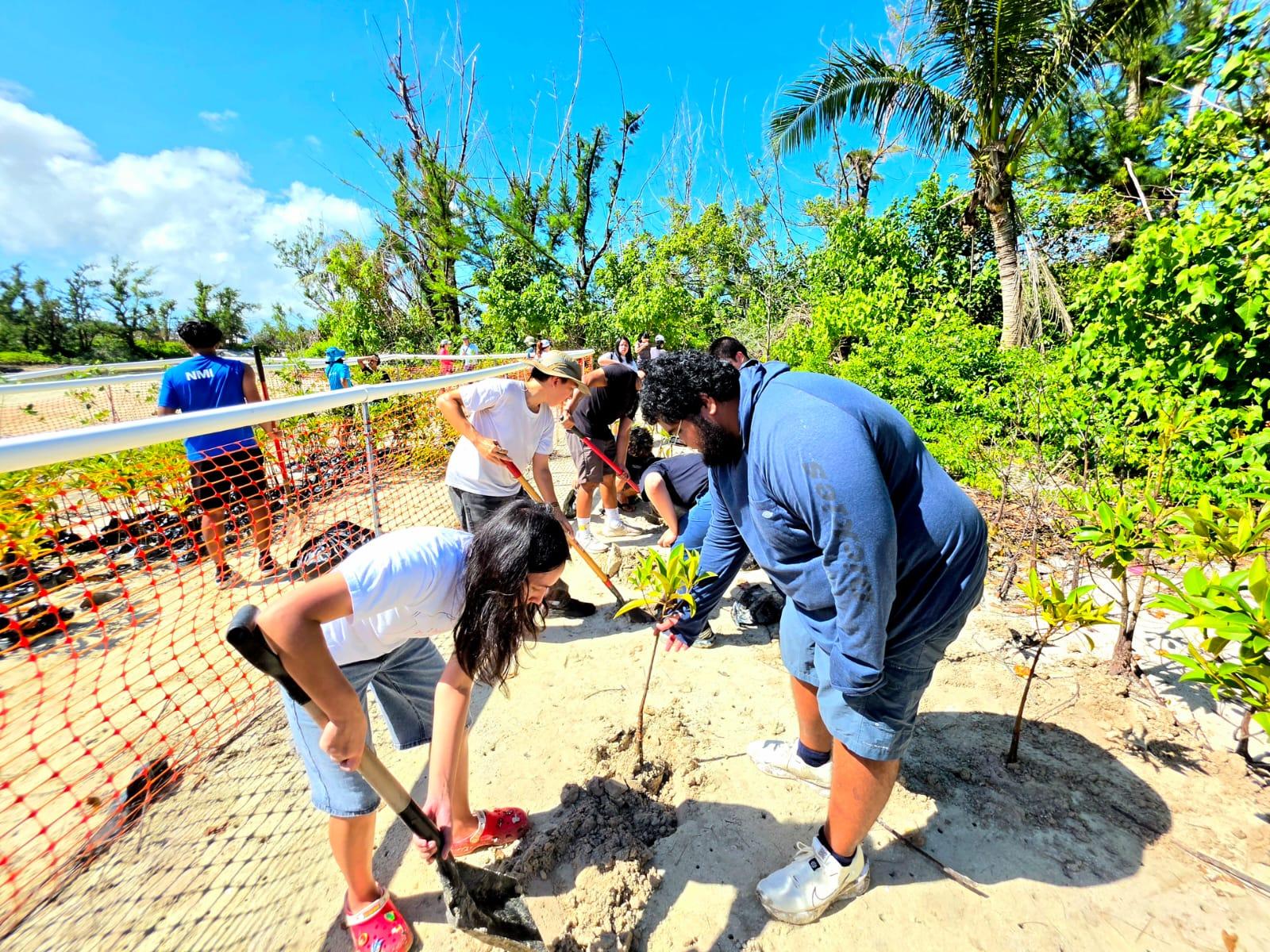
Under the blazing Saipan sun on the morning of October 8, twenty-five college students traded their textbooks for the muddy, tidal trenches of American Memorial Park. They weren't just taking a field trip; they were actively rebuilding their island’s coastline. Led by Zachary Williams of Pacific Coastal Research and Planning (PCRP), the short hike from the parking lot to the shoreline transformed into a living, breathing masterclass on the native mangroves that safeguard the Marianas.
Representing a diverse cross-section of majors—from nursing and business to marine science—these students from Northern Marianas College (NMC) rolled up their sleeves for a critical out-planting mission. They are the latest cohort in Assistant Professor Kelsey McClellan’s Introduction to Natural Resource Management program, learning firsthand that conservation is a contact sport.
The catalyst for this boots-on-the-ground initiative was a brilliant, high-stakes pivot. When Super Typhoon Sinlaku recently battered Saipan, it derailed several large-scale environmental projects. PCRP was left with a critical choice, either return unused NOAA watershed funds, or rapidly redirect them. They chose action. By pivoting the grant toward "shovel-ready" projects, the organization immediately launched a massive expansion of local mangrove nurseries—simultaneously reinforcing the island's storm defenses and carving out tangible career pathways for young scientists.
"With our work and the grants, we secure, we are able to provide vital job opportunities for people right here at home," Williams explained. "As much as I can, I try to hire students currently in or out of NMC. We have a great pool of young scientists looking for local natural resource management jobs... contributing to the conservation of our island."
But planting a forest in the ocean requires tactical precision. McClellan emphasized that the primary lesson of the day was zonation—the strict environmental principle dictating exactly where certain plants can survive based on their tolerance for salt and tidal floods.
"Different species of mangroves have higher survivability in different places," McClellan noted. "You have some that are more able to tolerate an inundation zone, and others that are less adapted to have their roots fully covered. We are tracking and mapping to assess the vegetation's zonation around the coastline." Armed with this knowledge, students learned to follow nature's blueprint, strategically placing sea-loving species like “Rhizophora” right at the water's edge where they naturally thrive.
The work these students are executing serves as a vital frontline defense for Saipan, focusing on Rhizophora mucronata and Bruguiera gymnorrhiza – two hardy native species. The proof of their resilience is already visible. While many of the island’s iconic, non-native flame trees suffered heavy mortality during Sinlaku, the young mangroves planted just before the storm boasted a remarkably high survival rate. As these trees mature and their complex, stilt-like root systems spread, their capacity to absorb catastrophic storm surges and sheer typhoon winds will only multiply.
Beyond acting as an organic seawall, mangroves are active land-builders. Their dense, underwater root matrices trap floating sediment over time. As new seedlings take root in this captured soil, the shoreline literally extends outward. In an era of climate uncertainty, this mangrove-driven land growth is successfully keeping pace with—and in some parts of Micronesia, even exceeding—rising sea levels.
This innovative "coastal-scaping" is also breathing new life into local food webs. The submerged roots act as a bustling aquatic nursery; preliminary camera-trap research has already captured juvenile mafuti and trevally jacks utilizing the mangroves for shelter before braving the open reefs. Above the water, the expanding canopy offers a protected haven for fiddler crabs and native birds, including the vibrant fruit dove.
With this latest batch of seedlings now standing resilient along the coastline, the momentum is only accelerating. Williams is actively navigating the permitting process to construct two cutting-edge nurseries near Peace Park and Lower Base. It’s a visionary cycle by redirecting federal funding to heal the ecosystem, protecting the island from the next storm, and empowering the next generation of Saipan's environmental stewards.
Share this article: