RB eyes safer, cleaner Saipan in second term amid economic challenges
Fresh from a landslide reelection victory, Saipan Mayor Ramon “RB” Camacho is setting his sights on making the island safer and cleaner while confronting a struggling economy, shrinking government resources, illegal drugs, and the challenge of getting residents more involved in their communities.
In an interview with Marianas Press last Nov. 5, Camacho said his second four-year term will build on the priorities of his first administration, particularly crime prevention, village beautification, and greater community involvement.
“My agenda, I'll continue to stick on my Top 3 priorities, which is to promote safe community, safe village and a clean island,” he said.
Camacho won reelection in the Nov. 3 general election, receiving 8,331 votes against fellow independent Joseph Muna Mendiola's 1,892 votes, according to results posted by the Commonwealth Election Commission.
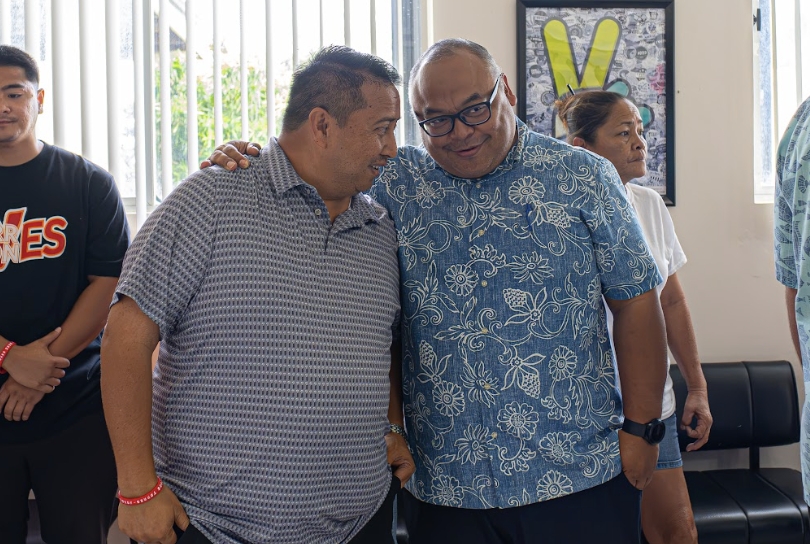
The reelected mayor credited his family, campaign committee, municipal employees, and supporters for his victory, saying voters recognized the work his administration has done over the past four years.
“To be honest, I'm not a politician. You know, I took it as a servant,” he said.
For his second term, Camacho wants to strengthen community-based crime prevention, particularly as the Department of Public Safety faces manpower shortages and illegal drugs continue to threaten the islands.
He said law enforcement officers cannot be everywhere, making residents' participation essential in keeping their neighborhoods safe.
Among his planned initiatives is a village inspection task force involving the mayor's office, sanitation officials, and the Bureau of Environmental and Coastal Quality to address abandoned vehicles, accumulated garbage, and other neighborhood concerns.
Camacho said his administration continues to remove junk vehicles from residential areas and respond to complaints involving stray dogs. He is also considering recognition programs for the cleanest residence, cleanest village, and village with the lowest crime rate.
During the first 100 days of his second term, he plans to meet directly with Saipan's various ethnic communities, including Pohnpeian and Palauan residents, to encourage their participation in municipal programs.
The mayor also wants businesses to become more involved in maintaining public spaces, particularly in western Garapan, where previous revitalization efforts have not always been followed by adequate maintenance.
Camacho said keeping commercial districts clean and safe is essential to attracting tourists and encouraging local consumers to patronize businesses.
Beyond village concerns, Camacho acknowledged that the CNMI's worsening fiscal condition and reduced government funding present serious challenges to delivering basic municipal services.
“You know, this is a very tough, you know, to be honest. We just gotta do the job,” he said.
He expressed frustration over reductions in municipal manpower, saying lawmakers should recognize that mayors are often the first government officials residents approach when problems arise.
Camacho also intends to continue working with his counterparts on Tinian, Rota, and the Northern Islands through a unified mayors' initiative to pursue assistance from the federal government.
According to Camacho, the mayors previously sent a joint appeal to President Donald Trump and the U.S. Congress seeking financial assistance to help the CNMI overcome its economic difficulties.
Another priority is strengthening the fight against illegal drugs. Camacho, a retired police officer, said the mayors have jointly appealed to the Drug Enforcement Administration for additional personnel and resources in the CNMI because of its limited local staffing.
On economic development, the mayor believes Saipan must make better use of its land and marine resources instead of depending almost entirely on tourism.
He proposed making agricultural land available to interested residents for as little as $1 per acre and exploring low-interest financing through the Commonwealth Economic Development Authority for farming and fishing equipment.
Camacho suggested a 1% annual percentage rate for eligible borrowers interested in developing these industries, saying greater food production would help strengthen the islands' economic resilience.
“We need this sustainability and food security. This is serious,” he said.
He pointed to Palau's backyard farming and locally processed agricultural products as examples of how Saipan could develop small-scale food production while creating additional income opportunities for residents.
On seabed mining, Camacho reiterated his opposition to proceeding without a clear understanding of its potential environmental consequences, saying the unified mayors had already communicated their concerns.
As for expanding U.S. military activities in the Marianas, Camacho said local businesses should receive a greater share of the economic opportunities generated by military construction and related projects.
He expressed concern that contractors sometimes procure supplies from outside the CNMI despite the availability of local businesses capable of providing similar goods and services.
Camacho said the mayors have raised these concerns with military officials and encouraged greater consideration of local suppliers and workers.
Despite the economic uncertainty and challenges facing his administration, Camacho said the election results have reinforced his commitment to serving residents regardless of their political affiliation or background.
He thanked the more than 8,000 voters who supported his reelection and credited his municipal employees for helping implement his programs.
“I want to embrace with everybody,” he said. “Because I strongly believe working together is the solution to all problems.”
Share this article: