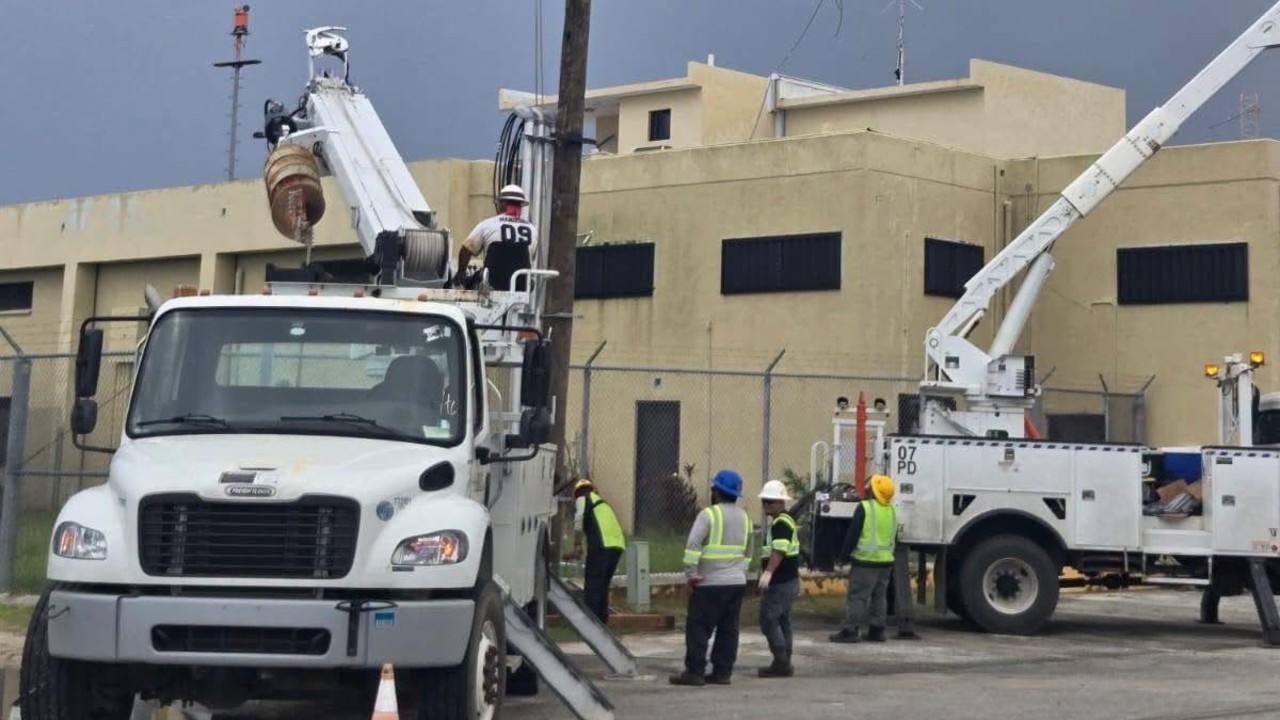
Tinian power restoration faces uphill climb as officials outline damage, temporary fixes
Tinian’s power system remains fully offline in the aftermath of Super Typhoon Sinlaku, with the Commonwealth Utilities Corp. warning that restoration will depend on repairs to heavily damaged infrastructure and the installation of temporary generation.
During a special meeting of the Commonwealth Public Utilities Commission last May 4 in its office at the Marianas Business Plaza, CPUC member Bruce Camacho pressed CUC executive director Kevin Watson for clarity on the island’s situation, including contingency plans and timelines for restoring electricity.
“All power feeders remain offline,” Watson said, noting that 1,059 customers on Tinian are still without service, including 743 residential accounts. He added that damage assessments are about 90% complete, with at least 111 power poles and 55 transformers identified as damaged.
Camacho raised concerns about earlier discussions with federal officials regarding temporary generation support, saying he had been told the U.S. military was considering deploying additional capacity.
“I was asking if he was aware of Tinian’s power plant situation, and he was telling me that the Navy had plans to ship over a 2.7-megawatt generator,” Camacho said.
Watson confirmed that such a request had been made, emphasizing that the island’s existing generation facility suffered extensive storm damage.
“Yes, we put in that request,” Watson said. He explained that the power plant’s roof and side panels were severely damaged, leaving engines and control systems exposed. “A lot of the roof was damaged and blown away as well as the side panels, and that we have to get repaired before the engines can be dried out and worked on.”
The extent of the damage has forced officials to rely on temporary measures while longer-term repairs are underway.
Critical facilities such as the Tinian hospital are currently operating on backup generation.
“What’s powering up the hospital down there in Tinian?” Camacho asked.
“Yes,” Watson replied, confirming that the hospital is running on a generator, either Federal Emergency Management Agency-supplied or its own.
Camacho also cited reports that the island’s generators and control systems were broadly impacted.
“I was also reading where the delegate mentioned that pretty much all the generators for the engines in Tinian was damaged,” he said.
Watson agreed, adding that the damage went beyond mechanical components. “Yes. And the control circuits as well.”
He said repairs to the plant must first focus on restoring the building envelope to allow equipment to dry out safely, a process that could take time given the complexity of electrical systems.
“Pending repairs to the power plant building in order to dry in the generators,” Watson said, describing ongoing cleanup, debris removal, and securing of equipment.
Despite the widespread outages, officials noted that Tinian’s generation capacity—estimated at 8.8 megawatts before the storm—remains theoretically sufficient once repairs are completed, as pre-typhoon peak demand was only about 2.3 megawatts. However, the challenge lies in restoring both the plant and the distribution network.
On Saipan, the storm knocked out power to 15,624 customers, with restoration proceeding in phases as crews repair damaged feeders and infrastructure. Officials reported 624 downed power poles and 552 damaged transformers, representing about 5% of poles and 13% of transformers on the island.
Some areas have been partially energized, including critical facilities such as the hospital, while crews continue work on transmission and distribution lines. Officials said progress is expected to accelerate with additional personnel and equipment, though full restoration could take up to 90 days.
On Rota, power service has largely returned. Feeder 1 is 100% energized, while Feeder 2 is about 95% energized, leaving only a small number of residential and commercial customers without power due to localized damage such as weatherheads and meter boxes.
Water production on Saipan has recovered significantly with the help of temporary generators installed at well sites.
“As of May 3rd, we are producing 7.8 million gallons of water per day,” Watson said. He noted that this represents about 68% of pre-typhoon production levels of 11.5 million gallons per day.
Service remains uneven, with some areas receiving 24-hour water and others on partial schedules depending on system pressure and infrastructure conditions.
On Tinian, water service remains tied to ongoing power restoration and generator support, with crews continuing debris removal and system assessments.
Rota’s water system has returned to normal operations as of April 23, with infrastructure largely intact compared to the other islands.
Share this article: