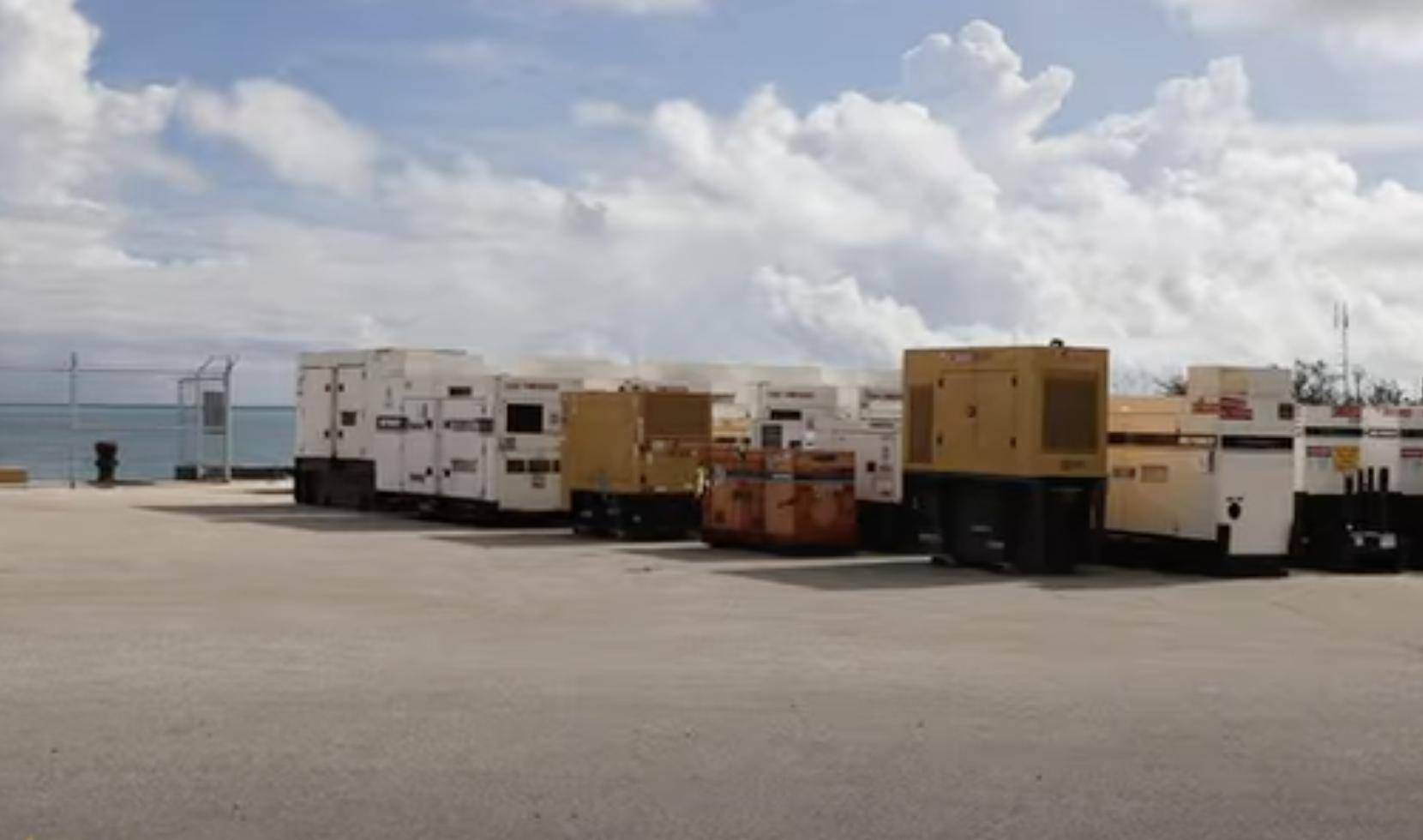
The U.S. Army Corps of Engineers has removed the last of its emergency generators from Saipan and Tinian, marking a major recovery milestone more than two months after Super Typhoon Sinlaku devastated the CNMI’s power infrastructure.
In a social media post last June 22, the USACE Temporary Power Planning and Response Team announced that all temporary generators installed following the storm have now been deinstalled as the Commonwealth Utilities Corp. reconnects critical facilities to permanent power sources.
The temporary generators were provided by the Federal Emergency Management Agency.
"Temporary power demobilizing is a good thing because that means that the CUC here on Saipan and Tinian have been able to hook up critical infrastructure back to the permanent grid and we are now able to remove our temporary generators allowing them to provide permanent power for the people of CNMI," said Capt. Zach Bailey, mission commander for the Temporary Power Planning and Response Team from the Honolulu District.
Bailey said USACE installed 128 generators on Saipan and Tinian during the emergency response effort.
The temporary power team initially deployed to Guam last April 11 before moving to Saipan last April 18 as part of the federal response to Sinlaku.
The generators provided emergency electricity to water wells, sewage lift stations, and other critical facilities while repairs to the islands' power grid were underway.
The milestone comes as CUC completes the transition of critical infrastructure back to permanent power ahead of the July 9 expiration of FEMA's 100% federal cost-share arrangement for emergency generators.
CUC executive director Kevin Watson said the utility was on track to complete the transition away from FEMA generators.
"So we should be in good shape in Saipan to keep on schedule for the FEMA to be able to do the maintenance that they need to do, crate it up and ship it back to Guam," Watson said during a Commonwealth Public Utilities Commission meeting last June 18 at the Marianas Business Plaza,
At the height of the recovery effort, FEMA deployed dozens of generators to keep critical infrastructure operating while utility crews worked to restore damaged transmission and distribution systems.
"At one point we had 45 generators from FEMA powering either water wells or lift stations," Watson said.
Those generators are now being removed as facilities are returned to the power grid.
Watson said the transition back to permanent power was also underway on Tinian.
He said FEMA had been operating a generator at the Carolina Heights booster station to maintain adequate water pressure for residents at higher elevations. CUC recently installed a new pump and pressure tank while crews worked to connect the facility to permanent power.
"We were also in line to get CUC 10 million grid power to that booster," Watson said, adding that officials expected the booster station to be energized and connected to the grid before FEMA removed its generator.
CUC is also working to restore permanent power to the Tinian airport before another FEMA generator is withdrawn.
"I've been in communication with the manager CPA and letting her know that we should have grid power to the airport within two to three days," Watson said.
The executive director also reported that Saipan has returned to full-time water service.
"We have 24-hour water throughout the island of Saipan," he said.
Watson said the utility remains within the period during which FEMA is covering 100% of eligible disaster recovery costs.
"We will be under the time period where FEMA will be paying 100% of the costs that we incurred," he said.
Earlier this month, Watson warned that continued reliance on FEMA generators beyond that date could expose the utility to significant costs—$120,000 per day—while it worked to reconnect water and wastewater facilities using newly arriving transformers and other equipment needed to restore normal operations.
Share this article: