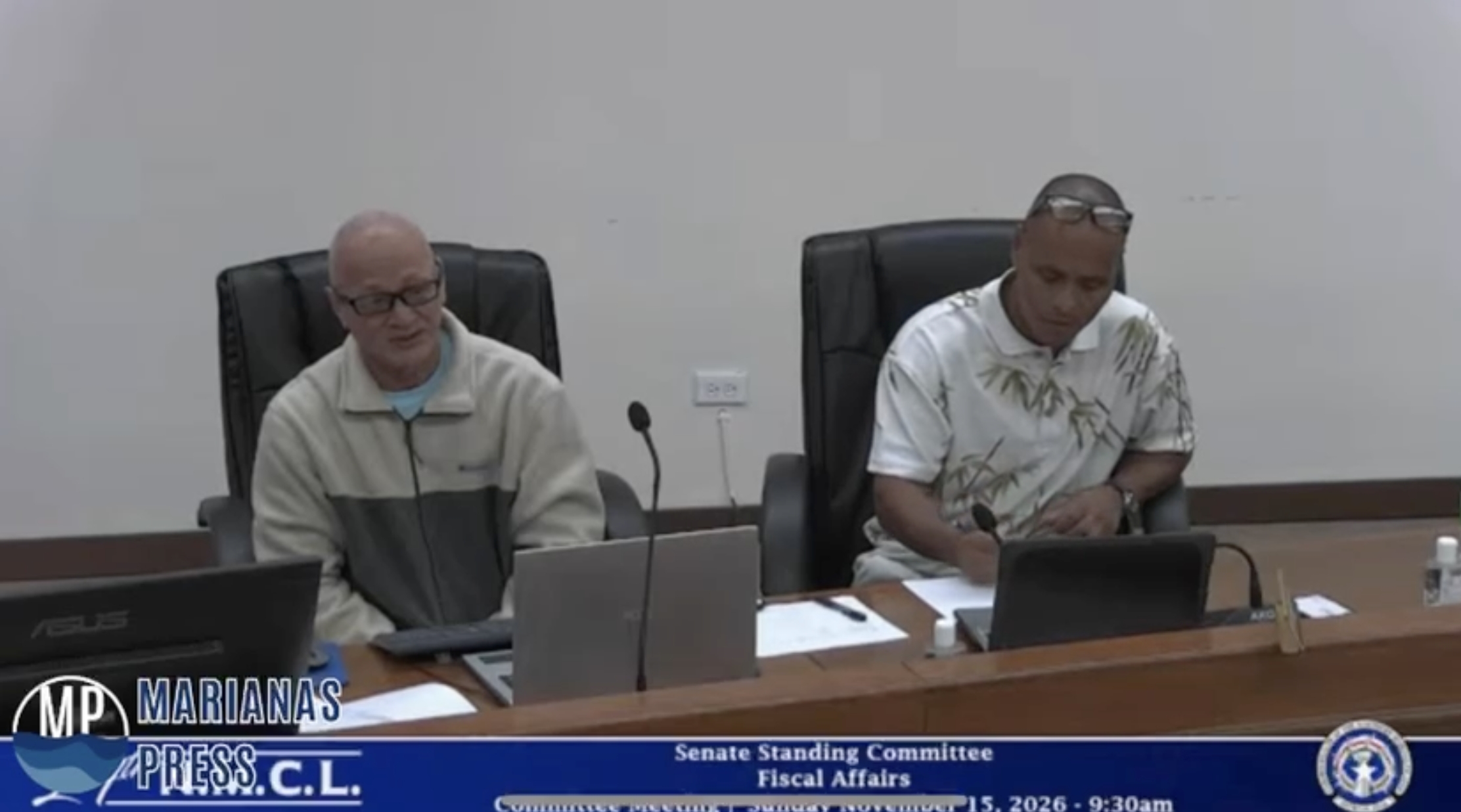
The billing practices of the Commonwealth Utilities Corp. came under scrutiny last Nov. 16 as the CNMI Supreme Court heard oral arguments in the utility’s appeal involving $541,702.47 in alleged power undercharges involving Coca Cola Beverage Company Micronesia, Inc.
While CUC attorney Michael N. Evangelista defended the utility’s computation of the undercharges, Coca-Cola attorney Steven P. Pixley questioned CUC’s compliance with its own regulations and raised concerns about the ability of ordinary customers to challenge disputed charges.
Chief Justice Alexandro C. Castro and associate justices John A. Manglona and Roberto C. Naraja took the matter under advisement following the nearly hour-long hearing.
Both lawyers declined to comment when approached by Marianas Press after the hearing.
Evangelista argued that the administrative hearing officer’s decision was supported by evidence and that the Superior Court erred in questioning the methodology used by CUC in computing the undercharges from January 2007 to June 2013.
He explained that CUC arrived at the amount by averaging Coca-Cola’s power consumption before its digital meter malfunctioned and its subsequent consumption after the problem was corrected.
Manglona sought clarification on how CUC arrived at its computations, particularly the significant increase in estimated power consumption between 2006 and 2007.
Evangelista maintained that the methodology was consistent with CUC regulations and yielded the most accurate estimate of Coca-Cola’s power consumption during the disputed period.
The CUC lawyer also argued that the Superior Court overstepped its authority in directing the utility to undertake additional billing procedures, saying CUC already had a system in place to address billing disputes.
Manglona, meanwhile, raised the issue of the lack of detailed monthly billing statements in CUC’s demand for payment.
For his part, Pixley argued that Coca-Cola had repeatedly sought to resolve the billing dispute, but that CUC failed to respond to its complaints within the 20-day period prescribed by its regulations.
He said a Coca-Cola representative requested an informal settlement conference as early as April 2014, but that CUC failed to act on the request.
Pixley said the company instead received a demand letter from CUC in January 2017, nearly four years after the meter problem was corrected.
Citing testimony during the administrative hearing that CUC received approximately 1,000 billing disputes annually, Pixley questioned how many of the utility’s customers had the resources to wage a protracted legal battle over disputed charges.
He argued that requiring CUC to abide by its own regulations was also a matter of public policy.
Pixley also brought up CUC’s initial allegations of meter tampering, which Evangelista said were subsequently dropped due to insufficient evidence. Evangelista said an investigation found that two wires were incorrectly connected but could not establish who was responsible.
Another point of contention was whether Coca-Cola had properly raised the issue of the sufficiency of evidence in its petition for judicial review.
Evangelista argued that the issue had not been properly preserved for judicial review, while Pixley maintained that the arguments were contained in documents incorporated into the petition.
In his rebuttal, Evangelista disputed several of Pixley’s assertions and reiterated his arguments regarding the alleged deficiencies in Coca-Cola’s petition.
In a July 11, 2025, decision, Superior Court Associate Judge Lillian A. Tenorio ruled that while substantial evidence supported findings on the existence and duration of Coca-Cola’s digital meter malfunction, CUC failed to present sufficient evidence to substantiate its calculation of the undercharges.
Tenorio also found deficiencies in CUC’s demand letter, including its failure to cite applicable rate schedules, itemize charges by billing cycle, and disclose the methodology used to compute the undercharges.
On Sept. 15, 2025, Tenorio denied CUC’s motion for reconsideration.
The lower court did not bar CUC from recovering the undercharges, but remanded the matter for further administrative proceedings to ensure that the utility’s estimate complied with its own regulations and was supported by substantial evidence.
Share this article: