Hofschneider pushes EVS-TAP as US Senate chair presses him on China visa waiver
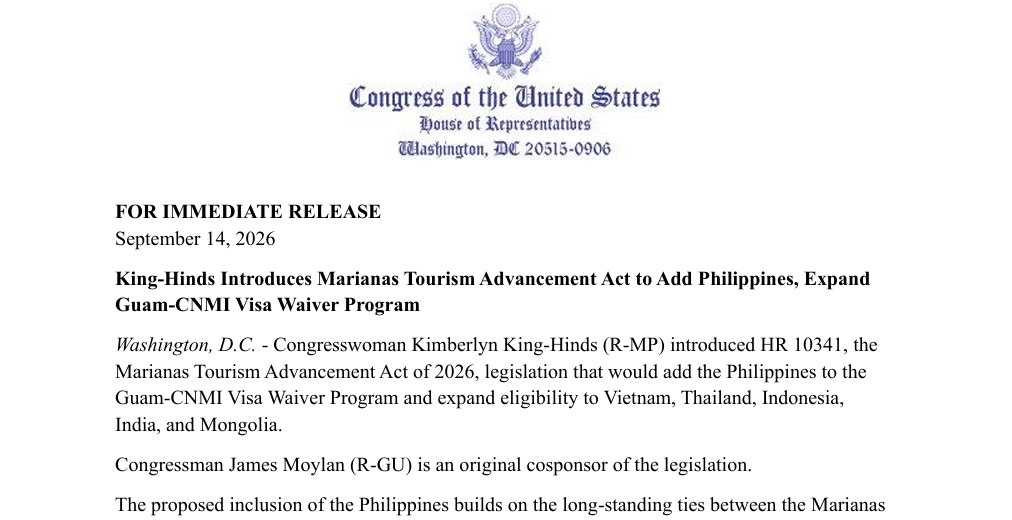
Gov. David M. Apatang's chief of staff, Henry Hofschneider, urged federal lawmakers Wednesday to preserve and strengthen travel programs critical to the CNMI's tourism industry, including the Economic Vitality and Security Travel Authorization Program, or EVS-TAP, and secure travel pathways for key visitor markets such as the Philippines.
Appearing before the U.S. Senate Energy and Natural Resources Committee on behalf of Apatang, Hofschneider said tourism remains the Commonwealth's primary economic engine and is essential to recovery from Super Typhoon Sinlaku, the pandemic and years of economic decline.
The hearing also featured a pointed exchange between committee chairman Sen. Mike Lee and Hofschneider over visa-free entry for Chinese visitors, highlighting the tension between national security concerns and the CNMI's dependence on tourism.
When Lee asked whether citizens of China should be allowed to enter a U.S. territory without a visa, Hofschneider initially replied, “They shouldn't, but there are other ways for other nationals to enter the CNMI without a visa.”
Lee then asked whether he agreed the program should be closed to Chinese nationals.
“Chairman Lee, that's a very difficult question to answer because our economy depends on tourism,” Hofschneider responded.
Pressed further on whether tourism dollars should outweigh national security concerns, Hofschneider said, “Of course not, but there's got to be a way to make them both work at the same time.”
Lee later told Hofschneider he was “not confused” by the answers and asked him to explain the distinction.
“What I'm saying is we need to work on a system that would protect national security and protect the CNMI's economy as well,” Hofschneider replied.
Earlier in his testimony, Hofschneider stressed the importance of EVS-TAP and other travel programs.
“This is why the Economic Vitality and Security Travel Authorization Program, EVS-TAP, and secure travel pathways are so important,” he said.
He urged federal officials to consider additional options for allied countries.
“We ask for serious consideration of secure travel pathways for the Philippines and other appropriate visitor markets,” Hofschneider said.
He noted that the Philippines has strong family and historical ties to the CNMI and could help diversify visitor arrivals.
Hofschneider also focused on the Commonwealth's energy challenges, telling senators that rising fuel costs and aging infrastructure continue to strain government finances and essential services.
“Our hospital cannot run on promises. Our economy cannot recover on promises. We need power that works every day, including after storms,” he said.
Later in the hearing, Hofschneider noted that the CNMI's power plant is more than 50 years old and said the Commonwealth is exploring a mix of conventional generation, solar energy, geothermal development and emerging technologies such as small modular reactors as it seeks to modernize its power system.
The chief of staff also highlighted longstanding concerns involving veterans healthcare in the CNMI, saying many veterans face delays in obtaining services and often must travel off-island for treatment.
“Veterans are ... they need services, medical services, answers from the veteran office. It takes time,” he said.
Hofschneider said veterans frequently travel to Guam for tests and treatment, adding that airfare alone can cost hundreds of dollars.
Deep-sea mining was another major issue discussed during the hearing.
Hofschneider reiterated Apatang's opposition to deep-sea mining and called for more meaningful consultation with island communities before federal officials advance any mining plans near the Mariana Islands.
“We need more meetings, more meaningful consultation,” he said.
“It doesn't just mean that we look at the environmental or the ecosystem that might be damaged. We need to look at our economic livelihood.”
Hofschneider said proposed mining areas now surround portions of the Mariana archipelago and raised concerns about impacts on fisheries, shipping, military operations, culture and the economy.
Guam Gov. Lou Leon Guerrero echoed those concerns, saying Pacific island governments have not been adequately included in discussions regarding seabed mining proposals.
“We want actually face-to-face communications,” Guerrero said.
She said Guam and the CNMI were surprised by the speed at which the federal process has advanced and called for more direct engagement with island communities.
Guerrero also urged Congress to revisit federal cabotage restrictions, arguing that allowing foreign airlines to transport passengers between Guam and the U.S. mainland could reduce airfare costs and improve economic opportunities throughout the Pacific.
“Removing the Cabotage Law is going to do a lot to improve commerce and the economy for islands in the Pacific,” she said.
American Samoa Gov. Pula Nikolao Pula told senators that Pacific fisheries are facing increasing competition from China and stressed the importance of maintaining a strong American presence in the region.
“China has now dominated our areas,” Pula said, noting that American Samoa's StarKist cannery remains a critical component of the U.S. tuna industry.
Pula said American Samoa remains opposed to deep-sea mining but would seek environmental safeguards, meaningful consultation and revenue sharing if the federal government eventually proceeds.
“I am against mining. However, should the federal government move forward ... we would very much appreciate revenue sharing,” he said.
Pula also framed the issue as part of a broader geopolitical competition in the Pacific.
“I don't want my grandchildren to speak Chinese 20 years from now,” he said. “I want the United States to have power over energy.”
During the hearing, senators entered into the record a joint letter from Guam and the CNMI seeking a pause in the federal deep-sea mining process while additional consultation with island communities takes place.
Throughout the hearing, territorial leaders repeatedly emphasized that Pacific communities should have a greater voice in decisions involving tourism, transportation, healthcare, energy infrastructure and offshore resource development.
Following the Senate hearing, both the Marianas Visitors Authority and the Hotel Association of the Northern Mariana Islands urged federal policymakers to retain the EVS-TAP Program, arguing that it remains a critical component of the CNMI's tourism recovery.
MVA board chair Warren Villagomez said security and economic development are not mutually exclusive, noting that EVS-TAP can continue under strict federal screening, vetting, accountability, and oversight. The agency also expressed support for exploring other secure travel options, including a possible visa-waiver program for Philippine visitors.
HANMI chair Ivan Quichocho similarly said the hospitality industry remains fragile, with visitor arrivals, airline capacity, and business activity still well below pre-pandemic levels.
Both organizations noted that Chinese visitors accounted for more than 40% of arrivals before the pandemic and helped sustain hotels, restaurants, retailers, transportation providers, and other tourism-related businesses. They warned that eliminating EVS-TAP without a viable alternative could further hinder efforts to restore air service, jobs, and economic activity, while emphasizing that strong border security and economic opportunity can coexist.
Share this article: