CNMI officials renewed their push to include the Philippines in the Guam-CNMI Visa Waiver Program, saying the proposal would strengthen tourism, reunite families and help diversify the Commonwealth's visitor economy during the inaugural Guam-CNMI Visa Waiver Working Group meeting held last July 22 at the Guam International Airport Authority Board Conference Room.
The meeting brought together officials from Guam, the CNMI, and the Philippine government to discuss the economic, tourism and security considerations surrounding a possible request to the U.S. Department of Homeland Security.
Representing CNMI Gov. David M. Apatang, CNMI Council of Economic Advisers co-chair and Marianas Visitors Authority board member Joe C. Guerrero said the Commonwealth has been pursuing Philippine inclusion through several avenues, including the Section 902 consultations with the U.S. government.
"I've been working with... others for some time on this effort to include the Republic of the Philippines among the countries under the Guam-CNMI visa waiver program," Guerrero said.
Guerrero said the proposal is supported by centuries of shared history and economic ties between the Marianas and the Philippines.
"Today, reestablishing this trade route between the Philippines and the Mariana Islands is a key component of the Marianas' efforts to grow and strengthen economic opportunities, especially for the Northern Marianas who continues to be challenged in recovering economically," he said.
CNMI House Tourism Committee chair Rep. Marissa Renee Flores said the initiative extends beyond economics and tourism.
"This is not just about tourism. This is not about job opportunity. This is also about family and connecting our families together," Flores said.
Flores also revealed that she has Filipino roots.
"I have family members and I believe that I am very much Filipino in blood. My great, great, great grandmother I have been told is from the Philippines," Flores said.
She said the working group builds upon earlier discussions with officials from the Philippine Bureau of Immigration and is intended to assemble the economic, tourism and security information needed to support a federal request.
"This is not an abstract policy exercise. It is a conversation about jobs, about airlines, about the visitors who sustain our hotels, our tour operators, our small businesses, but most of all families," Flores said.
Flores also pledged the committee's continued involvement in the effort.
"I will remain a full and active partner as this working group moves from this meeting towards a responsible well-supported request to the federal government," she said.
MVA board Chair Warren F. Villagomez thanked Guam leaders, CNMI officials, and members of the Philippine delegation for supporting the initiative, saying closer regional cooperation would strengthen the islands' economy.
"[A]ligning our needs definitely will... get to where we want to get to," Villagomez said as he described the effort to build greater economic resilience for the Marianas.
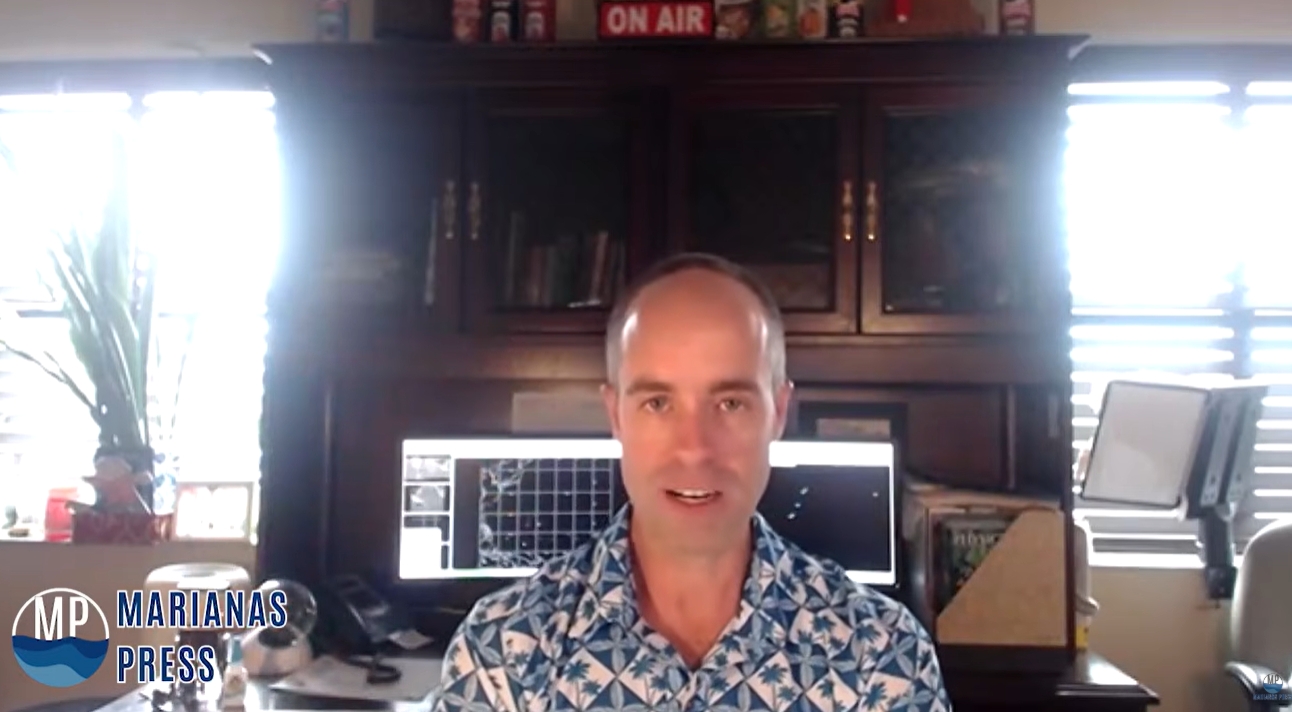
The working group also heard, via Zoom, a presentation by Roseann M. Jones, PhD, dean and professor of economics at the University of Guam's School of Business and Public Administration.
In her presentation, Jones argued that expanding the Guam-CNMI Visa Waiver Program to include the Philippines could diversify the visitor market and strengthen the region's long-term tourism economy. According to her presentation, Guam and the CNMI remain heavily dependent on Japan and South Korea for visitor arrivals, while the CNMI has experienced a roughly two-thirds decline in air-seat capacity since fiscal year 2018.
According to Jones' presentation, approximately 25,000 Philippine visitors already travel to Guam annually despite U.S. visa requirements. She described that figure as a "lower bound on latent demand," arguing that "the question is magnitude, not direction" if visa requirements for travel limited to Guam and the CNMI were eased.
Using a baseline direct visitor expenditure estimate of about $450 per traveler, Jones' presentation projected additional annual direct visitor spending ranging from approximately $5.6 million under a conservative scenario to $22.5 million under a robust scenario, with a central estimate of about $11.3 million in new direct spending each year. The presentation noted those estimates excluded multiplier effects, additional tax revenues, expanded cargo activity and other secondary economic impacts.
Jones' presentation also emphasized that the proposal would remain narrowly tailored. According to the presentation, the waiver would apply only to short-term visits of up to 45 days for business or pleasure, would not authorize employment or study, and would be limited to Guam and the CNMI. It further suggested that any implementation could include biometric passport requirements, enhanced information-sharing and a phased or pilot approach subject to periodic federal review.
In her Zoom presentation, Jones described expanding the Guam-CNMI Visa Waiver Program to include the Philippines as "a low-cost, reversible, administratively bounded action" that, if approved, could diversify the visitor economy, support neighborhood businesses, generate recurring public revenue and strengthen regional economic resilience while remaining consistent with U.S. strategic interests in the Indo-Pacific.
Share this article: