Senate unanimously approves amended $40M CUC financing bill
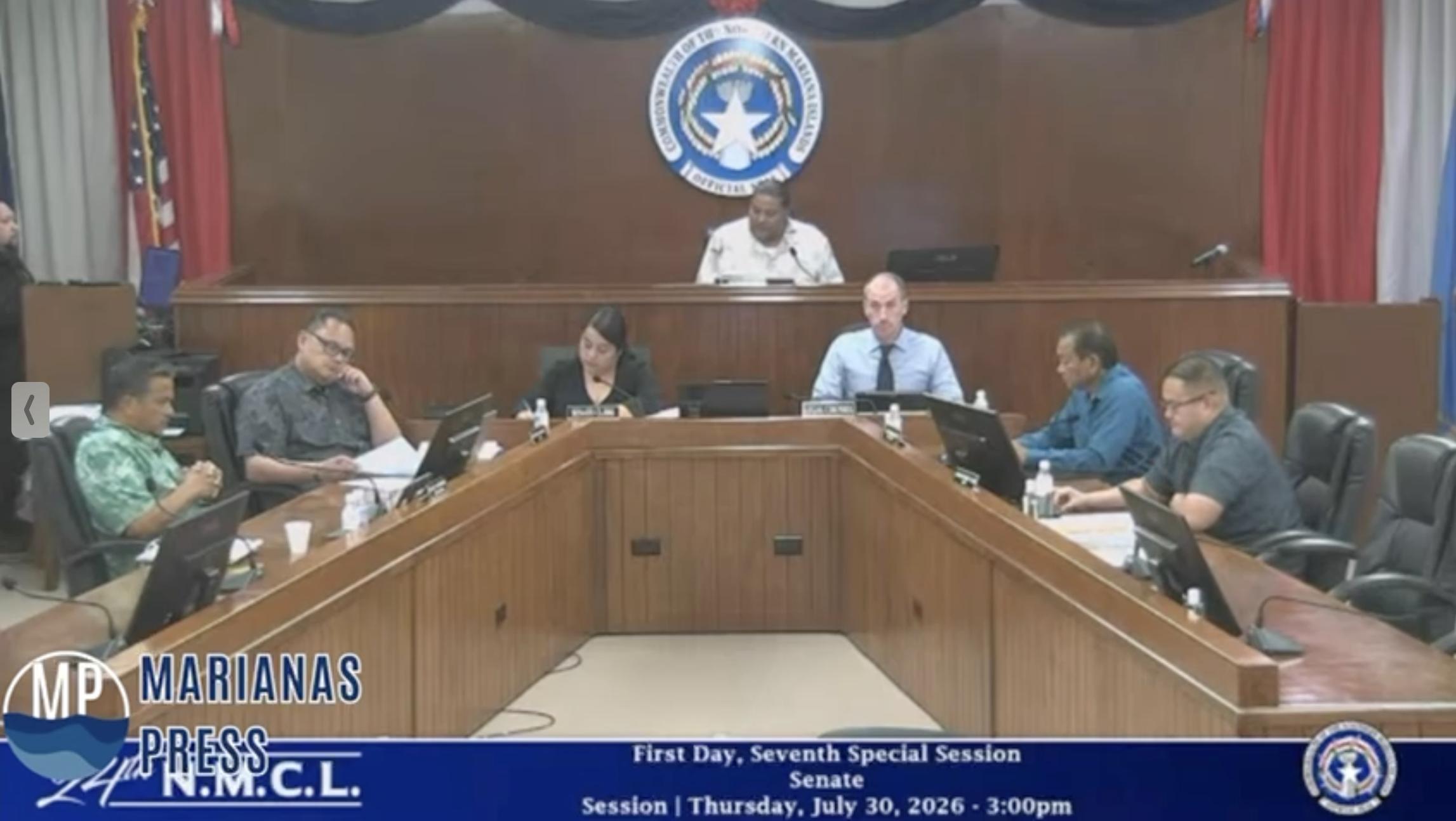
The Senate last Thursday, July 30, unanimously passed an amended bill authorizing the Commonwealth Utilities Corp. to obtain up to $40 million in emergency financing for utility restoration, stabilization, and fuel procurement following super typhoons Sinlaku and Bavi, sending the measure back to the House of Representatives because of Senate amendments.
House Bill 24-107 HD1 was amended on the Senate floor into House Bill 24-107 SD 1 before receiving unanimous support from the seven senators present—Senate President Karl R. King-Nabors and Sens. Manny T. Castro, Francisco Q. Cruz, Jude U. Hofschneider, Donald M. Manglona, Paul A. Manglona, and Ronnie M. Calvo. Paul Manglona and Calvo participated remotely.
The Senate first unanimously adopted four amendments introduced by Castro before unanimously passing the amended measure. Because the Senate changed the House version, the bill now returns to the House for concurrence before it can be transmitted to Gov. David M. Apatang for consideration.
According to senators' floor discussion, the amendments include removing residential customer security deposits from collateral that could be pledged for financing while retaining commercial and government security deposits. Lawmakers also discussed allowing certain Commonwealth Economic Development Authority dividend payments to serve as additional security to strengthen CUC's ability to secure more favorable financing terms.
Before floor debate began, CUC legal counsel Michael Ernest, chief financial officer Betty Terlaje, and executive director Kevin Watson urged senators to approve the amended legislation.
Ernest told lawmakers the proposed amendments would make the bill more attractive to potential lenders, allowing CUC to obtain financing under more favorable terms while reducing borrowing costs that could otherwise be passed on to ratepayers.
Terlaje said the revisions would give CUC greater flexibility to negotiate loans or lines of credit and help minimize the financial impact on residential and commercial customers.
Watson said the financing authority would allow CUC to accelerate restoration work, noting that more than 4,000 customers across Saipan, Tinian, and Rota were still without electricity.
During floor discussion, Hofschneider thanked CUC management and employees for their work following the twin disasters and said the legislation was intended to help address the utility's liquidity challenges.
"I hope that this exercise today by this house would narrow the gap," Hofschneider said.
He said the Senate's amendments removed residential customer security deposits from the proposed collateral while preserving commercial and government deposits and adding another financial asset that could strengthen CUC's ability to obtain a line of credit.
Donald Manglona, meanwhile, said residents deserve more detailed communication from CUC about restoration efforts, including realistic timelines and the challenges delaying power restoration.
"I hope that with our vote today ... we see a much quicker response," Manglona said.
He also urged CUC to provide more information so residents can better understand what to expect as recovery continues.
Castro, chairman of the Senate Public Utilities, Transportation and Communications Committee, defended the legislation, saying senators had been working for weeks to provide CUC with the authority needed to obtain financing.
"The issue is a cash flow and CUC needs it so that they can help our community," Castro said.
He said the measure would allow CUC to leverage available financing to purchase transformers, utility poles, and other materials needed to restore utility service while positioning the corporation to seek federal reimbursement.
Paul Manglona, speaking remotely, voiced support for the measure while emphasizing the importance of providing CUC with the manpower, financial flexibility, and oversight needed to continue restoration work on Rota following Super Typhoon Bavi.
Calvo likewise backed the legislation and stressed the importance of supporting utility workers responding to the disaster.
"Reliable utilities are not a luxury. They're essential to public health, public safety, and our economy and the daily lives of every resident and businesses throughout the Commonwealth," Calvo said.
He said extraordinary emergencies require timely action and that the measure provides CUC with the flexibility needed to restore essential utility services while helping lessen future financial burdens on ratepayers.
Following the session, Terlaje said the Senate's changes were necessary to improve the corporation's chances of obtaining competitive financing.
"The amendments are needed to get the best financing terms. Otherwise, if the Senate passes it the way the House advanced it, it would be very costly for the ratepayers or we might not even get interested lenders," she said in a statement provided to Marianas Press.
Share this article: