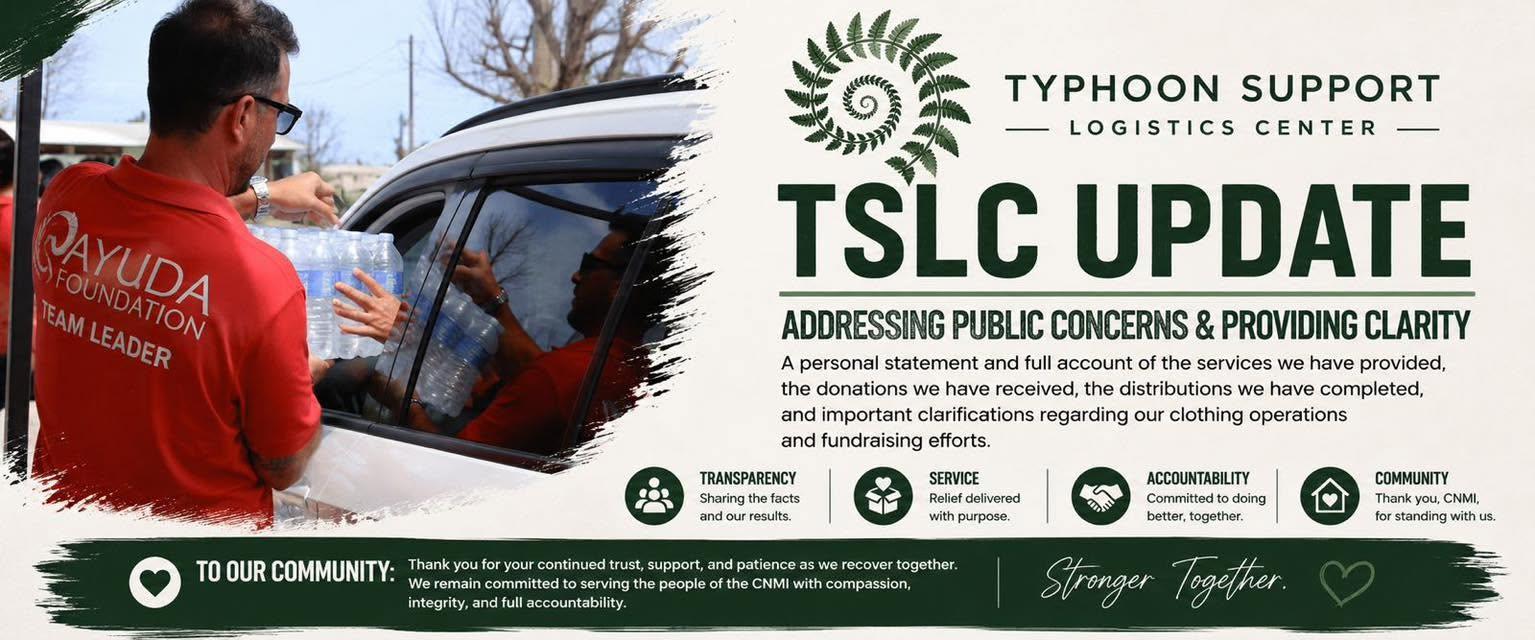
TSLC Team Lead Kai Murrell: In Support and Defense of Tatiana Hunter and the TSLC Clothing Team
Tuesday, June 23, 2026
3:06pm
Personal Statement from TSLC Team Lead Kai Murrell
In Support and Defense of Tatiana Hunter and the TSLC Clothing Team
Before we begin any public recap of the Typhoon Logistics Support Center’s efforts and accomplishments over the last two months, I must first address a serious issue our team has faced in recent days: the public defamation, personal attacks, and misrepresentation directed at one of our valued volunteer team leaders, Tatiana Hunter.
Tatiana is a mother, educator, community volunteer, and the Clothing Team Lead who stepped forward when the TSLC was faced with an overwhelming and urgent need. She did not create this situation. She did not act alone. She did not act for personal gain. She responded to a real need, under leadership direction, in service of our community.
Any issues, comments, questions, or concerns about the actions of TSLC volunteers should be directed to me personally as the lead of the TSLC. My name is Kai Murrell. I take full responsibility for the actions, approvals, and operational direction of my team. If anyone has concerns that are not addressed in this statement, they may reach me through our Helpline operators at or through the TSLC social media platform, @typhooncentercnmi on Instagram.
First and foremost, the actions taken by our Clothing Team were preapproved and were run through TSLC leadership and concerned parties. The thrift-style pop-up fundraising efforts were not created by Tatiana acting independently. They were developed in response to real operational strain, staffing shortages, storage limitations, and immediate funding needs. The purpose was not profit. The purpose was survival of the operation and continued service to the public.
Clothing sold during the two $5 fill-a-bag thrift pop-up days came from local clothing drives and Ayuda Foundation donations generously provided by Guam donors. Donations from our stateside familia were either still moving through inventory, already separated for future free distributions and Helpline orders, or already distributed through free community distributions held in recent weeks. The accusation that volunteers pocketed or personally benefited from this effort is false and unacceptable.
One hundred percent of proceeds from these thrift efforts are required to be absorbed back into TSLC operations. Specifically, the money generated was intended to support immediate operational needs such as gas for our delivery van and diesel for our temporarily donated forklift during a week of active deliveries, distributions, warehouse movement, and partner support.
The first thrift pop-up generated $515 after selling well over 100 bags, with the team being intentionally generous with the bag limit in order to move more clothing into the hands of the public. The second thrift pop-up generated an additional $580 with a similar turnout and the same community-first approach. These amounts are not “profits” in the way some have described them online. They are emergency operating funds for a relief center facing serious funding and staffing concerns.
Our operation runs entirely on the goodwill, free time, willingness, and commitment of volunteers. The public’s ability to access, receive, sort, and distribute donated goods depends on these volunteers choosing to keep showing up. The same people being attacked are the people who have carried bags, sorted soiled clothing, loaded vans, answered needs from families, distributed goods to shelters, and worked through exhaustion to keep relief moving.
My team includes educators responsible for the well-being of future generations, parents taking time away from their own families, faith leaders, nonprofit workers supporting survivors of domestic and sexual violence, women uplifting other women, youth and young adults trying to make a difference, diaspora community members doing whatever they can from afar, and residents who experienced the same typhoon and are still recovering themselves. Many have worked long, physically demanding days without pay and without personal benefit.
Please, pot fabot, be gentle with how you refer to our volunteers and teams. Without them, none of this would be possible. Without them, the TSLC will cease to exist.
The Typhoon Logistics Support Center was built as a comprehensive, community-based response to typhoon-related needs across the CNMI. Through the CNMI VOAD Helpline and through partnerships with nongovernmental organizations, TSLC has helped receive, organize, inventory, and distribute donated goods to individuals, families, shelters, partner organizations, and vulnerable populations.
TSLC is spearheaded by representatives from Ayuda Foundation Guam, CNMI Women’s Association, Micronesian Climate Change Alliance, Project Buddy Check 670, and the Northern Marianas Coalition Against Domestic & Sexual Violence. Through these organizations and dedicated volunteers, TSLC operates the CNMI VOAD Helpline, coordinates container arrivals from Guam, Hawaii, and the continental United States, organizes donated goods, and distributes relief supplies throughout the CNMI community.
Timeline
The TSLC did not begin as a clothing operation. In the earliest stages of relief, Ayuda Foundation activated its disaster response team to organize support from Guam. After donation operations began on Guam, I was sent to Saipan as the local team lead once storm conditions cleared and travel was possible. Upon arrival, I partnered with Becky Dania Mettao from the CNMI Women’s Association, who became our local counterpart and liaison throughout the response.
April 17 - “All Clear” declared for Saipan, Tinian, and Rota
April 18 - Our team coordinated and facilitated the arrival of pallets of water in Kagman for public distribution via helicopter due to unsafe road conditions on the main highway into Kagman.
April 19 - Our team participated in the first mass distribution of water to Kagman residents via point-of-distribution and house-to-house efforts. On this same day I arrived, we supported emergency communications by setting up a Starlink unit along with an EcoFlow solar battery at the Kagman High School shelter to ensure stable communication between the shelter and first responders. The Starlinks remained active and continue supporting community relief efforts until this day at various critical, even after shelter operations concluded.
April 20 - The following day, I attended my first Mass Care Task Force meeting, where I was appointed head of the water subcommittee, responsible for hygiene, sanitation, and potable water management for eight active shelters, seven on Saipan and one on Tinian. I also assisted the power and fuel subcommittee with generator fueling and support until shelter activity began consolidating into locations with restored power and water. During that period, Ayuda Foundation consistently supported water and gas distributions to shelters in need.
On the third day since my arrival, April 22nd, our team was invited to VOAD because of the inbound donations from Guam. At that meeting, I was appointed Head of Donation Management, Ms. Becky Dania was appointed Lead of Volunteer Management, and Ms. Maisie from the Northern Marianas Coalition Against Domestic & Sexual Violence was appointed Head of Donation Distribution. We were tasked with finding a warehouse that could accept, offload, inventory, and distribute incoming donated goods. Essentially we were tasked with the creation of the TSLC you all know today. This plan essentially came to fruition 6 days later on soft launch day, April 28th, accompanied by a sign up sheet of 231 volunteers .
The initial timeline for the warehouse operation expanded when the VOAD Board requested a six-month operational window based on need assessments done. That request, combined with the pressure of incoming containers, led to the securing of TSLC’s current location under a rental agreement for three months, with an option for an additional three months if needed. At the same time, many available warehouses were being occupied by federal partners and larger organizations, so urgency was required to prepare for the influx of donations.
While warehouse logistics and standard operating procedures were being developed, Becky Dania began volunteer recruitment. In the first week, approximately 200 volunteers signed up. Before the first containers arrived, these volunteers supported other recovery activities, including hot meal distributions with World Central Kitchen, water and MRE support with Homeland Security, point-of-distribution and house-to-house efforts, and damage assessments with the American Red Cross.
The TSLC space was designed around three major functions: a Communications Center, a Donation Warehouse, and a Volunteer Center. The Communications Center was created to support inter-organization collaboration, meeting space, Helpline development, and daily operations. The Donation Warehouse was created to receive, unpack, sort, log, and load donated goods into distribution vehicles. The Volunteer Center was intended to support volunteer retention by providing a place for volunteers to rest, charge devices, access Wi-Fi, store personal items, and build fellowship between field, warehouse, communications, and distribution shifts.
For the most part, the TSLC developed according to plan. The exception was the Volunteer Center, which was very quickly overtaken by clothing storage, sorting, and management.
The first urgent request made to TSLC after we received permission to begin on-site activities came from shelters. The request was simple and immediate: clothes were needed for displaced residents. At that point, no major donated goods had arrived on island yet. Our volunteers, specifically Tatiana, who were already participating daily in relief distributions, stepped forward with leadership approval to meet the need by organizing local clothing drives.
Two drop-off locations were established on opposite ends of the island: Latte Built in Chalan Kanoa and Casa Marianas in Garapan. Both drive sites produced an extraordinary outpouring of local support, including clothes, shoes, and toys for sheltered residents. The drives were so successful that we have been unable to fully end them, as community members continue donating large amounts of clothing.
Ayuda Foundation did not specifically request clothing from regional or stateside donors because previous disaster relief efforts had already shown us that clothing donations naturally arrive in large quantities. We hoped donors would prioritize food, baby and infant supplies, adult pads and diapers, tents, tarps, solar-powered appliances, and other urgent relief items. However, the volume of clothing that arrived locally, regionally, and through containers far exceeded expectations.
This sudden influx of clothing became one of the most space-consuming, time-consuming, labor-intensive, and logistically complicated parts of the entire TSLC operation. That is the moment Tatiana Hunter stepped up.
Tatiana saw the strain clothing was placing on TSLC operations and took responsibility for leading the effort to manage thousands of pounds of clothing generated by local drives and incoming donations. She recruited and guided a team of dedicated youth and young adults to sort clothing, conduct quality control, separate items by type, gender, and size, and prepare clothing for shelter distributions, partner requests, Helpline orders, and island-specific needs.
This work was not glamorous. It required sorting through massive amounts of inappropriate, soiled, moldy, damaged, and heavily used clothing and accessories that could not responsibly be distributed. It required protecting donation integrity in damp tropical conditions, where air conditioning and dehumidifying were needed around the clock to reduce spoilage and mold. It required transforming piles of mixed donations into usable, dignified relief supplies for real families.
Because of Tatiana and the Clothing Team, TSLC completed twelve free clothing and toy distributions directly to shelters. The team also completed four free clothing distributions for the general public, with six additional free distributions scheduled over the next two weeks, not including proposed thrift days.
Before the CNMI VOAD Helpline was active, the Clothing Team served nine clothing orders for children in the Division of Youth Services and twenty-two family orders. After the Helpline became active, the team packed and distributed forty-three requested clothing orders.
The Clothing Team also distributed approximately 200 pounds of clothing through our partnership with United 4 Saipan, sent a large load of bedding to Luta, loaded four van loads of clothing for Karidat Social Services, and maintained two clothing drive locations consistently since week one of the TSLC movement.
These accomplishments were organized by the same volunteer now being publicly attacked.
The attacks against Tatiana ignore the full context of the operation. Eight out of the ten relief containers received by TSLC included large amounts of unsolicited clothing. Some containers had as much as half of their available space filled with clothing. Clothing donations created floor-to-ceiling piles that overtook the Volunteer Center and occupied multiple pallets of warehouse space. Additional storage upstairs was also taken over by clothing donated from Guam and Saipan.
At the same time, TSLC’s financial resources were tightening. Monetary donations were already being allocated to rent, utilities, feeding and fueling volunteers, delivery needs, and continued purchases of requested medical equipment for CNMI medical organizations. Utility costs increased. Volunteer numbers dropped as people returned to work, faced burnout, and dealt with their own recovery needs. Attempts to establish a separate fundraising team were disrupted because remaining volunteers had to be reassigned into critical operational roles.
This is the context in which the thrift-style fundraising idea was developed by me and my team. Not by any one individual, not to pay our personal bills, or even reimburse volunteer contributions. It was not an act of greed. It was not a private business. It was not a volunteer taking advantage of donations. It was an emergency response to a real operational problem: too much clothing, too little space, reduced volunteer capacity, urgent funding needs, and continued public demand and support with physical goods that need moving. I wrongly assumed the idea of thrift stores selling donated goods for a cause was an acceptable practice in the islands, as many organizations do it. I take personal responsibility for the idea being a bad one.
All I ask is that you dont judge my efforts by the one bad idea, but by the hundreds of good ones my team and I have daily that have formed and run the entirety of the TSLC operations. We stood this project up 12 days after the storm, and we now have a helpline, warehouse, volunteer center, clothing center, communications center, distribution center, and small dedicated team running this large expansive operation. All of which is the direct product of good ideas coming to life in a very short amount of time, a feat many thought was ambitious and lofty our team made happen 8days after landing on island.
The TSLC distribution model has always prioritized vulnerable populations. When containers arrive, donations are offloaded, inventoried, and distributed according to a preapproved needs list. First priority is given to local nonprofit organizations actively serving at-risk individuals, including elders, people with disabilities, parents with infants, women’s shelters, medical patients, veterans, and families who experienced severe damage or loss. The next priority is support for shelters and residents transitioning back into damaged homes. TSLC also largely supports community partners, churches, NGOs, agencies, and first responders working to serve the broader public.
The remaining donations are distributed to the public in the most responsible way available. After participating in drive-through distributions, house-to-house distributions, and point-of-distribution models, TSLC concluded that the most effective way to stretch finite supplies was to create a self-reporting system for the public. This allowed residents to call in and request goods based on actual household needs. The Helpline team could then receive requests, packing teams could fulfill orders, and distribution teams could deliver directly to households.
That decision became the “CNMI VOAD Helpline powered by Docomo”. It was created because mass distribution alone could not guarantee that the most vulnerable residents would receive what they needed. A Helpline model allows us to better identify individual and household needs, reduce waste, and use limited donations more intentionally.
This same principle applies to clothing. Tatiana and the Clothing Team were not randomly giving away or selling donated goods without structure. They were trying to manage a massive clothing stream responsibly while still meeting shelter needs, Helpline needs, partner needs, public needs, financial demands, and storage limitations.
The public does not need to agree with every operational decision in order to treat volunteers with basic dignity. Community members are welcome to ask questions. They are welcome to request transparency. They are welcome to volunteer, attend planning conversations, help sort clothing, help distribute supplies, or contribute ideas for better systems. But personal attacks, slander, and accusations against an unpaid volunteer who has carried one of the hardest functions of this operation are unacceptable.
If anyone was offended by the thrift-style fundraising effort, I personally apologize for the confusion and concern it caused. I accept responsibility as TSLC Team Lead for the actions and direction of my team. But I will not allow Tatiana Hunter, or any volunteer for that matter under my leadership, to be treated as a scapegoat for decisions made in the middle of a disaster response under real operational pressure.
Tatiana stepped up when clothing threatened to overwhelm the TSLC. She brought order to chaos. She built a team. She protected donation quality. She made sure shelter residents, children, families, Helpline callers, partner organizations, and island communities received clothing with dignity. She deserves thanks, not character assassination.
The TSLC has now served the CNMI for more than sixty days. Our volunteers have shown up through weekends, holidays, power outages, heat, exhaustion, reduced staffing, and public scrutiny. We have supported shelters, Tinian, Luta, partner NGOs, Helpline callers, public agencies, and families across the CNMI. We have done this while building systems from the ground up and adapting daily to changing needs.
This is not perfect work. Disaster response rarely is. But it is sincere work, community work, and necessary work.
I apologize for the thrift store, it was my idea after a month of trying to fundraise through donors and community partners, the unsuccessful creation of a fundraising focused team due to manpower limitations, and an additional influx of hidden fees and operational expenses. I will take responsibility and admit it perhaps was not my brightest idea, but it was an genuine attempt at making money for the cause, turn the bulk surplus of clothes into donations that people are immediately asking for that we dont have enough of like baby food, adult/infant diapers, and solar appliances.
Finally I’d like to show my appreciation to our donors, the sheer volume of goods coming in warranted a much larger space than we were initially anticipating and has been an amazing issue to try and solve, but those solutions have been expensive. The funding needed to run an entirely volunteer operation of this size, at this capacity, with this small of a team, for as long as currently projected, in a way that we believe helps the people that need it most first, far outweighs the initial projected budget proposed. Trufully the cost of our Sinlaku efforts is far greater than any relief tour the Ayuda foundation has managed this far on any island, and we havent even really started the Chuuk Tour thats starts here next month, which will need its own funding and resources as well. The physical donations have been absolutely incredible but the money needed to process, inventory, and distribute are small but many. i apologize for the optics of the thrift store, I do, and I apologise again to anyone my solution to the projects funding problem may have offended.
We thank you for you concern and interest in our operations but there is a place and a space for everything, anonymous Facebook forums hiding behind fake profiles and aliases is not respectable nor is it appropriate space to share valid concerns. We are a small group of volunteers and are always welcoming any additional help we can find wether its physically or in the form of informed solutions. We are also still accepting monetary or inkind donations to further our efforts.
To the public: please direct your questions, concerns, and criticism towards leadership to me. Do not personally attack our volunteers. Do not spread accusations without context. Do not come to the table with profane vocabulary and hot blooded threats. And last but not least do not tear down the very people who have been carrying donated goods, sorting clothing, answering requests, and serving families for two months straight. I'm not sure where any of you learned that but growing up in the islands I learned to respect the men and women actually helping people, and never would i have dreamed of slandering them on social media.
Dispensa yu to those who will read this but stay neutral on the matter for the noise this has caused the community. Un Dangkulu Na Si Yu’us Ma’ase to those who defended our work! For those who continue to press hate into your keyboards, allow me to introduce the team of people you are talking about, the team who uprooted their entire lives to concentrate on helping those that have less. This team consists of parents, children, youth, students, church staff, developing artists, and more. This team is what hope looks like pulling up to the houses with nothing, van full of supplies. This team the reason your donations get to those said houses, and this team is responsible for some of the most amazing feats of compassion, generosity, and inafa’ maolek that I have ever witnessed from our local population in my 8 years of disaster relief work. I would be embarrassed to have my name, alias, or not above a comment trying to break down what this team has built. This makes me wonder what your actions, screenshots, and comments are telling the next generation? How will they help themselves? Who will be there to lead our people through the storm, and there will be many to come, if you villainize the ones doing it now? I pray you ask yourselves these questions before you get back on your forums and proceed to spew uneducated nonsense.
To our volunteers: I see you. I apologize for my days of silence on the matter, and allowing me the time to have formal statements made on behalf of our leadership. I hear you. I value you & I will defend you. In all matters of this and the like we will face it together, the work you have done matters, and this community has benefited greatly from your sacrifice. You have been a blessing through the storm and after. Thank you!
To Tatiana’s family: I sincerely apologize to you on behalf of our TSLC team for having to witness the public humiliating themselves in an attempt to ask for information. I want to personally apologize to you for how your loved one was caught in the middle and unjustly used as a target for public criticism. Our team has in many ways become a family, we eat, sleep and breathe this project, every day, and we protect our own. We stand together regardless of opposition, be it super typhoon or super annoying hater. Our team stands together, and we stand on business when it comes to defending one of ours. Again I apologize that your family member was dragged on social media, it should have been my name and pictures, for that I am sincerely sorry. I pray you accept this letter as official recognition of my faults, and forgive my shortcomings as her leader.
To Tatiana: Thank you for stepping forward when the need became overwhelming. Thank you for protecting the dignity of families receiving clothing. Thank you for leading youth and young adults into service. Thank you for carrying a large part of this operation on your back. I know that few people fully understand and even fewer could sustain. You are absolutely incredible and I wouldn’t wish for anyone else in the world to be in charge of the job you do. You are missed dearly here on site by everyone in the TSLC Familia.
The TSLC remains committed to transparency, accountability, and service. We will continue working to improve our systems, communicate more clearly, and invite the community into the process. But we will also defend our people when they are unfairly attacked for doing difficult work in service of the CNMI.
To that note our team and leadership will be releasing a two-month updated press packet prepared by the various department leads. It will include an inventory list of goods received so far, a list of completed distributions, and a letter from the VOAD Leadership all in solidarity of our efforts and our team. You can expect to see all of that released here on our new official facebook page. If you still have questions after reading this statement and supporting documents, please leave a comment below. Our team will review and respond to comments at the close of each day.
Respectfully & with love for our islands,
Kai Murrell
TSLC Team Lead
Typhoon Logistics Support Center
@typhooncentercnmi
Share this article: