Public School System Faces ‘Structural Collapse’ Under Proposed $25 Million Budget
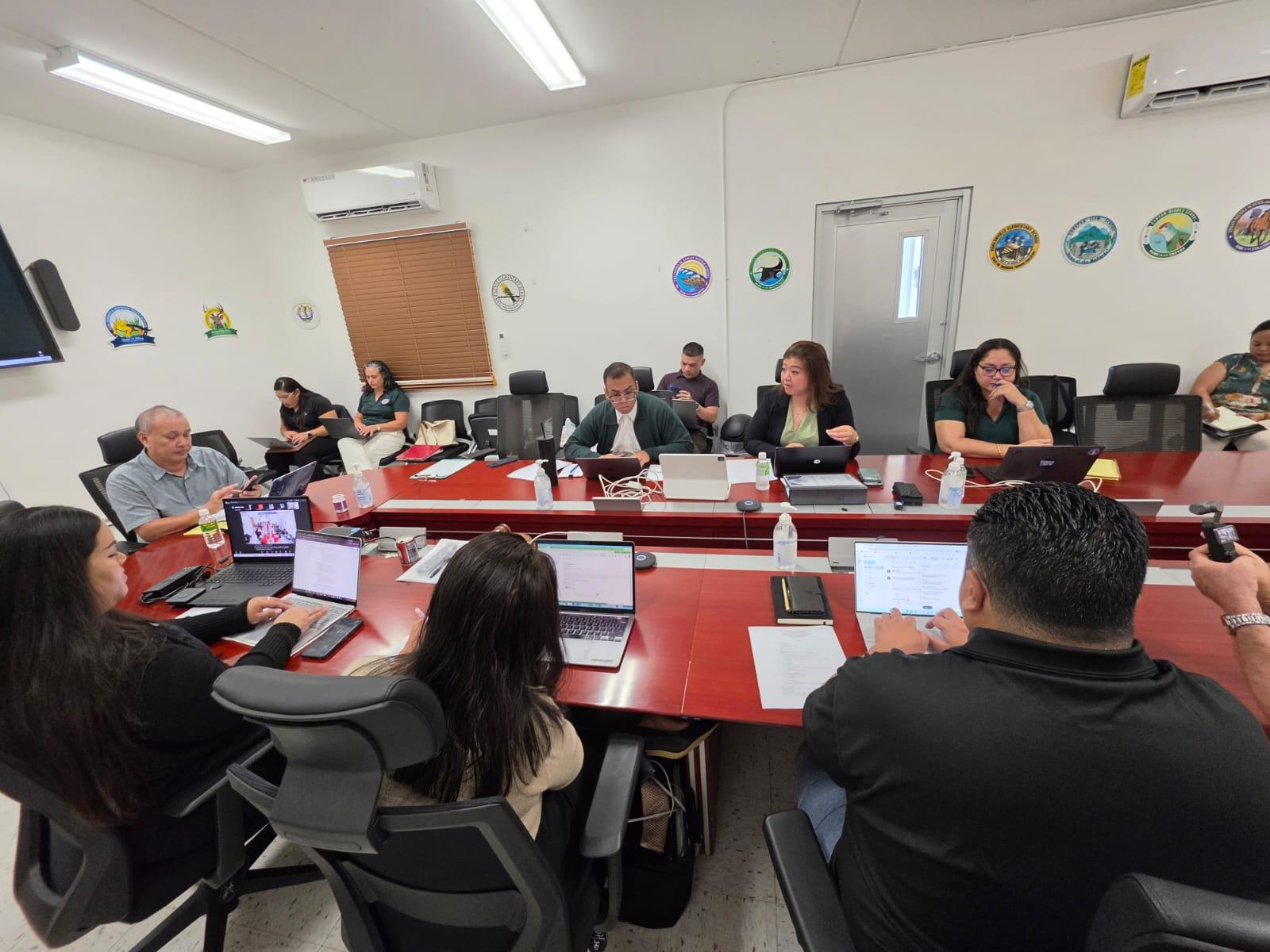
The CNMI State Board of Education reached a tense crossroads during emergency deliberations on September 24, forcefully rejecting the Legislature’s interpretation of the 25 percent constitutional funding mandate while debating whether to immediately declare an official fiscal state of emergency across the Public School System (PSS). With the October 1 fiscal deadline looming, education officials warned that lawmakers are attempting to enforce an artificially suppressed $25 million budget that distorts constitutional definitions, violates compulsory education standards, and threatens the school system with catastrophic operational collapse.
The dispute stems from ongoing negotiations over a projected $100 million government-wide budget. While the House of Representatives passed House Bill 24-108 appropriating $37.5 million for a 64-hour biweekly schedule, the Senate halted budget hearings to demand contingency plans modeled down to a bare 25 percent allocation of $25 million. PSS warned that a $25 million baseline would dismantle public schooling across Saipan, Tinian, and Rota, slashing student instruction to just two or three days per week and forcing 19 elementary schools into four or five consolidated campuses.
Education officials and board members pushed back aggressively against the Senate’s budgetary math, emphasizing that basic compensation for local classrooms teachers alone commands $19 million, leaving virtually zero funding for busing routes, campus electricity, water, or repairs.
Addressing the board, Interim CNMI PSS Commissioner of Education, Jacqueline Che laid bare the consequences of the Senate's proposed bottom line:
"As we review the ten tiers, the math makes one thing devastatingly very clear, and that is a $25 million budget forces PSS into structural collapse. It’s not something we can work with. Twenty-five million is bare bones; we will not be able to operate. If we operate at $25 million, that means two or three days of school a week. That would mean what—five days at home, if they even have a home to return to? We cannot fold with $25 million. Our students depend on us, and we need to continue advocating for the money that we rightfully deserve to provide a high-quality education."
Board Chair Maisie Tenorio challenged lawmakers’ legal justification for arriving at $25 million, noting that legislators are improperly siphoning funds before calculating the education guarantee mandated under Article XV, Section 1(e) of the CNMI Constitution.
"Yesterday I heard multiple times that they were only giving PSS 25 percent, and they were calculating 25 percent off of what is available for appropriation after they took out all of that debt service, retirement allocation, all of that," Tenorio stated. "As you know, the board has been very clear that that is not the correct calculation according to the Supreme Court definition of general revenue versus special revenue. If the $25 million is not 25 percent according to our understanding, it has been time to ask the Supreme Court to assist us in clarifying those definitions so that we are on the same page."
Board member Andrew Orsini also warned that starving schools of operational funding conflicts directly with the Commonwealth's statutory requirement to educate its youth.
"Let's be honest here: right now, it's a campaign year. The House and Senate play tug-of-war at the expense of our children, and that's not right," argued Orsini. "Where is the draw line as far as that compulsory law that requires our children to be educated on a quality-based level? And if that's the case, how about the citizenry out there? Can parents sue our local government to ensure that our students get the proper quality education? Our children have already suffered learning loss since the pandemic all the way to Sinlaku. If they are not going to fulfill providing PSS the adequacy of budgetary measures that we need, then remove the compulsory law—take it out. Stakeholders, parents, and even teachers have the right to sue."
The escalating standoff triggered an intense debate over whether the board should enact a formal Declaration of Fiscal Emergency immediately or hold off until the Legislature concludes its budget vote.
Che strongly urged the board to issue the emergency declaration without delay, arguing that district schools have already been enduring emergency conditions and that waiting for the Legislature risks leaving schools unprepared.
"The alarm is already ringing and we're feeling it, and I don't want us to wait and hope that they would pass a budget that would give us the 64 hours," leadership urged. "I think we've already been in a state of emergency for some time now. We are one week away from October 1, and here we are putting scenarios for the Senate to look at, with no guarantee that they would pick the scenario we want them to select."
Che further underscored that teacher layoffs cannot be treated like ordinary public-sector reductions.
"When you let go of certain employees within an agency, it impacts families. But when you let go of a teacher—one classroom teacher—that impacts 20 to 30 students in their trajectory. Letting go of a teacher is not the same as another employee. Public education really should be non-negotiable and unthinkable."
Other board members urged temporary caution, warning that declaring an emergency prior to final legislative action could trigger widespread panic and undermine delicate conference negotiations.
"Let's not act out of haste. We need to be certain what we have," Orsini cautioned. "Once we make this declaration out there, skeletons are going to break out of here, and yet the Legislature has not been given the final outcome of what they're trying to do to address our situation. We don't even know exactly where we're going to be living. And keep in mind, a furlough is only as good as 30 days. Nobody is going to hang around expecting that they will be picked up after 30 days. People are going to treat that as a complete layoff."
PSS Director of Finance Jonathan Aguon confirmed that dropping operations below 60 hours biweekly would trigger an immediate benefit cliff, automatically reclassifying school personnel as part-time workers and stripping them of health and retirement coverage. To avoid that outcome under a sub-60-hour budget, PSS would have no choice but to initiate rolling furloughs.
Following extensive deliberations, the board agreed to take the draft emergency declaration under review rather than voting on it immediately. Leadership directed finance staff to re-examine House Bill 24-108 to verify all revenue deductions and compute the true 25 percent general revenue baseline in accordance with Supreme Court standards.
The board scheduled a special emergency session for late afternoon on Thursday, October 1, 2026. If the final legislative budget fails to maintain an operational baseline of at least 64 hours, the board will convene to formalize the declaration of fiscal emergency, authorize restructuring protocols, and adopt a reduced school operating calendar.
Share this article: